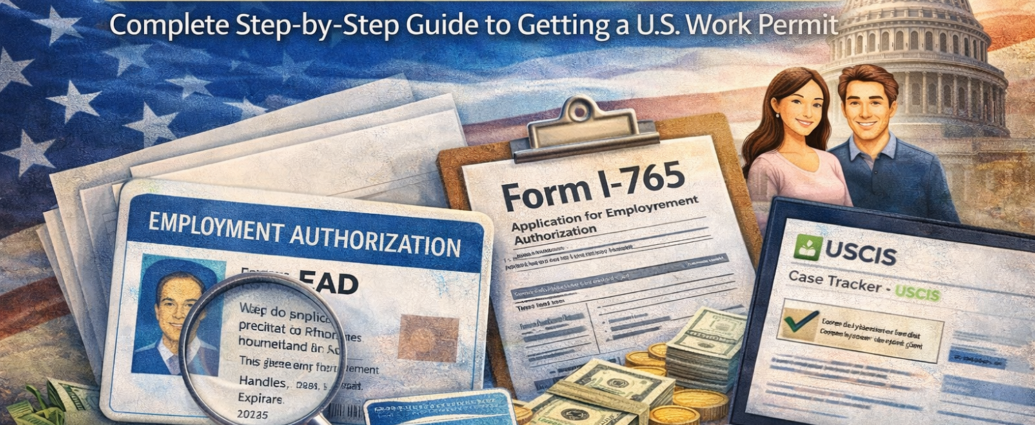
Applying for an Employment Authorization Document (EAD) is one of the most important steps in many immigration journeys inside the United States. For thousands of immigrants every year, receiving an EAD means the difference between waiting in uncertainty and being able to legally work, earn income, support family members, build credit history, and gain professional experience. Without proper work authorization, employment is not legally permitted for most non-citizens. With it, financial stability and opportunity can begin to grow.
An EAD is often referred to as a “work permit,” but it is important to understand that it is not the same as a visa, green card, or citizenship. It is a temporary authorization issued to eligible non-citizens allowing them to work in the United States for a specific period of time. The application process may appear complicated at first, especially because immigration categories and eligibility codes can feel overwhelming. However, when broken down into clear steps and explained carefully, the process becomes much easier to understand and follow.
How to Apply for an EAD
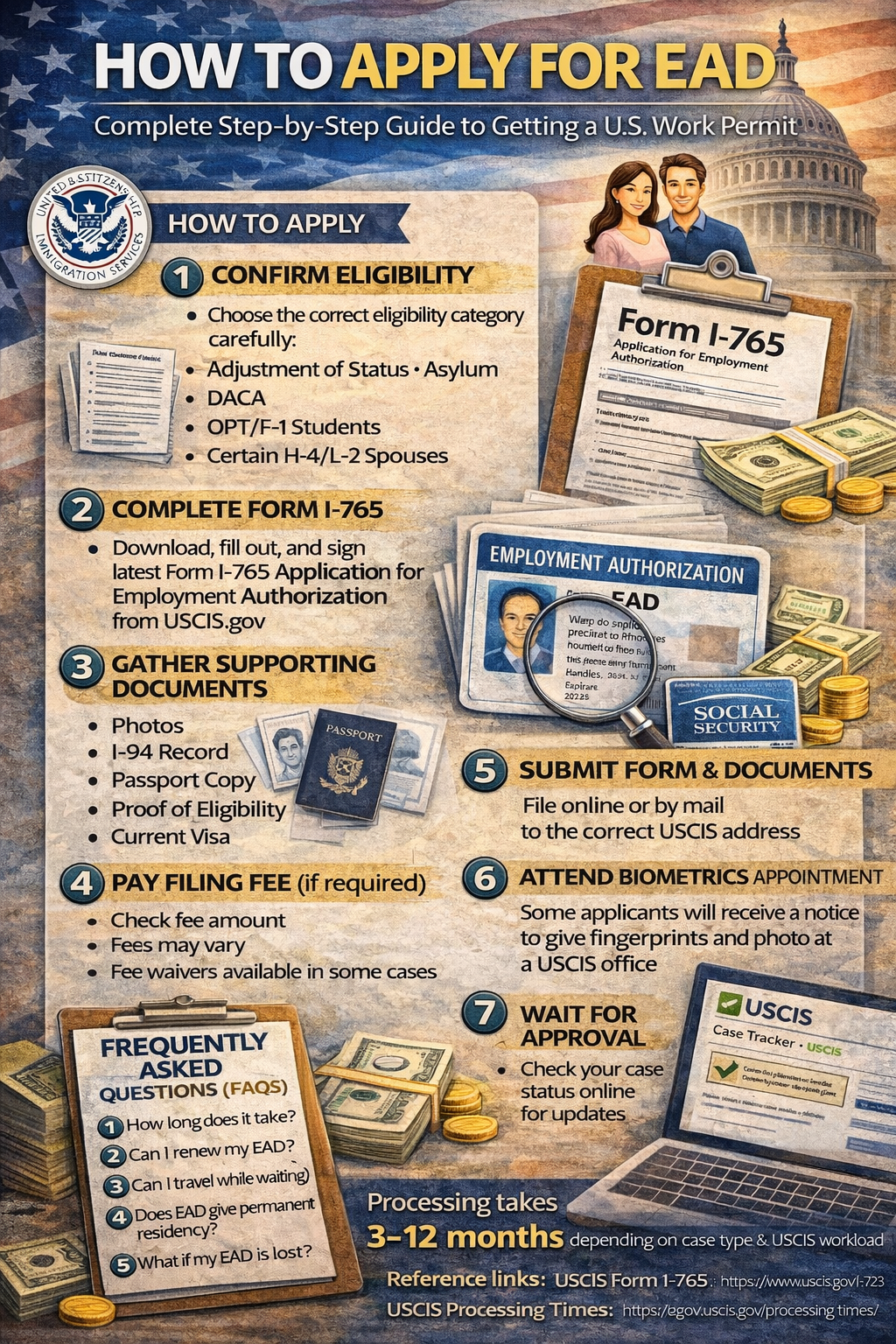
The process of applying for an EAD generally follows a structured sequence. While the steps may vary slightly depending on category, the overall framework remains consistent.
Confirm Your Eligibility Category Carefully
Before completing any forms, your immigration status must be reviewed carefully. Each EAD category has specific requirements. For example, adjustment of status applicants must typically have already filed Form I-485. F-1 students applying for OPT must first receive approval from their school’s Designated School Official (DSO) and obtain an updated Form I-20.
It is strongly recommended that the official instructions for Form I-765 be reviewed on the USCIS website. Filing under the wrong category can cause denial or require refiling with additional fees.
Complete Form I-765 Accurately
Form I-765 must be completed using the most recent edition available on the USCIS website. Outdated forms may be rejected.
Important sections include:
-
Full legal name
-
Mailing address
-
Immigration status
-
Eligibility category code
-
Social Security number request (if applicable)
-
Signature (this is critical)
Care must be taken to ensure that all information matches passport records and previous immigration filings. Even small mistakes, such as incorrect dates or mismatched names, can cause delays.
Gather Required Supporting Documents
Supporting documents vary by category, but most applicants will need to provide:
-
Copy of passport biographic page
-
Copy of current visa
-
Copy of I-94 arrival/departure record
-
Two passport-style photographs (if filing by mail)
-
Previous EAD card (if renewing)
-
Proof of eligibility (for example, I-485 receipt notice or approved asylum application)
Documents should be clear and legible. Poor-quality copies can lead to Requests for Evidence (RFEs).
Pay the Filing Fee (If Required)
Filing fees vary depending on the eligibility category. Some applicants qualify for fee exemptions, while others must pay the required amount.
USCIS updates fees periodically. Before submitting payment, the official USCIS website should be checked to confirm the correct amount and acceptable payment methods.
Incorrect payment is one of the most common reasons applications are rejected.
Submit the Application (Online or By Mail)
Many applicants can file Form I-765 online through a USCIS account. Online filing offers several advantages, including easier document uploads and digital case tracking.
Others must mail their applications to the correct USCIS lockbox address. Mailing to the wrong address may result in rejection.
After submission, a receipt notice (Form I-797) will be issued.
Attend Biometrics Appointment (If Required)
Some applicants are scheduled for a biometrics appointment at a local Application Support Center. During this appointment, fingerprints, photographs, and signatures are collected for background checks.
Not all categories require biometrics for EAD processing.
Wait for Processing and Final Decision
After biometrics (if applicable), the application enters the review stage. Processing times vary widely depending on category and service center workload.
If approved, the EAD card will be produced and mailed. If additional information is needed, a Request for Evidence (RFE) may be issued.
How Long Does EAD Processing Take?
Processing times vary significantly. Some categories may take several months, while others may take longer depending on:
-
Application category
-
Background check requirements
-
USCIS workload
-
Policy updates
-
Staffing levels
Processing time estimates are available on the USCIS website.
How Long Is an EAD Valid?
Most EAD cards are valid for one year, though some categories may receive two-year validity periods. The expiration date is printed directly on the card.
Renewal applications should typically be filed up to 180 days before expiration. Filing early helps avoid employment gaps.
In certain categories, automatic extensions of up to 540 days may apply if renewal is filed before expiration.
How to Renew an EAD
Renewal requires filing a new Form I-765 with updated supporting documents. It is strongly recommended to file early to prevent work interruption.
If the renewal is filed on time, some applicants may continue working under automatic extension rules while waiting for the new card.
Frequently Asked Questions (FAQs)
Can I start working while my EAD is pending?
Generally, no. Work authorization begins only after the EAD is approved unless your immigration status independently allows employment.
Can I travel while waiting for my EAD?
Travel rules depend on your underlying immigration status. Adjustment of status applicants often need Advance Parole before leaving the United States.
Does an EAD give me permanent residency?
No. An EAD only grants temporary work authorization. It does not provide a green card.
What happens if my EAD is denied?
The denial notice will explain the reason. In some cases, refiling may be possible.
Can I apply for a Social Security Number?
Yes. You may request a Social Security Number directly on Form I-765.
How do I check my case status?
Case status can be checked online using the receipt number provided on Form I-797.
Can I change jobs with an EAD?
Yes, unless restricted by specific immigration rules tied to your underlying status.
What if my EAD card is lost or stolen?
You must file Form I-765 again to request a replacement card.
Is premium processing available?
Premium processing is generally not available for most I-765 categories, though limited expansion may apply in specific cases.
What is the eligibility category code?
It is a letter and number combination that identifies your immigration category when filing Form I-765.
Reference Links
USCIS Form I-765 https://www.uscis.gov/i-765
USCIS Official Website https://www.uscis.gov
USCIS Processing Times https://egov.uscis.gov/processing-times/
USCIS Case Status https://egov.uscis.gov/casestatus/landing.do
Disclaimer
Program Clarity is an independent informational website and is not affiliated with any government agency. This article is for educational purposes only. Program rules and availability may change. Always verify details with official USCIS authorities.