
Starting and growing a small business is never easy. For businesses located in economically struggling communities, the challenges are even greater. These areas often face higher unemployment, lower income levels, fewer investment opportunities, and limited access to government contracts. To help businesses in these communities grow and create jobs, the U.S. government created the HUBZone program.
Many small business owners have heard the term “HUBZone,” but they do not fully understand what it means or how it works. Some believe it is only for construction companies. Others think it is too complicated or only for very large businesses. In reality, the HUBZone program is specifically designed to help small businesses in certain geographic areas compete for federal government contracts.
What Does HUBZone Mean?
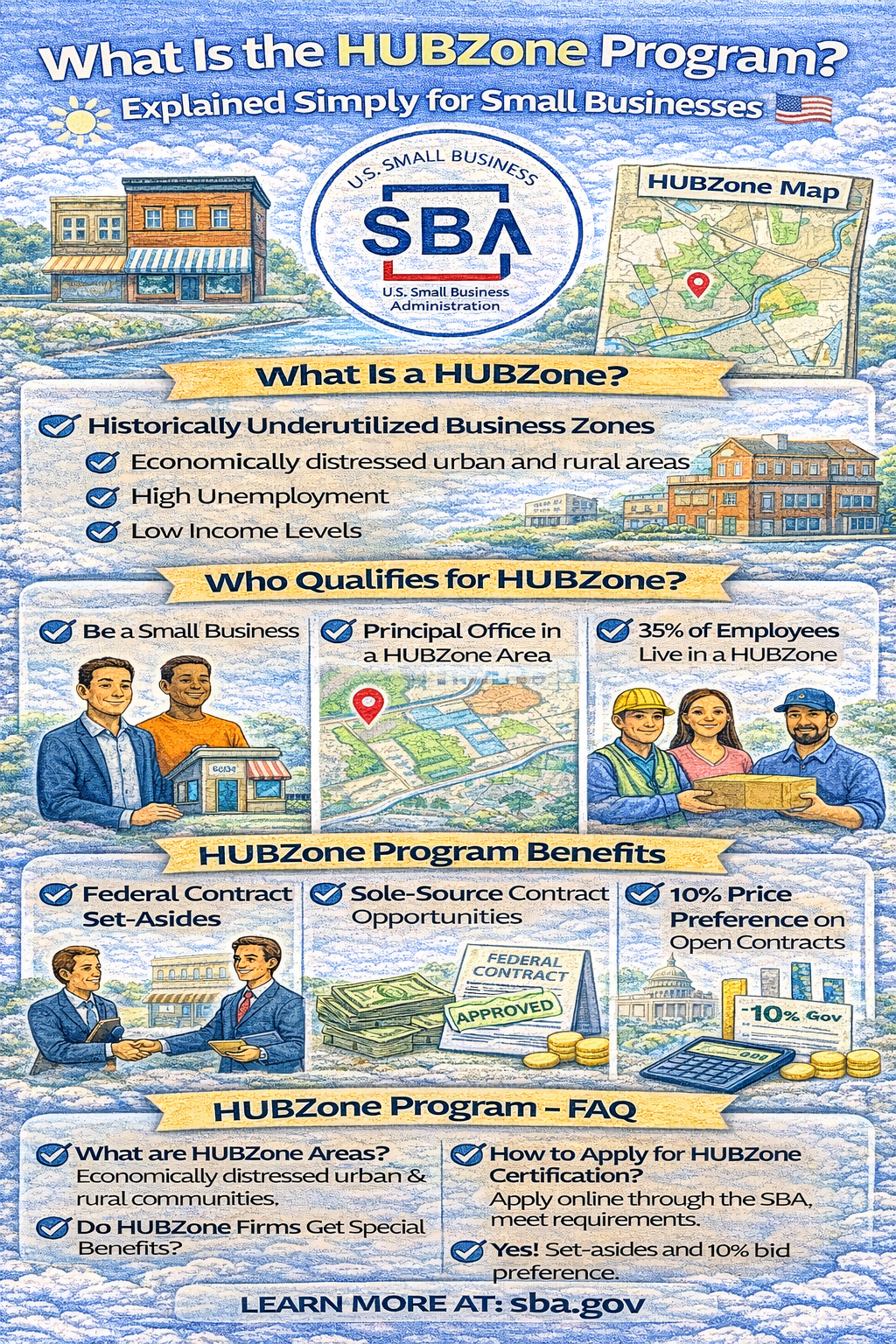
HUBZone stands for Historically Underutilized Business Zone. These are areas identified by the government as economically distressed. This usually means they have high unemployment, low income levels, or both.
The HUBZone program was created to encourage businesses to operate and hire employees in these areas. The goal is to create jobs and stimulate economic growth in communities that need it most.
What Are HUBZone Areas?
HUBZone areas include certain urban and rural communities that meet economic criteria. These may include.
Areas with high poverty rates
Areas with high unemployment
Qualified census tracts
Certain Native American lands
Military base closure areas
The SBA maintains an official online map that shows which areas qualify as HUBZones. Businesses must verify that their principal office is located in an eligible area.
Who Qualifies for the HUBZone Program?
To qualify for HUBZone certification, a business must meet several requirements.
First, the business must qualify as a small business under SBA size standards. Size standards vary by industry.
Second, the principal office of the business must be located in a designated HUBZone area.
Third, at least 35 percent of the company’s employees must live in a HUBZone area. These employees do not all need to live in the same HUBZone, but they must live in qualified areas.
Finally, the business must be at least 51 percent owned and controlled by U.S. citizens, a Community Development Corporation, an agricultural cooperative, or a Native Hawaiian organization.
What Are the Benefits of HUBZone Certification?
HUBZone-certified businesses receive special advantages when competing for federal government contracts.
Federal agencies have annual goals to award a certain percentage of contracts to HUBZone businesses. This increases opportunities for certified companies.
HUBZone businesses may qualify for.
Competitive set-aside contracts
Sole-source contracts (in certain cases)
A 10 percent price evaluation preference in full and open contract competitions
These benefits can make a major difference when competing for government work.
What Is a HUBZone Set-Aside Contract?
A HUBZone set-aside contract is a federal contract reserved only for HUBZone-certified small businesses. This means only qualified HUBZone companies can compete.
What Is a Sole-Source HUBZone Contract?
In certain situations, a federal agency may award a contract directly to a HUBZone-certified business without competition. This is called a sole-source contract.
How to Apply for HUBZone Certification
Businesses must apply for HUBZone certification through the SBA. The process involves submitting documentation to prove eligibility.
This may include proof of business location, employee addresses, ownership information, and tax documents.
Maintaining HUBZone Compliance
Certification is not permanent without compliance. Businesses must continue meeting the 35 percent employee residency requirement and maintain their principal office in a HUBZone area.
Frequently Asked Questions (FAQs)
What Is the HUBZone Program in Simple Terms?
It is a government program that helps small businesses in struggling areas win federal contracts.
Is HUBZone Only for Construction Companies?
No. Businesses in many industries can qualify.
Does HUBZone Certification Guarantee Contracts?
No. It increases opportunities but does not guarantee awards.
How Long Does HUBZone Certification Take?
Processing times vary depending on application completeness and SBA review.
Can a Business Lose HUBZone Status?
Yes, if it no longer meets eligibility requirements.
Is HUBZone the Same as Other SBA Programs?
No. HUBZone is separate from programs like 8(a) or Women-Owned Small Business programs.
Reference Links
HUBZone Program Official Page: https://www.sba.gov/federal-contracting/contracting-assistance-programs/hubzone-program
U.S. Small Business Administration (SBA): https://www.sba.gov
HUBZone Eligibility Requirements: https://www.sba.gov/federal-contracting/contracting-assistance-programs/hubzone-program/eligibility-requirements
HUBZone Map (Check Qualified Areas): https://maps.certify.sba.gov/hubzone/map
How to Apply for HUBZone Certification: https://www.sba.gov/federal-contracting/contracting-assistance-programs/hubzone-program/how-apply
SBA Size Standards Tool: https://www.sba.gov/size-standards
Disclaimer
Program Clarity is an independent informational website and is not affiliated with any government agency. This article is for educational purposes only. Program rules and availability may change. Always verify details with official housing authorities.