
Immigration law in the United States is one of the most complex areas of federal law, yet it affects millions of people every single day. It controls who can enter the country, how long someone can stay, whether they are allowed to work, whether they can bring family members, and whether they can become permanent residents or citizens.
For many people, immigration law feels overwhelming because it includes many different rules, government agencies, applications, deadlines, interviews, and legal terms. People often hear words like visa, green card, asylum, deportation, removal proceedings, and naturalization, but they do not clearly understand what these words mean or how they connect to each other. Because immigration decisions can change a person’s entire life, understanding the basics is extremely important.
Immigration law is not just about crossing borders. It affects students studying in American universities, workers employed by U.S. companies, families trying to reunite with loved ones, refugees seeking protection from danger, and lawful permanent residents working toward citizenship. Even small mistakes, such as overstaying a visa by a short period of time or filing an incorrect form, can create serious consequences. That is why learning the foundation of immigration law helps people avoid confusion and make better decisions.
What Is Immigration Law?
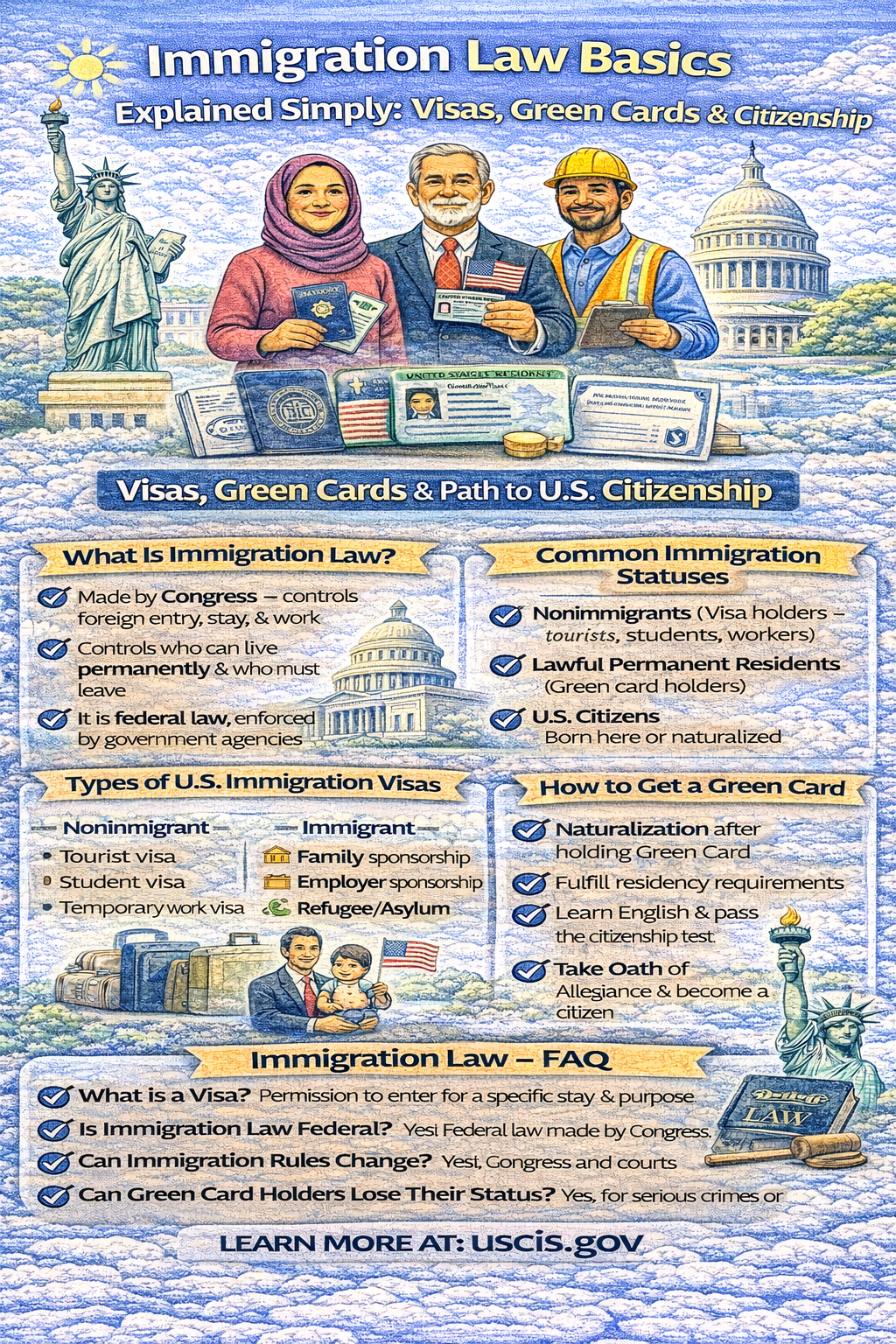
Immigration law is the system of federal laws and regulations that control who can enter the United States, who can stay legally, and who must leave. These laws are passed by Congress and enforced by federal government agencies. Immigration law applies to non-citizens, which include visitors, students, workers, refugees, green card holders, and undocumented individuals. It does not usually apply to U.S. citizens because citizens have the right to live in the country permanently.
In simple terms, immigration law answers several basic questions. Who is allowed to come into the country? For how long? For what purpose? What rights and responsibilities do they have? And under what circumstances can they become permanent residents or citizens? These laws are detailed because they try to balance national security, economic needs, family reunification, humanitarian protection, and fairness.
Which Agencies Enforce Immigration Law?
Immigration law is enforced by multiple federal agencies that each have different responsibilities. The main agency that handles immigration benefits is U.S. Citizenship and Immigration Services (USCIS). USCIS processes applications for visas, green cards, work permits, asylum, and citizenship. When someone applies for a benefit, such as permanent residence, USCIS reviews the application and decides whether it should be approved.
Immigration enforcement inside the United States is handled by U.S. Immigration and Customs Enforcement (ICE). ICE investigates violations of immigration law and may arrest individuals who are subject to removal.
Border enforcement and inspection at airports, seaports, and land borders are handled by U.S. Customs and Border Protection (CBP). CBP officers decide whether travelers are allowed to enter the country.
All of these agencies operate under the Department of Homeland Security (DHS). However, immigration courts are part of the Department of Justice (DOJ). Immigration judges hear removal cases and decide whether someone can remain in the United States or must leave.
What Is a Visa and How Does It Work?
A visa is official permission for a foreign national to request entry into the United States. It is usually placed inside a passport and issued by a U.S. embassy or consulate abroad. However, a visa does not guarantee entry. It simply allows a person to travel to a port of entry and request admission.
There are two major categories of visas: nonimmigrant visas and immigrant visas. Nonimmigrant visas are for temporary stays. These include tourist visas, student visas, and temporary work visas. Each visa has specific rules about what activities are allowed and how long the person may remain in the country. For example, a student visa allows study but has strict employment limitations.
What Is Lawful Permanent Residence (Green Card)?
A green card is proof of lawful permanent residence. It allows a person to live and work in the United States indefinitely. Green card holders can work for almost any employer and travel internationally, although long trips abroad can create problems.
Permanent residence is not the same as citizenship. Green card holders cannot vote in federal elections and can lose their status under certain conditions, such as serious criminal convictions or abandoning residence.
Family-Based Immigration Basics
Family reunification is one of the main goals of U.S. immigration law. U.S. citizens and lawful permanent residents can sponsor certain family members for green cards. Immediate relatives of U.S. citizens, such as spouses, unmarried children under 21, and parents, usually receive priority and are not subject to annual numerical limits.
Other family categories are subject to yearly caps, which means applicants may wait many years before a visa becomes available. Waiting times depend on the relationship and the applicant’s country of origin.
Employment-Based Immigration Basics
Employment-based immigration allows U.S. employers to sponsor foreign workers for permanent residence. These categories are divided into preference levels based on skills, education, and job requirements.
Some employment categories require proof that no qualified U.S. workers are available for the position. Others, such as individuals with extraordinary ability, may self-petition.
Asylum and Refugee Protection
Immigration law also includes humanitarian protection. Asylum is granted to individuals who are already in the United States or at a port of entry and who fear persecution in their home country due to race, religion, nationality, political opinion, or membership in a particular social group.
Refugees apply for protection from outside the United States. Both refugees and asylees may eventually apply for green cards.
Removal (Deportation) Basics
Removal, often called deportation, is the legal process of removing someone from the United States for violating immigration law. Reasons may include overstaying a visa, entering without inspection, fraud, or criminal convictions.
Removal cases are heard in immigration court before a judge. Individuals may present defenses, apply for relief, or request voluntary departure.
Naturalization and Citizenship
Naturalization is the process through which a lawful permanent resident becomes a U.S. citizen. Applicants must meet residency requirements, demonstrate good moral character, pass English and civics tests, and take an oath of allegiance.
Why Immigration Law Is So Complex
Immigration law is complex because it combines federal statutes, agency regulations, policy guidance, and court decisions. Rules can change due to new legislation or judicial rulings. Small factual differences can lead to very different outcomes.
Frequently Asked Questions (FAQs)
Is Immigration Law Federal?
Yes, immigration law is controlled by the federal government.
Can Immigration Laws Change?
Yes, Congress and courts can change immigration laws and policies.
Is a Green Card Permanent?
It allows permanent residence, but it can be revoked under certain conditions.
Can Visa Holders Work?
Only if their visa category allows employment.
Can Green Card Holders Become Citizens?
Yes, through naturalization if they meet eligibility requirements.
Reference Links
U.S. Citizenship and Immigration Services (USCIS): https://www.uscis.gov
Department of Homeland Security (DHS): https://www.dhs.gov
U.S. Immigration and Customs Enforcement (ICE): https://www.ice.gov
U.S. Customs and Border Protection (CBP): https://www.cbp.gov
Department of Justice – Executive Office for Immigration Review (EOIR): https://www.justice.gov/eoir
Immigrant Visas Overview: https://travel.state.gov/content/travel/en/us-visas/immigrate.html
Nonimmigrant Visas Overview: https://travel.state.gov/content/travel/en/us-visas/tourism-visit.html
Naturalization Process: https://www.uscis.gov/citizenship
Asylum Information: https://www.uscis.gov/humanitarian/refugees-and-asylum/asylum
Disclaimer
Program Clarity is an independent informational website and is not affiliated with any government agency. This article is for educational purposes only. Program rules and availability may change. Always verify details with official housing authorities.