The Low Income Home Energy Assistance Program, commonly known as LIHEAP, is one of the most important yet often misunderstood assistance programs in the United States. It was created to help low-income households afford the cost of heating and cooling their homes. While many people know it has something to do with energy bills, very few truly understand how it works, who qualifies, how much help is available, and how to apply successfully without delays.
Energy is not a luxury. Heating in the winter and cooling during extreme summer heat are basic needs that directly affect health and safety. When families cannot afford their energy bills, they may face shutoffs, unsafe heating methods, or dangerous indoor temperatures. LIHEAP exists to reduce those risks and to protect vulnerable households from life-threatening conditions caused by energy insecurity.
What Is LIHEAP and Why Was It Created?
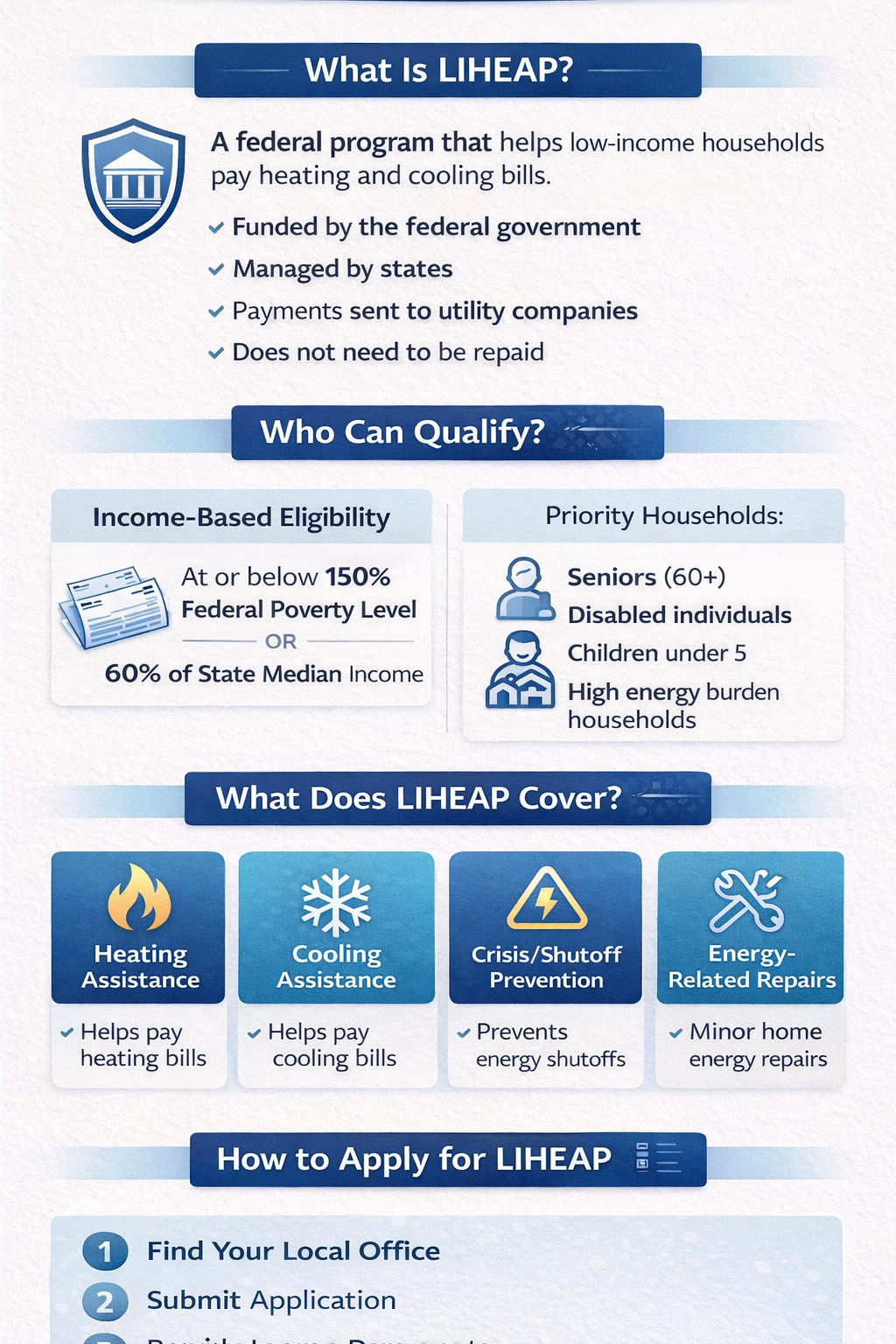
LIHEAP is a federally funded program that provides financial assistance to help eligible households pay their home energy bills. It was established in 1981 in response to rising energy costs that were placing heavy financial pressure on low-income families. The program is funded by Congress each year and administered at the federal level by the U.S. Department of Health and Human Services, specifically through its Office of Community Services. However, although the funding comes from the federal government, the program is operated at the state, territorial, and tribal levels. This means that each state manages its own application process, sets specific income limits within federal guidelines, and determines benefit amounts.
The purpose of LIHEAP is not just to pay utility bills. Its broader goal is to ensure that households are not forced to choose between paying for energy and paying for other necessities like food, rent, or medication. Energy insecurity can lead to serious health problems, especially for elderly individuals, young children, and people with disabilities. In extremely cold weather, lack of heating can result in hypothermia. In extremely hot weather, lack of cooling can lead to heat stroke. By helping families manage energy costs, LIHEAP plays a direct role in protecting public health.
How LIHEAP Works at the State Level
Because LIHEAP is administered locally, each state has its own system for distributing benefits. Some states operate the program through departments of social services, while others use community action agencies. Tribal governments may also administer LIHEAP for their members. This local control allows states to adjust the program to meet the specific climate and economic conditions of their region.
For example, states with very cold winters may allocate more funding toward heating assistance, while southern states may focus more on cooling assistance during summer months. States also determine application periods, documentation requirements, and payment methods.
Types of Assistance Provided by LIHEAP
LIHEAP offers several forms of support, and understanding these categories is important because they serve different needs.
Heating Assistance
Heating assistance is the most common form of LIHEAP support. It helps households pay for winter heating bills, which can be extremely high in colder states. The benefit is usually provided once per heating season and is based on household size, income, fuel type, and climate.
Cooling Assistance
In states with extreme summer heat, LIHEAP may also provide cooling assistance. This support helps cover electricity costs associated with air conditioning. Not all states offer cooling benefits, but many do, especially those in southern regions.
Crisis Assistance
Crisis assistance is designed for emergency situations. If a household has received a shutoff notice or has already lost utility service, crisis funds may be used to restore or prevent disconnection. Crisis benefits are often processed more quickly because of the urgent nature of the situation.
Weatherization and Energy Repairs
Some LIHEAP funds may be used to improve energy efficiency, such as repairing or replacing a broken furnace, sealing drafts, or improving insulation. While these services are sometimes connected to the separate Weatherization Assistance Program, LIHEAP funds may contribute to minor energy-related repairs in certain states.
Who Qualifies for LIHEAP?
Eligibility for LIHEAP is primarily based on income, but several other factors are considered. Federal guidelines require that states set income limits at or below 150% of the Federal Poverty Level or 60% of the state median income, whichever is higher. However, states may choose stricter limits within those federal boundaries.
Household size is an important factor. A family of four will have a higher income limit than a single individual. Income typically includes wages, Social Security benefits, unemployment benefits, and other sources of financial support.
Priority is often given to households that include elderly individuals (age 60 or older), people with disabilities, or children under the age of five. These groups are considered especially vulnerable to temperature-related health risks.
How Much Assistance Can You Receive?
The amount of LIHEAP assistance varies significantly depending on the state and individual household circumstances. Benefits are influenced by several factors, including income level, household size, type of heating fuel used, and regional energy costs.
In some cases, households may receive a few hundred dollars per season. In colder states with high heating costs, benefits may be higher. Crisis assistance amounts also vary depending on the severity of the emergency.
How to Apply for LIHEAP
Applying for LIHEAP requires contacting your local administering agency. Applications may be submitted online, by mail, or in person, depending on your state’s procedures.
Most applicants must provide documentation such as proof of income, identification, Social Security numbers for household members, and copies of recent utility bills. Some states may also request lease agreements or landlord information if utilities are included in rent.
Because funding is limited and distributed on a first-come, first-served basis in many states, applying early is strongly recommended. Application periods often open in the fall for heating assistance and in late spring for cooling assistance.
Common Misunderstandings About LIHEAP
One common misconception is that only unemployed individuals qualify. In reality, many working families qualify because their wages are not high enough to cover rising energy costs. Another misunderstanding is that LIHEAP covers the entire energy bill. While the program can significantly reduce costs, it usually does not eliminate the entire balance.
Some people also believe that applying is too complicated. While documentation is required, local agencies often provide assistance to help applicants complete the process.
Frequently Asked Questions (FAQs)
What exactly is LIHEAP?
LIHEAP is a federally funded energy assistance program that helps low-income households pay heating and cooling bills. The program is funded by Congress and administered nationally by the U.S. Department of Health and Human Services, but it is managed locally by states, territories, and tribal governments. Its main purpose is to prevent energy shutoffs and protect families from extreme temperatures that can threaten health and safety.
Who qualifies for LIHEAP?
Eligibility is primarily based on household income. Most states require income to be at or below 150% of the Federal Poverty Level or 60% of the state’s median income, depending on local rules. Priority is often given to households that include seniors (age 60+), people with disabilities, or young children. Some states also automatically qualify households receiving SNAP, SSI, or certain other benefits.
Do I have to be unemployed to qualify?
No. Many people who qualify for LIHEAP are working. The program is designed to help households with low income, whether that income comes from employment, retirement benefits, disability benefits, or other sources.
How much money can I receive?
The amount varies by state and household situation. Factors that affect benefit amounts include household size, income, type of heating or cooling fuel, and regional climate conditions. Some households receive a few hundred dollars per season, while others may receive more in states with higher energy costs.
Does LIHEAP pay the money directly to me?
In most cases, no. LIHEAP payments are usually sent directly to your utility company to reduce your bill. This ensures that the assistance is used specifically for energy expenses.
Can LIHEAP stop my utilities from being shut off?
Yes, in many cases. If you receive a shutoff notice, you should apply for crisis assistance immediately. Emergency LIHEAP funds may prevent disconnection or restore service if it has already been shut off. However, approval is not automatic, so acting quickly is very important.
What documents are required to apply?
While requirements vary by state, most applicants must provide:
-
Proof of income (pay stubs, benefit letters, etc.)
-
A recent utility bill
-
Identification
-
Social Security numbers for household members (if required)
When should I apply?
Application periods often open in the fall for heating assistance and in late spring or early summer for cooling assistance. Because funds are limited and often distributed on a first-come, first-served basis, applying early increases your chances of receiving help.
Is LIHEAP a loan that must be repaid?
No. LIHEAP benefits are grants. You do not have to repay the assistance you receive.
Is LIHEAP considered taxable income?
No. LIHEAP assistance is not taxable and does not need to be reported as income on your federal tax return.
Can renters apply for LIHEAP?
Yes. Renters can qualify if they are responsible for paying heating or cooling costs, even if those costs are included in rent. Documentation may be required to show that energy expenses are part of your housing payment.
What if I use propane, wood, or oil instead of electricity or gas?
LIHEAP can cover different types of heating fuels, including electricity, natural gas, propane, heating oil, and sometimes even wood or coal. The specific rules depend on your state.
Can I receive LIHEAP every year?
Yes, if you continue to meet eligibility requirements. However, you must reapply each year during the open application period.
What if my income changes during the year?
If your income drops significantly, you may qualify for assistance even if you did not qualify before. It is important to contact your local LIHEAP office if your financial situation changes.
How long does it take to get approved?
Processing times vary by state and demand levels. During peak seasons, approval may take several weeks. Crisis assistance is often processed more quickly due to emergency circumstances.
Can college students qualify?
It depends on income and household circumstances. Students who live independently and meet income requirements may qualify. Students who are claimed as dependents may not qualify separately from their household.
Does receiving LIHEAP affect other benefits?
Generally, LIHEAP does not reduce or interfere with other federal benefits like SNAP, SSI, or Medicaid. In fact, participation in other assistance programs may help you qualify for LIHEAP.
What happens if I am denied?
If your application is denied, you may have the right to appeal. Your denial notice should include instructions for requesting a review. It is important to read all communications carefully and respond within the required timeframe.
Can immigrants qualify for LIHEAP?
Eligibility rules regarding immigration status vary. Some qualified non-citizens may be eligible. It is best to contact your local office to understand specific requirements.
Where can I find my local LIHEAP office?
You can find contact information through the official federal program website managed by the U.S. Department of Health and Human Services.
Reference Links
LIHEAP Program Overview U.S. Department of Health and Human Services https://www.acf.hhs.gov/ocs/programs/liheap
Find Your Local LIHEAP Office https://www.acf.hhs.gov/ocs/map/liheap-map-state-and-tribal-contact-listing
Benefits.gov LIHEAP Information https://www.benefits.gov/benefit/623
Disclaimer
Program Clarity is an independent informational website and is not affiliated with any government agency. This article is for educational purposes only. Program rules and availability may change. Always verify details with official housing authorities.