Owning a home is a major goal for many families in the United States. A home provides stability, safety, and long-term financial security. However, paying a mortgage every month can become difficult when unexpected events happen. Job loss, illness, reduced work hours, divorce, natural disasters, or rising expenses can make it hard to keep up with payments. When homeowners fall behind, they may worry about foreclosure, damaged credit, and losing their homes.
Many people do not realize that mortgage assistance programs exist to help homeowners during difficult times. These programs are designed to provide temporary relief, lower monthly payments, prevent foreclosure, and keep families in their homes. Some programs are offered by the federal government. Others are offered by state agencies, nonprofits, or private lenders. The key is understanding what options are available and how they work.
What Are Mortgage Assistance Programs?
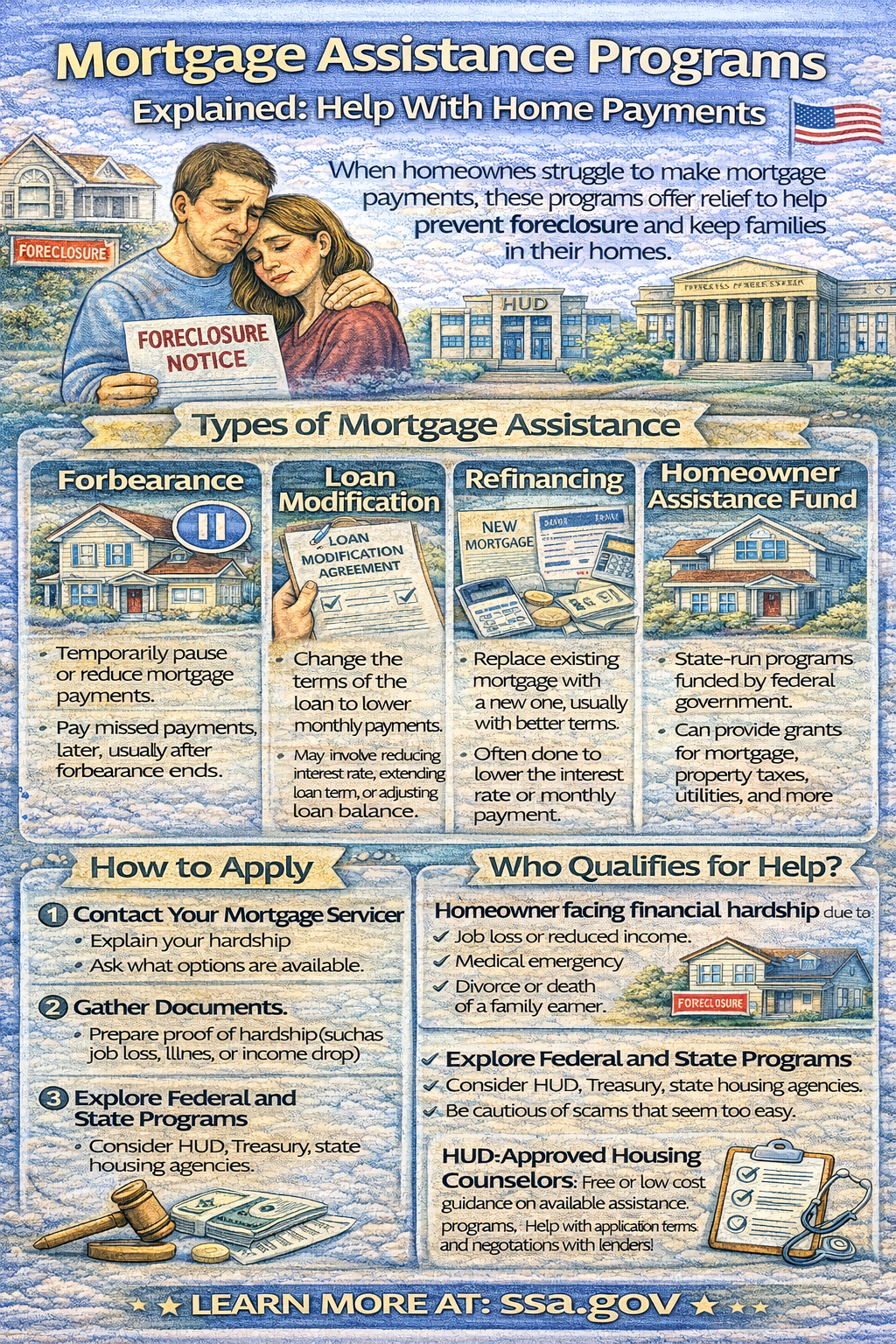
Mortgage assistance programs are financial support programs that help homeowners who are struggling to make their mortgage payments. These programs can reduce monthly payments, pause payments temporarily, provide grants, refinance loans, or prevent foreclosure.
Mortgage assistance does not mean your loan disappears. In most cases, it means the terms of the loan are adjusted to make payments more affordable.
Types of Mortgage Assistance Programs
Mortgage assistance programs come in several forms. Understanding each type helps homeowners choose the right solution.
Forbearance Programs
Forbearance allows homeowners to temporarily pause or reduce mortgage payments. This is often used during short-term financial hardship, such as job loss or medical emergencies.
During forbearance, payments are not forgiven. Instead, they are delayed. At the end of the forbearance period, homeowners may need to repay missed payments through a repayment plan, loan modification, or extended loan term.
Loan Modification Programs
Loan modification changes the terms of your existing mortgage to make payments more affordable. This may include:
-
Lowering the interest rate
-
Extending the loan term
-
Adding missed payments to the balance
-
Converting adjustable-rate loans to fixed-rate loans
Refinancing Assistance
Refinancing replaces your current mortgage with a new one, often with better terms. Some government-backed programs allow refinancing even when home values decline.
Programs backed by Fannie Mae and Freddie Mac may allow lower interest rates or extended terms for qualified homeowners.
Homeowner Assistance Fund (HAF)
The Homeowner Assistance Fund was created to help homeowners impacted by financial hardship. Funds are distributed by individual states.
HAF programs may provide:
-
Mortgage payment assistance
-
Property tax assistance
-
Utility payment assistance
-
Help with homeowner association fees
FHA, VA, and USDA Relief Options
Homeowners with government-backed loans may qualify for specific relief programs.
FHA borrowers may qualify for partial claims or loan modifications.
VA borrowers may qualify for repayment plans or interest rate reductions.
USDA borrowers may access restructuring options for rural homeowners.
These programs are designed to prevent foreclosure whenever possible.
State and Local Mortgage Relief Programs
Many states offer their own mortgage assistance programs, especially during economic downturns or disasters. These programs may include grants, emergency loans, or foreclosure mediation.
Local housing agencies often provide counseling and support at no cost.
Who Qualifies for Mortgage Assistance?
Eligibility depends on several factors, including:
-
Type of mortgage
-
Income level
-
Proof of hardship
-
Current loan status
-
State of residence
Homeowners must usually show financial hardship, such as job loss, reduced income, illness, or unexpected expenses.
Frequently Asked Questions (FAQs)
Is Mortgage Assistance Free Money?
Not usually. Some programs provide grants, but most adjust loan terms rather than erase debt.
Will Mortgage Assistance Hurt My Credit?
It depends on the program. Some relief options may affect credit, while others may not.
Can I Get Help If I Am Already Behind on Payments?
Yes, many programs are specifically designed for delinquent borrowers.
How Do I Apply for Mortgage Assistance?
Contact your mortgage servicer first and ask about hardship options.
Is Foreclosure Automatic If I Miss Payments?
No, but ignoring missed payments can lead to foreclosure.
Reference Links
U.S. Department of Housing and Urban Development (HUD): https://www.hud.gov
HUD-Approved Housing Counseling Agencies: https://www.hud.gov/housingcounseling
U.S. Department of the Treasury – Homeowner Assistance Fund: https://home.treasury.gov/policy-issues/coronavirus/assistance-for-state-local-and-tribal-governments/homeowner-assistance-fund
Federal Housing Administration (FHA) Loss Mitigation Options: https://www.hud.gov/program_offices/housing/sfh/nsc/lossmit
Department of Veterans Affairs (VA) Home Loan Assistance: https://www.va.gov/housing-assistance/home-loans
Freddie Mac Mortgage Assistance: https://myhome.freddiemac.com
Consumer Financial Protection Bureau – Mortgage Help: https://www.consumerfinance.gov/housing
Disclaimer
Program Clarity is an independent informational website and is not affiliated with any government agency. This article is for educational purposes only. Program rules and availability may change. Always verify details with official housing authorities.