
Paying for college is one of the biggest financial challenges many families face in the United States. Tuition, books, housing, transportation, and living expenses can quickly add up to thousands of dollars every year. Many students believe that student loans are the only way to afford college. However, the federal government offers financial aid programs that do not need to be repaid. One of the most important of these programs is the Pell Grant.
The Pell Grant provides free money to eligible students to help cover the cost of higher education. However, not everyone qualifies. Many students and parents are confused about the eligibility rules. Some believe only the lowest-income families qualify. Others think grades determine eligibility. Some students assume they are not eligible and never apply. Understanding Pell Grant eligibility rules is essential because this program can significantly reduce or even eliminate the need for student loans.
What Is a Pell Grant?
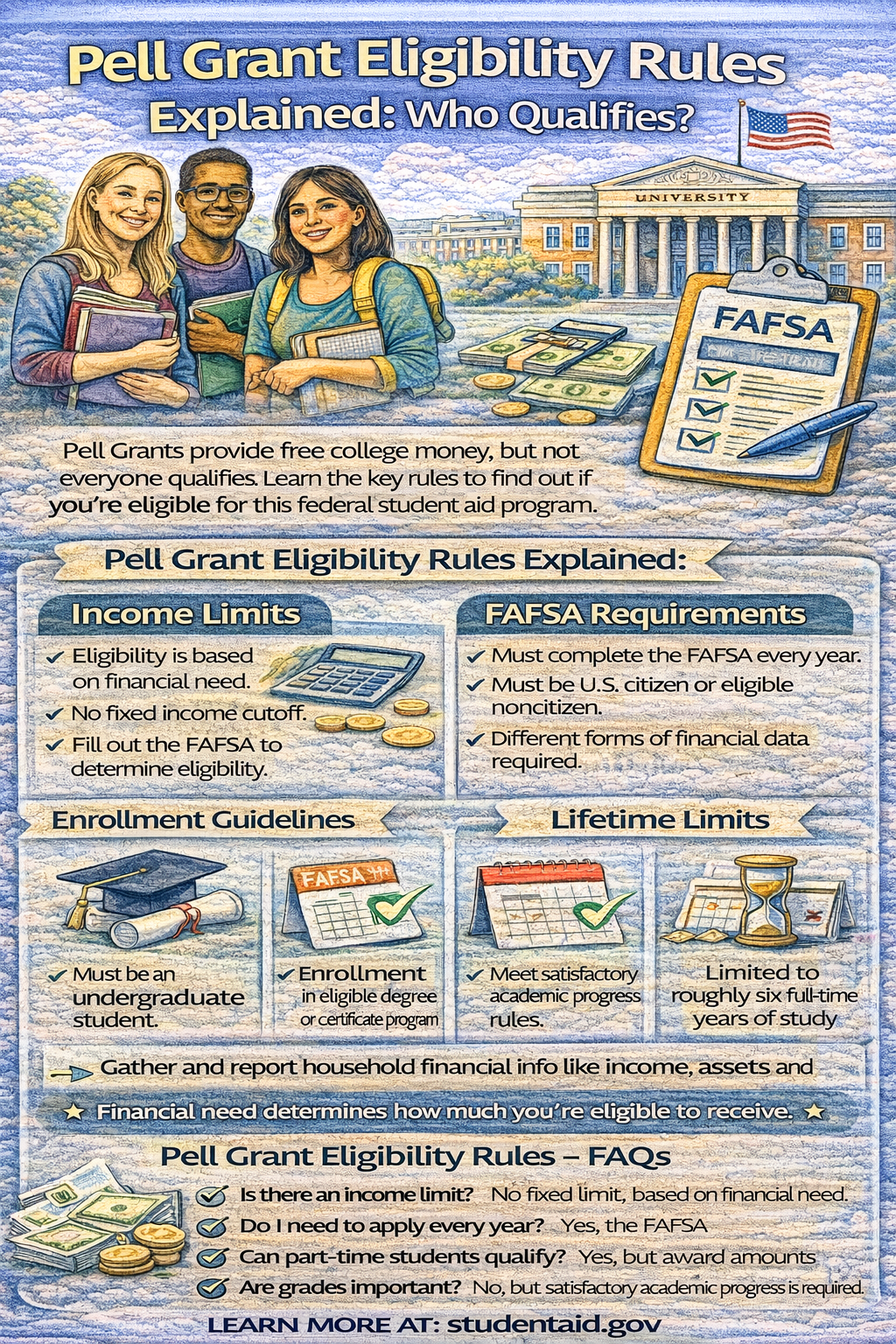
A Pell Grant is free financial aid provided by the federal government to help undergraduate students pay for college or career school. Unlike loans, Pell Grants do not need to be repaid, except in rare situations such as withdrawing from school early.
The program is administered by the U.S. Department of Education through the Federal Student Aid system. Schools receive Pell Grant funds on behalf of eligible students and apply the money to tuition and related expenses.
In simple terms, a Pell Grant is free college money for students who qualify.
Basic Pell Grant Eligibility Requirements
To qualify for a Pell Grant, students must meet several basic requirements. These requirements apply to almost all forms of federal student aid.
A student must:
-
Be a U.S. citizen or eligible noncitizen
-
Have a valid Social Security number (in most cases)
-
Be enrolled or accepted for enrollment in an eligible degree or certificate program
-
Have a high school diploma or equivalent
-
Not be in default on a federal student loan
-
Complete the Free Application for Federal Student Aid (FAFSA)
These are general eligibility rules. However, Pell Grant eligibility also depends heavily on financial need.
Financial Need
Financial need is the main factor in determining Pell Grant eligibility. The government uses information from the FAFSA to calculate a student’s financial situation.
The FAFSA looks at:
-
Family income
-
Assets
-
Household size
-
Number of family members in college
-
Tax information
Based on this information, the government calculates a number that determines how much financial aid a student may receive.
Students from low-income families are more likely to qualify for the maximum Pell Grant amount. However, moderate-income families may also qualify depending on their financial situation.
Income Limits for Pell Grants
There is no fixed income cutoff that automatically disqualifies a student. Instead, eligibility depends on overall financial circumstances.
Generally, students from families with lower annual income are more likely to qualify. Families with higher income may still qualify if they have multiple dependents or special financial situations.
Enrollment Status and Pell Grant
Enrollment status also affects Pell Grant eligibility and award amount.
Students who attend school full-time may receive a larger Pell Grant than those who attend part-time. However, part-time students can still qualify for a reduced award.
Students must remain enrolled and make satisfactory academic progress to continue receiving Pell Grants.
Academic Requirements for Pell Grant
Unlike scholarships, Pell Grants are not based on grades. High grades are not required to qualify.
However, students must:
-
Maintain satisfactory academic progress
-
Complete coursework successfully
-
Avoid failing or withdrawing from too many classes
If a student fails to meet academic standards set by the school, Pell Grant eligibility may be suspended.
Lifetime Eligibility Limits
There is a lifetime limit on how long a student can receive Pell Grants. Students may receive Pell Grant funds for the equivalent of approximately six full-time years of study.
Once this limit is reached, the student can no longer receive Pell Grants, even if they have financial need.
Special Eligibility Situations
Certain special circumstances can affect Pell Grant eligibility.
Independent students, such as those over age 24, married students, veterans, or students with dependents, are evaluated differently than dependent students.
Students experiencing homelessness or foster care situations may also receive special consideration.
Does Immigration Status Affect Eligibility?
To qualify for a Pell Grant, a student must be a U.S. citizen or an eligible noncitizen. Eligible noncitizens may include permanent residents (green card holders), refugees, asylees, and certain other protected statuses.
Undocumented students generally do not qualify for federal Pell Grants, although they may qualify for state-based aid programs in some states.
Common Pell Grant Eligibility Mistakes
Many students fail to complete the FAFSA because they assume they are not eligible. Others make errors on their FAFSA application, which can delay processing.
Some families forget to update financial information annually, which can affect eligibility.
Another common mistake is missing deadlines. FAFSA deadlines vary by state and school, and missing them can reduce financial aid opportunities.
Frequently Asked Questions (FAQs)
Is Pell Grant Based on Grades?
No. It is based on financial need, not academic performance.
Do I Have to Repay a Pell Grant?
No, unless you withdraw from school early or receive funds improperly.
Is There an Income Cutoff?
No fixed cutoff exists. Eligibility depends on overall financial information.
Can Part-Time Students Get a Pell Grant?
Yes, but the amount may be reduced.
Do I Need to Apply Every Year?
Yes, the FAFSA must be completed each year.
Can Adults Qualify for a Pell Grant?
Yes, age does not prevent eligibility if other requirements are met.
Reference Links
Federal Pell Grant Overview: https://studentaid.gov/understand-aid/types/grants/pell
U.S. Department of Education – Federal Student Aid: https://studentaid.gov
Free Application for Federal Student Aid (FAFSA): https://studentaid.gov/h/apply-for-aid/fafsa
Pell Grant Eligibility Information: https://studentaid.gov/understand-aid/types/grants/pell#eligibility
Pell Grant Lifetime Eligibility Used (LEU): https://studentaid.gov/understand-aid/types/grants/pell#lifetime
Satisfactory Academic Progress Rules: https://studentaid.gov/understand-aid/eligibility/staying-eligible
Disclaimer
Program Clarity is an independent informational website and is not affiliated with any government agency. This article is for educational purposes only. Program rules and availability may change. Always verify details with official authorities.