
When someone begins an immigration journey to the United States, one government agency quickly becomes central to almost every step of the process. That agency is commonly known as USCIS. The name appears on application forms, receipt notices, approval letters, biometrics appointment notices, and citizenship interview schedules. For many immigrants, families, students, and workers, USCIS becomes one of the most important institutions in their lives. However, confusion often exists about what USCIS actually does, how it functions within the government, how it differs from other immigration agencies, and what role it plays in shaping immigration outcomes.
In simple terms, USCIS is the government agency responsible for processing lawful immigration benefits in the United States. Applications for green cards, work permits, asylum, naturalization, family sponsorship, temporary protected status, and many other immigration benefits are reviewed and decided by this agency. Every year, millions of applications are submitted to USCIS, making it one of the busiest federal agencies in the country.
The Core Mission and Purpose of USCIS
The fundamental mission of USCIS is to administer the nation’s lawful immigration system. This responsibility involves reviewing applications and petitions submitted by individuals who seek immigration benefits under U.S. law. These benefits include permanent residence, employment authorization, family reunification, humanitarian protection, and citizenship.
USCIS officers are responsible for examining each application carefully to ensure that all legal requirements are met. Background checks are conducted. Supporting documents are reviewed. Interviews are scheduled when necessary. Decisions are issued based on established immigration laws and regulations.
The agency’s work is guided by two important principles:
Facilitating lawful immigration
Protecting national security and preventing fraud
The History and Creation of USCIS
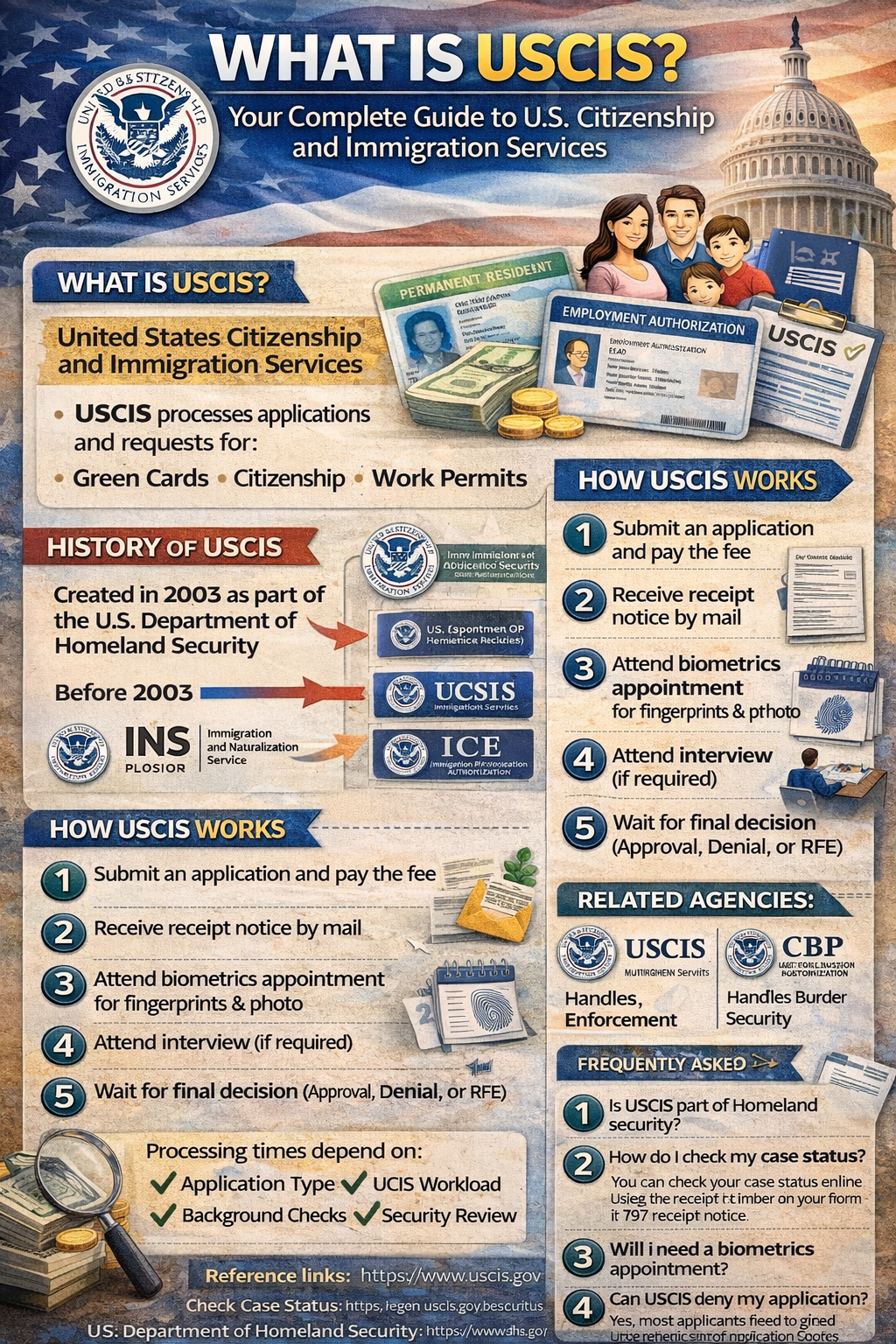
Before USCIS existed, immigration services were handled by the former Immigration and Naturalization Service (INS), which operated under the Department of Justice. However, following the tragic events of September 11, 2001, major structural changes were made to the federal government’s approach to immigration and security.
In 2003, the INS was dissolved, and its functions were divided into three separate agencies within the Department of Homeland Security. These agencies were created to separate immigration services from enforcement and border security.
The three agencies are:
United States Citizenship and Immigration Services Handles immigration benefits and services
U.S. Immigration and Customs Enforcement Handles enforcement and removal operations
U.S. Customs and Border Protection Manages border security and entry inspections
What Services Does USCIS Provide?
USCIS offers a wide range of immigration-related services. Each service category involves its own eligibility requirements, documentation rules, and processing steps.
Green Cards (Lawful Permanent Residency)
One of the most well-known services provided by USCIS is processing applications for permanent residency, commonly referred to as a green card. Individuals may apply through family sponsorship, employment sponsorship, refugee or asylum status, or other specialized categories.
Adjustment of status applications filed within the United States are handled by USCIS, while immigrant visa processing outside the U.S. typically involves coordination with the Department of State.
Naturalization and Citizenship
Individuals who meet eligibility requirements may apply to become U.S. citizens through naturalization. The naturalization process includes submitting Form N-400, attending a biometrics appointment, completing an interview, and passing an English and civics test.
Employment Authorization
Non-citizens who qualify for work authorization may apply for an Employment Authorization Document (EAD). This card allows individuals to work legally in the United States while maintaining their immigration status.
Asylum and Humanitarian Protection
Individuals who fear persecution in their home countries may apply for asylum through USCIS if they are already present in the United States. Officers conduct detailed interviews and evaluate supporting evidence before making decisions.
Family-Based Petitions
U.S. citizens and lawful permanent residents may sponsor certain family members. Petitions such as Form I-130 are reviewed by USCIS to confirm family relationships and eligibility.
Temporary Protected Status (TPS)
Nationals of certain designated countries experiencing armed conflict or natural disasters may apply for temporary protection through USCIS.
How USCIS Processes Applications
The USCIS process typically follows several structured steps. Although procedures may vary depending on the benefit type, the general process includes:
-
Submission of the application and required fee
-
Issuance of a receipt notice (Form I-797)
-
Biometrics appointment for fingerprinting and background checks
-
Review of documents and eligibility
-
Interview (if required)
-
Final decision (approval, denial, or request for additional evidence)
Processing times vary significantly depending on application type, case complexity, workload, and policy changes.
USCIS Fees and Funding Structure
Unlike many federal agencies funded primarily by taxpayers, USCIS is largely fee-funded. Application filing fees are used to support operations, staffing, and infrastructure.
Each immigration form has a specific fee. Additional biometric service fees may apply. Fee waivers are available in certain cases for applicants who demonstrate financial hardship.
Because USCIS relies heavily on application fees, fluctuations in application volume can directly impact the agency’s financial stability and processing capacity.
USCIS Online Services and Digital Accounts
USCIS now allows many applications to be filed online. Applicants may create secure online accounts to:
Track case status
Upload evidence
Receive notifications
Respond to Requests for Evidence (RFEs)
Digital modernization has improved efficiency, but paper filings are still accepted for many forms.
Frequently Asked Questions (FAQs)
Is USCIS responsible for deportations?
No. Deportation and enforcement actions are handled by U.S. Immigration and Customs Enforcement, not USCIS.
Does USCIS control the U.S. border?
No. Border inspection and security are managed by U.S. Customs and Border Protection.
Can USCIS deny an application?
Yes. If eligibility requirements are not met, the application may be denied.
What is a Request for Evidence (RFE)?
An RFE is issued when additional documents or clarification are required before a decision can be made.
How can case status be checked?
Case status can be checked online using the receipt number provided after filing.
Is hiring an immigration lawyer required?
No, but legal assistance may help in complex cases.
How long does it take to become a U.S. citizen?
Naturalization typically takes 6 to 18 months, though timelines vary.
What happens at a biometrics appointment?
Fingerprints, photographs, and signatures are collected for background checks.
Where is USCIS headquarters located?
USCIS headquarters is located in Washington, D.C.
Can applications be expedited?
In limited circumstances, expedited processing may be requested for urgent cases.
Reference Links
Official USCIS Website https://www.uscis.gov
U.S. Department of Homeland Security https://www.dhs.gov
USCIS Case Status https://egov.uscis.gov/casestatus/landing.do
Immigration Forms https://www.uscis.gov/forms
Processing Times https://egov.uscis.gov/processing-times/
Disclaimer
Program Clarity is an independent informational website and is not affiliated with any government agency. This article is for educational purposes only. Program rules and availability may change. Always verify details with official authorities.