

International students on F-1 visas cannot simply work anywhere in the United States whenever they want. The U.S. immigration system places strict restrictions on employment because the main purpose of the F-1 visa is education, not unrestricted employment.
However, the government also understands that practical work experience is valuable for educational development. This is where OPT and CPT Rules become important. These programs create legal pathways for students to gain real-world experience connected to their academic field.
The government expects students to follow every requirement carefully. Employment authorization is not automatic. Students must receive permission before beginning work, and they must ensure that all employment directly relates to their academic major.
Overview of CPT and OPT
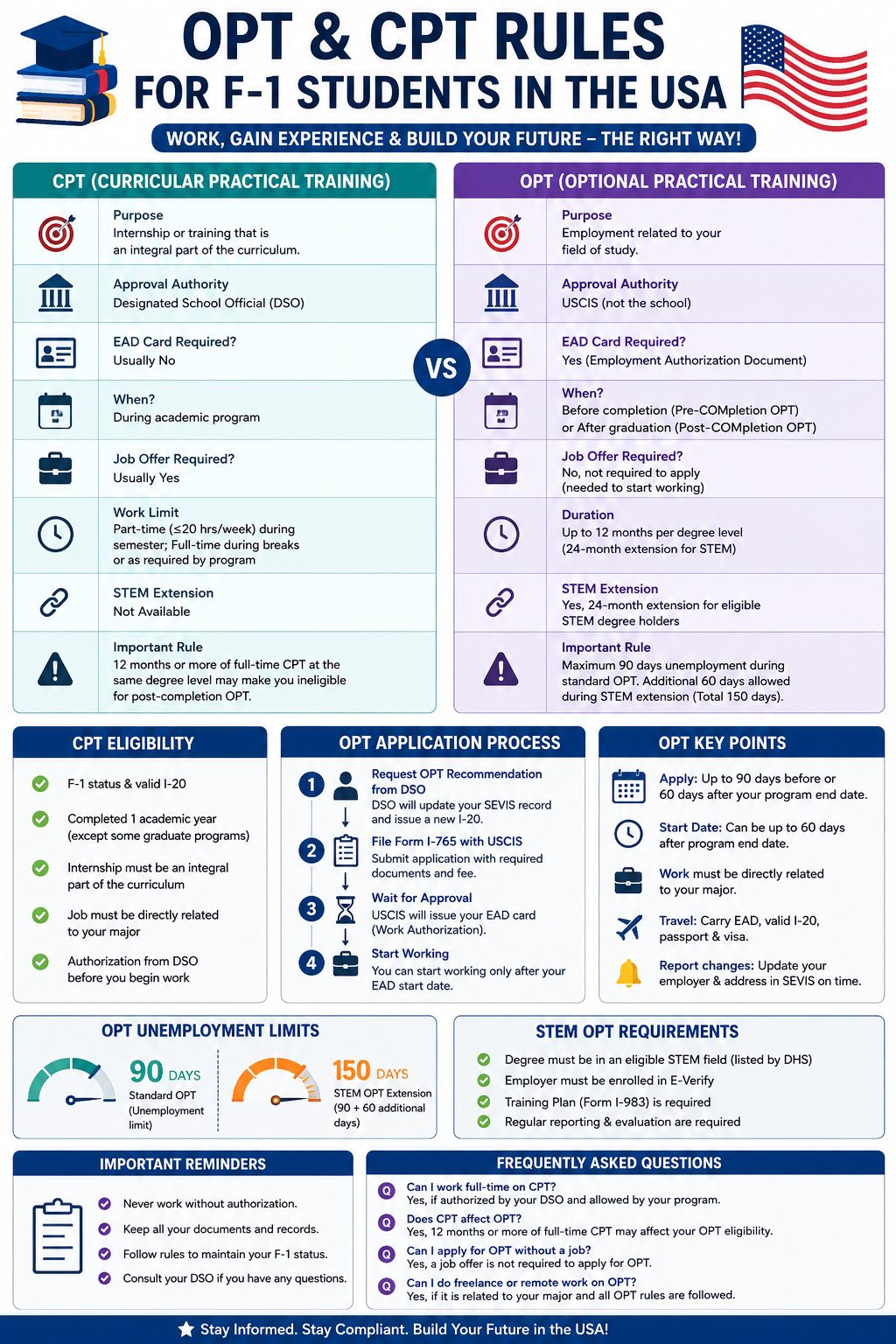
CPT (Curricular Practical Training) and OPT (Optional Practical Training) are two important work authorization programs available for F-1 international students in the United States. These programs allow students to gain valuable professional experience related to their academic field while maintaining legal immigration status. CPT is usually used during studies for internships or training connected to the curriculum, while OPT is commonly used before or after graduation for broader work opportunities. Understanding the differences between CPT and OPT is extremely important because proper planning can help students build stronger careers, avoid immigration problems, and increase future employment opportunities in the USA.
What Is CPT for F-1 Students?
Curricular Practical Training, commonly known as CPT, is a temporary employment authorization that allows F-1 students to participate in internships, cooperative education programs, practicums, or training opportunities directly connected to their academic curriculum.
CPT is primarily designed for students who need practical experience as part of their educational program. Many universities include internships, field training, research placements, or cooperative education requirements inside their degree structure. CPT exists to legally support these experiences.
One important aspect of CPT is that the work authorization is tied to the academic program itself. This means the internship or employment cannot simply be random work chosen by the student. Instead, it must have a direct educational purpose connected to the curriculum.
For many students, CPT becomes the first opportunity to gain real professional experience in the American workforce. It helps students understand workplace culture, improve communication skills, build resumes, and create industry connections before graduation.
Important for International Students
CPT provides several important advantages for international students who want to strengthen their careers while studying in the United States.
One of the biggest benefits is the opportunity to gain practical industry experience before graduation. Many employers in the USA prefer candidates who already understand professional workplace environments. Students who complete internships during their degree programs often become stronger job candidates after graduation.
CPT also helps students apply classroom knowledge to real business situations. A student studying finance may learn investment theories in class but understand financial analysis much better after working inside a real investment company. Similarly, engineering students often improve technical problem-solving abilities through industry training.
CPT Eligibility Requirements
Students must meet several conditions before qualifying for CPT authorization.
Maintaining Valid F-1 Status
Students must maintain active F-1 immigration status throughout their studies. This means following all immigration regulations, maintaining full-time enrollment requirements, and avoiding unauthorized employment.
Falling out of status may make a student ineligible for CPT.
Completing One Academic Year
Most students must complete one full academic year before becoming eligible for CPT. (uscis.gov)
This requirement exists because immigration authorities expect students to first focus on academic adjustment before beginning off-campus employment.
However, some graduate programs may allow earlier CPT if immediate practical training is officially required by the curriculum.
Having an Internship or Job Offer
Unlike OPT, CPT usually requires a specific employment offer before authorization can be approved.
Students generally must provide details such as:
- Employer name
- Job location
- Employment dates
- Position description
- Relationship to major field
The university reviews this information before approving CPT.
Employment Must Relate Directly to the Major
The work experience must clearly connect to the student’s field of study.
For example:
- A nursing student working in healthcare may qualify
- A business student interning in marketing may qualify
- A computer science student working in software engineering may qualify
However, unrelated jobs generally do not qualify for CPT authorization.
Part Time CPT vs Full-Time CPT
CPT authorization can be approved as either part-time or full-time depending on the student’s academic situation.
Part Time CPT
Part-time CPT allows students to work up to 20 hours per week while classes are in session.
This is common during fall and spring semesters when students must balance academic responsibilities alongside employment.
Part-time CPT is generally considered safer from an immigration planning perspective because it does not negatively affect OPT eligibility the same way full-time CPT can.
Many students choose part-time internships during semesters to gradually build professional experience while still prioritizing academics.
Full Time CPT
Full-time CPT allows students to work more than 20 hours weekly.
Students commonly use full-time CPT during:
- Summer breaks
- Co-op semesters
- Required internship terms
- Graduate practical training periods
While full-time CPT provides valuable experience and often higher income, students must monitor usage carefully.
The 12 Month Full Time CPT Rule
One of the most important immigration rules states that students who complete 12 months or more of full-time CPT at the same academic level may lose eligibility for post-completion OPT. (legalclarity.org)
This rule is extremely important because OPT is often the primary pathway toward long-term employment opportunities after graduation.
For example:
- 11 months of full-time CPT may still preserve OPT eligibility
- 12 months or more may eliminate OPT entirely
Part-time CPT usually does not count toward this restriction.
Students planning long-term careers in the United States should discuss CPT strategies carefully with their DSO before accepting long-term full-time internships.
What Is OPT for F-1 Students?
Optional Practical Training, commonly called OPT, allows F-1 students to gain temporary employment experience directly related to their academic field. (uscis.gov)
OPT is one of the most valuable benefits available to international students because it allows graduates to remain in the United States and work legally after finishing their degree.
Unlike CPT, OPT is not necessarily tied to a specific course or internship requirement. Instead, it provides broader professional flexibility.
OPT helps students transition from academic life into professional careers. Many international graduates use OPT to:
- Gain American work experience
- Build industry connections
- Improve resumes
- Qualify for H-1B sponsorship
- Explore long-term immigration options
For many students, OPT becomes the most important bridge between university life and professional employment in the United States.
Types of OPT
OPT exists in two primary forms.
Pre Completion OPT
Pre-completion OPT is used before graduation while the student is still completing academic studies.
Students may:
- Work part-time during semesters
- Work full-time during vacations or official breaks
However, many students avoid using pre-completion OPT because any time used reduces available post-completion OPT time later. (uscis.gov)
Since post-graduation employment is usually more valuable, students often preserve OPT for after graduation.
Post Completion OPT
Post-completion OPT begins after graduation and is the most popular form of OPT.
Students typically use post-completion OPT to work full-time in professional positions related to their degree field.
This period allows graduates to build career experience and potentially transition toward longer-term employment sponsorship.
OPT Eligibility Requirements
To qualify for OPT, students must satisfy several important requirements.
Valid F-1 Immigration Status
Students must remain compliant with all F-1 visa regulations.
Violations such as unauthorized employment may affect eligibility.
Academic Year Completion Requirement
Students usually must complete one academic year before qualifying for OPT. (uscis.gov)
Employment Must Match Degree Field
The work performed during OPT must relate directly to the student’s major.
For example:
- Engineering graduates may work in technical engineering roles
- Public health graduates may work in healthcare administration
- Information technology graduates may work in cybersecurity or software roles
USCIS Authorization Is Required
Unlike CPT, OPT requires direct approval from USCIS.
Students cannot begin employment until they receive an approved Employment Authorization Document (EAD).
OPT Application Process Explained
The OPT application process includes multiple steps that students must follow carefully.
Request OPT Recommendation From DSO
Students first contact the international student office at their university.
The DSO reviews eligibility and enters the OPT recommendation into SEVIS.
After approval, the student receives an updated Form I-20 recommending OPT.
File Form I-765 With USCIS
Students submit Form I-765 to USCIS to officially request work authorization. (uscis.gov)
Application packages often include:
- OPT-recommended I-20
- Passport copies
- Visa copies
- I-94 travel record
- Passport photos
- Filing fees
Students must ensure all forms are accurate because mistakes may cause delays or denials.
Wait for USCIS Approval
USCIS reviews the application and eventually issues the EAD card if approved.
Students must wait until:
- The EAD is received
- The start date becomes active
Working early without authorization may create serious immigration violations.
OPT Filing Deadlines
Timing is one of the most important parts of the OPT process.
Students generally may apply:
- Up to 90 days before graduation
- Up to 60 days after graduation (uscis.gov)
Additionally, USCIS usually requires the application to be filed within 30 days of the DSO recommendation appearing in SEVIS.
Missing deadlines can result in denied applications and lost work opportunities.
STEM OPT Extension
Students graduating from eligible STEM fields may qualify for a 24-month OPT extension. (uscis.gov)
This allows eligible students to remain employed in the USA longer.
Total possible OPT duration becomes:
- 12 months standard OPT
- 24 months STEM extension
- Total: 36 months
STEM OPT is highly valuable because it provides additional chances for H-1B sponsorship selection.
STEM OPT Requirements
Students must satisfy additional conditions for STEM OPT.
Eligible STEM Degree
The degree must appear on the official DHS STEM Designated Degree Program List.
E-Verify Employer
The employer must participate in the E-Verify program.
Form I-983 Training Plan
Students and employers must complete a detailed training plan explaining how the employment supports educational growth.
Reporting Requirements
Students must submit periodic reports and evaluations during STEM OPT participation.
Failure to complete reporting obligations may affect immigration status.
OPT Unemployment Rules
OPT students cannot remain unemployed indefinitely.
Standard OPT Unemployment Limit
Students generally may not accumulate more than 90 days of unemployment during regular OPT.
STEM OPT Additional Limit
Students on STEM OPT receive an extra 60 unemployment days.
Combined total:
- 150 unemployment days maximum across OPT and STEM OPT
Students who exceed these limits may violate F-1 status requirements.
Travel Rules During OPT
International travel during OPT requires careful preparation.
Students should usually carry:
- Valid passport
- Valid F-1 visa
- Signed OPT I-20
- EAD card
- Employment verification letter
Travel while an OPT application is pending may create complications in certain situations.
Students should always consult their DSO before international travel.
Can F-1 Students Freelance or Work Remotely?
This is one of the most misunderstood topics among international students.
Many students incorrectly assume online work or freelancing does not count as employment.
In reality, paid remote work, freelance contracts, consulting, online services, and side gigs may all require authorization if performed while physically present in the United States. (reddit.com)
Students should never assume a job is allowed without consulting their DSO.
Unauthorized work remains one of the fastest ways to create immigration problems.
Common Mistakes International Students Make
Starting Work Too Early
Students sometimes begin internships before official authorization dates.
Even a few unauthorized workdays can become problematic.
Accepting Unrelated Jobs
Employment must connect directly to the degree field.
Ignoring Reporting Requirements
OPT students must update employment information regularly.
Misunderstanding Volunteer Work
Some unpaid work may still count as employment under immigration rules.
Excessive Full-Time CPT Usage
Too much CPT can eliminate future OPT opportunities.
Day 1 CPT Programs
Some universities advertise “Day 1 CPT” programs allowing students to begin practical training immediately after enrollment.
While certain programs may legally structure CPT this way, students should research carefully. Immigration authorities continue examining aggressive CPT models more closely. (reddit.com)
Students should verify:
- Accreditation
- SEVP certification
- Academic legitimacy
- Program structure
Choosing questionable programs may create future immigration risks.
How OPT Helps Build Long-Term Careers
OPT provides more than temporary work authorization.
For many international students, OPT becomes the foundation of a long-term professional future in the United States.
Graduates gain:
- Real industry experience
- Professional references
- American workplace exposure
- Networking opportunities
- Sponsorship possibilities
Many employers prefer hiring candidates who already understand workplace expectations and professional systems inside the USA.
OPT also gives students time to compete in the H-1B lottery process multiple times, especially with STEM extensions.
Transitioning From OPT to H-1B
Many international graduates eventually seek H-1B sponsorship.
The H-1B visa allows specialty occupation employment in the United States.
OPT often becomes the bridge connecting education and employer sponsorship.
Students who build strong professional performance during OPT may improve their chances of receiving sponsorship support from employers.
Maintaining Compliance During OPT
Students remain under F-1 immigration regulations even while working on OPT.
Important responsibilities include:
- Reporting employment updates
- Updating addresses
- Maintaining valid documents
- Following unemployment rules
- Working only in authorized positions
Good recordkeeping is extremely important.
Students should save:
- Offer letters
- Pay stubs
- Employment agreements
- Work schedules
- Tax records
These documents may become useful during future immigration applications.
Best Tips for International Students
Communicate With Your DSO Regularly
Your DSO is one of the most important resources for immigration compliance guidance.
Apply Early Whenever Possible
Delays happen frequently, especially during busy graduation seasons.
Keep Immigration Documents Organized
Store physical and digital copies securely.
Avoid Unauthorized Work
Never assume online jobs are automatically permitted.
Think Long-Term
Short-term decisions can affect future immigration opportunities..
FAQs About OPT and CPT Rules for F-1 Students
What is the difference between CPT and OPT?
CPT is curriculum-based training used during studies, while OPT is broader work authorization usually used after graduation.
Can I work full-time on CPT?
Yes, universities may authorize full-time CPT depending on academic requirements.
Does CPT require USCIS approval?
No. CPT is typically approved through the university DSO.
Can full-time CPT affect OPT eligibility?
Yes. Using 12 months or more of full-time CPT may remove OPT eligibility.
How long does standard OPT last?
Standard OPT generally lasts up to 12 months per degree level.
What is STEM OPT?
STEM OPT is a 24-month extension available for qualifying STEM graduates.
Can I work remotely on OPT?
Yes, if the work directly relates to your major and follows OPT regulations properly.
Can I freelance during OPT?
Freelancing may be allowed if properly related to the degree field and documented correctly.
What happens if I exceed unemployment limits?
Exceeding unemployment limits may violate F-1 status.
Can I apply for OPT before getting a job?
Yes. A job offer is not required before applying for OPT.
Is premium processing available for OPT?
Yes, USCIS offers premium processing for certain OPT applications.
Can I travel while OPT is pending?
Travel may be possible, but students should consult their DSO because risks can vary.
Reference Links
- USCIS OPT for F-1 Students
- USCIS Students and Employment
- Study in the States Practical Training
- USCIS Form I-765
Disclaimer
Program Clarity is an independent informational website and is not affiliated with any government agency. This article is for educational purposes only. Program rules and availability may change. Always verify details with official authorities.