
Deferred Action for Childhood Arrivals, commonly called DACA, remains one of the most important immigration programs for undocumented immigrants who arrived in the United States as children. Although legal challenges continue to affect the program, thousands of current recipients still renew their DACA protections every year.
Understanding the eligibility requirements for DACA is essential before preparing an application or renewal. Many applicants become confused by the rules related to age, education, continuous residence, criminal history, and physical presence in the United States. Missing even one requirement can result in delays or denial.
This guide explains the DACA eligibility requirements in simple language, including who qualifies, what documents are needed, common mistakes to avoid, and recent updates affecting Dreamers in 2026.
What Is DACA?
Deferred Action for Childhood Arrivals (DACA) is an immigration policy introduced in 2012 by the Department of Homeland Security (DHS). It provides temporary protection from deportation for certain undocumented immigrants who came to the United States as children.
Overview of DACA Eligibility Requirements
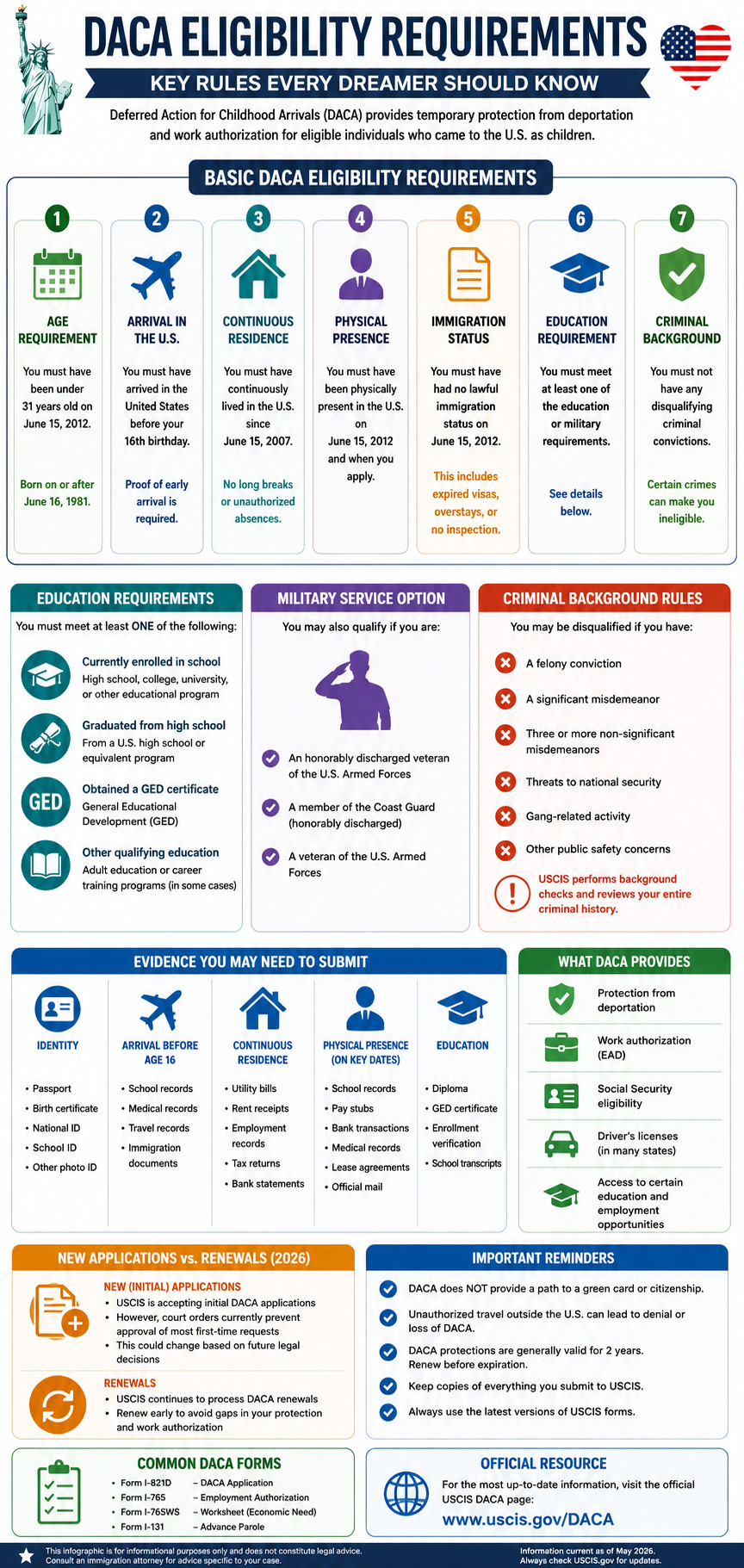
Here is a quick overview of the main DACA eligibility rules.
| Requirement | Basic Rule |
|---|---|
| Age Requirement | Must have been under 31 on June 15, 2012 |
| Arrival in U.S. | Must have arrived before turning 16 |
| Continuous Residence | Must have lived continuously in the U.S. since June 15, 2007 |
| Physical Presence | Must have been physically present on June 15, 2012 |
| Immigration Status | Must have had no lawful immigration status on June 15, 2012 |
| Education or Military Service | Must meet school or military requirements |
| Criminal Background | Must not have serious criminal convictions |
Age Requirement for DACA
One of the first qualifications USCIS reviews is the applicant’s age.
To qualify for DACA, you must have been:
- Under the age of 31 on June 15, 2012
- Born on or after June 16, 1981
This rule applies regardless of your current age today.
For example:
- Someone born in 1985 may still qualify
- Someone born in 1979 would not qualify
The age rule is fixed because DACA eligibility is based on the original 2012 policy framework.
Official USCIS guidance confirms that applicants must prove they were under 31 years old as of June 15, 2012.
Requirement to Arrive Before Age 16
Applicants must prove they entered the United States before their 16th birthday.
This is one of the most important parts of DACA because the program was specifically created for individuals brought to the country as children.
Common documents used to prove early arrival include:
- School records
- Vaccination records
- Medical documents
- Travel records
- Immigration documents
- Lease agreements
- Church records
USCIS carefully reviews evidence to confirm the date of arrival.
Continuous Residence Requirement
Applicants must show they have continuously lived in the United States since June 15, 2007.
This does not mean you were never absent from the country. Short and casual trips may sometimes be acceptable, especially if they occurred before August 15, 2012.
However, long absences or unauthorized travel can create problems.
Examples of documents proving continuous residence include:
- School transcripts
- Utility bills
- Rent receipts
- Employment records
- Medical records
- Bank statements
- Tax documents
Applicants usually need documents covering multiple years to show an uninterrupted presence in the United States.
Physical Presence Requirement
DACA applicants must prove they were physically present in the United States on:
- June 15, 2012
- The date they submitted the DACA request
USCIS may request evidence such as:
- School attendance records
- Pay stubs
- Bank transactions
- Medical appointments
- Lease agreements
- Official correspondence
If USCIS cannot verify physical presence on the required dates, the application may be denied.
Immigration Status Requirement
Applicants must show they had no lawful immigration status on June 15, 2012.
This generally includes individuals who:
- Entered the U.S. without inspection
- Overstayed a visa
- Lost lawful immigration status before June 15, 2012
People who maintained lawful status on that date typically do not qualify for DACA.
Examples of expired statuses include:
- Expired tourist visas
- Expired student visas
- Expired temporary protected status
Education Requirements for DACA
Education is another major eligibility category.
To qualify, applicants must meet at least one of these conditions:
- Currently enrolled in school
- Graduated from high school
- Obtained a GED certificate
- Honorably discharged veteran of the U.S. military or Coast Guard
USCIS accepts several forms of education programs, including:
- Public high schools
- Private schools
- Adult education programs
- GED preparation courses
- Career training programs in some cases
Applicants who dropped out and are not currently enrolled generally do not qualify unless they later return to school.
Military Service Qualification
Some applicants qualify through military service instead of educational enrollment.
Eligible military applicants must be:
- Honorably discharged veterans
- Former members of the Coast Guard
- Former members of the U.S. Armed Forces
Military discharge records may be required as evidence.
Criminal Background Restrictions
Criminal history is one of the most serious areas reviewed by USCIS.
Applicants are generally disqualified if they have:
- A felony conviction
- A significant misdemeanor
- Three or more non-significant misdemeanors
- National security concerns
- Gang-related issues
- Public safety threats
USCIS uses fingerprinting and background checks to review criminal records.
According to USCIS, even some misdemeanor offenses can prevent DACA approval.
What Counts as a Felony?
A felony is usually defined as a criminal offense punishable by more than one year in prison.
Examples may include:
- Drug trafficking
- Violent crimes
- Serious theft offenses
- Major fraud offenses
A single felony conviction can disqualify a DACA applicant.
What Is a Significant Misdemeanor?
A significant misdemeanor may include offenses such as:
- Domestic violence
- Burglary
- Sexual abuse
- Drug distribution
- DUI offenses
Even one significant misdemeanor can make an applicant ineligible.
This area can become legally complicated, so applicants with criminal records often consult immigration attorneys before filing.
Evidence Needed for DACA Eligibility
Strong supporting documentation is critical.
Applicants commonly submit evidence in these categories:
Proof of Identity
Examples include:
- Passport
- Birth certificate with photo ID
- School identification card
- National identity document
Proof of Arrival Before Age 16
Examples include:
- School records
- Medical records
- Entry stamps
- I-94 travel records
Proof of Continuous Residence
Examples include:
- Utility bills
- Employment records
- Tax returns
- Bank statements
- School transcripts
Proof of Education
Examples include:
- High school diploma
- GED certificate
- Enrollment verification letters
Organizing documents clearly can improve application processing.
DACA Renewal Eligibility
DACA renewals are available for current recipients who still meet eligibility rules and have no serious legal issues. Renew before your status expires to avoid gaps in protection.
Can New Applicants Apply for DACA in 2026?
New applicants can still submit DACA requests in 2026, but many first-time applications are not currently being approved due to court rulings. USCIS continues accepting and processing renewal applications.
Common Reasons DACA Applications Are Denied
Many DACA applications face delays or denials due to avoidable mistakes.
Common problems include:
| Issue | Explanation |
|---|---|
| Missing Documents | Incomplete evidence packages |
| Criminal Record Problems | Undisclosed arrests or convictions |
| Incorrect Dates | Inconsistent timeline information |
| Gaps in Residence | Missing proof for certain years |
| Filing Errors | Incorrect forms or signatures |
| Unauthorized Travel | Leaving the U.S. without permission |
Carefully reviewing forms before submission can reduce risks.
How Long Does DACA Protection Last?
DACA protections generally last for two years.
Recipients may apply for renewal before expiration.
Benefits usually include:
- Deferred deportation
- Employment authorization
- Ability to apply for Social Security numbers
However, DACA does not provide:
- Green cards
- Citizenship
- Permanent legal status
DACA and Work Authorization
Approved DACA recipients may apply for an Employment Authorization Document (EAD).
This allows recipients to:
- Work legally in the United States
- Obtain state IDs in many states
- Build employment history
- Pay taxes legally
Work authorization is one of the most valuable benefits of DACA.
DACA and Advance Parole
Some DACA recipients may request advance parole for travel outside the United States under limited circumstances.
Approved reasons may include:
- Educational travel
- Humanitarian reasons
- Employment purposes
Travel without approved advance parole can create serious immigration consequences.
USCIS warns that unauthorized departures may terminate DACA protections.
DACA and Pathways to Permanent Residency
DACA itself does not lead directly to a green card.
However, some recipients may later qualify for lawful permanent residency through:
- Marriage to a U.S. citizen
- Employment sponsorship
- Family petitions
- Military pathways
- Humanitarian programs
Online immigration discussions also mention employment-based visa opportunities for some DACA recipients in specialized professions.
Each case depends on individual immigration history and lawful entry issues.
Important DACA Forms
Several USCIS forms are commonly used for DACA.
| Form | Purpose |
|---|---|
| Form I-821D | DACA application |
| Form I-765 | Employment authorization request |
| Form I-765WS | Worksheet for economic need |
| Form I-131 | Advance parole request |
Applicants should always use the latest USCIS versions.
DACA Filing Fees
DACA applications include government filing fees.
Fees may change periodically, so applicants should verify current amounts on the USCIS website before filing.
Some applicants facing financial hardship may qualify for limited fee exemptions under specific circumstances.
Tips for Preparing a Strong DACA Application
Preparing carefully can improve approval chances.
Helpful tips include:
- Organize documents chronologically
- Keep copies of everything submitted
- Double-check dates and names
- Respond quickly to USCIS requests
- File renewals early
- Avoid unauthorized travel
- Consult legal professionals if criminal history exists
Many applicants also create timelines covering residence history and school attendance to simplify documentation.
Recent DACA Updates in 2026
DACA continues facing ongoing legal uncertainty.
Current USCIS policy states:
- Renewals continue to be processed
- Existing protections remain valid until expiration
- Initial applications are accepted but generally not approved
Future court decisions or federal legislation could change DACA eligibility rules.
Applicants should regularly monitor USCIS announcements for updates.
Why DACA Eligibility Rules Matter
DACA requirements are strict because the program is discretionary.
USCIS officers review:
- Immigration history
- Criminal background
- Residence evidence
- Educational qualifications
- Public safety concerns
Even small inconsistencies may trigger requests for additional evidence.
Understanding the rules beforehand can help applicants avoid costly mistakes.
Frequently Asked Questions
Who qualifies for DACA?
Individuals who came to the United States before age 16, lived continuously in the country since June 15, 2007, meet education or military requirements, and have no serious criminal record may qualify.
Can first-time applicants still apply for DACA?
USCIS continues accepting initial applications, but current court orders prevent approval of many first-time cases. Renewals are still being processed.
Does DACA provide a green card?
No. DACA only provides temporary deferred action and work authorization. It does not create permanent legal status.
How often must DACA be renewed?
DACA protections are generally valid for two years and require renewal before expiration.
Can DACA recipients travel internationally?
Some recipients may travel with approved advance parole authorization. Unauthorized travel can create immigration problems.
What crimes disqualify someone from DACA?
Felonies, significant misdemeanors, and multiple non-significant misdemeanors may result in denial.
Is a GED accepted for DACA?
Yes. A GED certificate generally satisfies the education requirement.
Can someone with an expired visa qualify for DACA?
Possibly. Many applicants qualify after overstaying lawful visas if they meet all other eligibility requirements.
Does DACA lead to citizenship?
No. DACA itself does not provide a path to citizenship.
Where can applicants verify official DACA requirements?
Applicants should review the official USCIS DACA page for current rules and updates.
Official USCIS Resource:
USCIS DACA Eligibility Guidelines
Disclaimer
Program Clarity is an independent informational website and is not affiliated with any government agency. This article is for educational purposes only. Program rules and availability may change. Always verify details with official authorities.