

As people enter retirement, managing income becomes more important than ever. Many seniors live on a combination of Social Security benefits, pensions, retirement account withdrawals, investment income, and part-time employment earnings. While taxes remain an important financial consideration, the U.S. tax system provides several tax benefits specifically designed to help older adults reduce their tax burden and keep more of their retirement income.
Understanding tax benefits for seniors can lead to substantial savings each year. From higher standard deductions and favorable treatment of Social Security benefits to medical expense deductions and retirement account strategies, seniors have access to numerous opportunities that younger taxpayers may not receive.
This comprehensive guide explains the most important tax benefits available to seniors, how they work, eligibility requirements, and practical strategies for maximizing tax savings during retirement.
Overview of Tax Benefits for Seniors
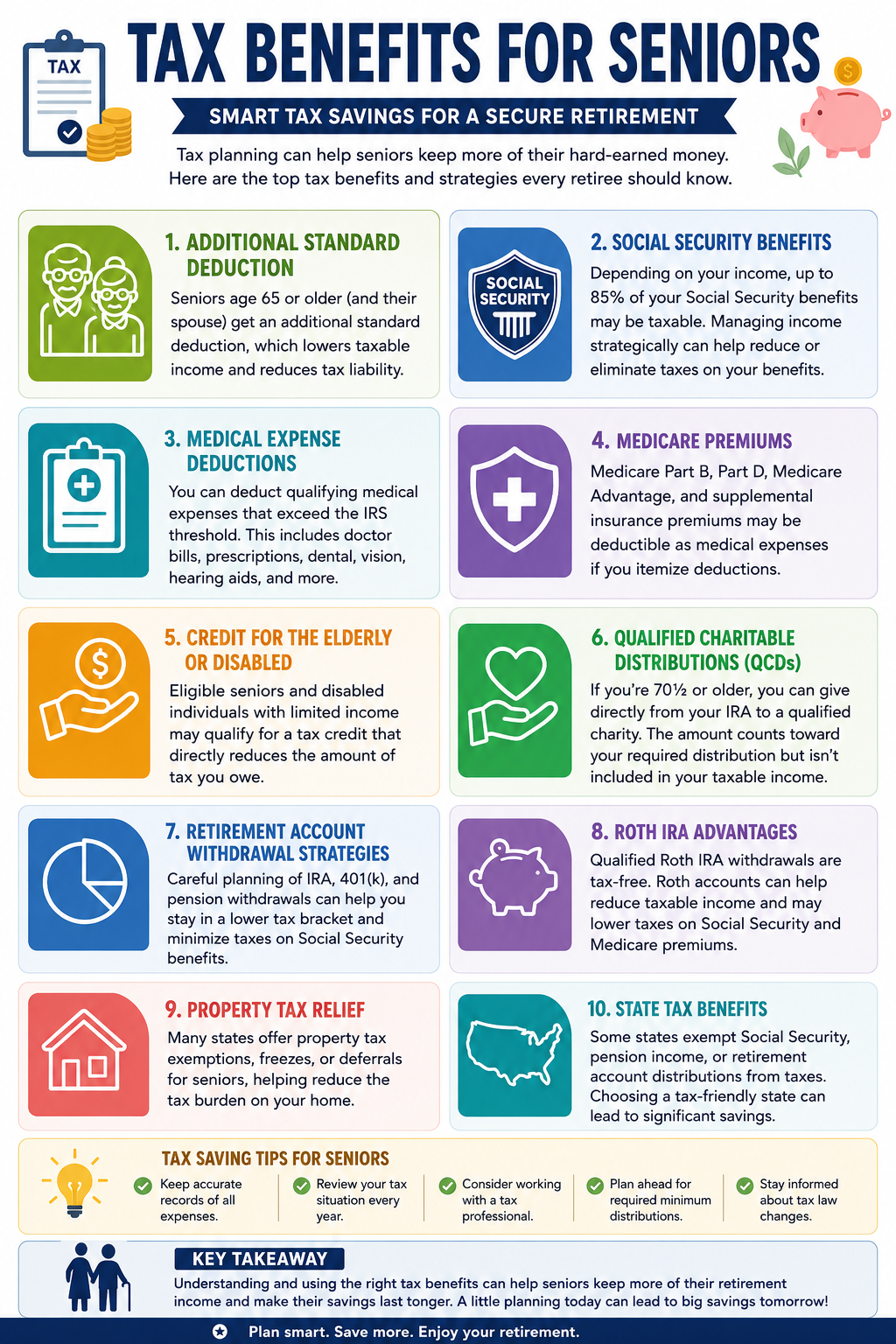
| Tax Benefit | Description |
|---|---|
| Higher Standard Deduction | Additional deduction available for taxpayers age 65 and older |
| Enhanced Senior Deduction | Additional temporary deduction available for eligible seniors |
| Social Security Tax Advantages | Some or all Social Security benefits may be tax-free |
| Medical Expense Deduction | Eligible healthcare expenses may be deductible |
| Credit for Elderly or Disabled | Tax credit for qualifying seniors with limited income |
| Retirement Account Tax Planning | Tax-efficient withdrawals and Roth conversion opportunities |
| Qualified Charitable Distributions (QCDs) | Tax-free charitable giving from IRAs |
| Home Sale Exclusion | Potential exclusion of capital gains on home sales |
| State Tax Benefits | Many states offer senior-specific tax relief |
| Property Tax Relief Programs | Available in many states and local jurisdictions |
Understanding Senior Tax Status
The IRS generally considers a taxpayer a senior for certain tax purposes beginning in the year they turn 65. Even if a taxpayer reaches age 65 on January 1 of the following year, the IRS typically treats them as having reached age 65 on the last day of the previous tax year.
This age threshold unlocks several valuable tax benefits that can significantly reduce taxable income and overall tax liability.
Many retirees assume that retirement automatically eliminates taxes. However, retirement income sources can still create taxable income. Understanding the available deductions, credits, and exclusions helps seniors minimize unnecessary tax payments.
Higher Standard Deduction for Seniors
One of the most valuable tax benefits available to seniors is the higher standard deduction.
The standard deduction reduces taxable income before tax rates are applied. Taxpayers age 65 or older qualify for an additional deduction amount on top of the regular standard deduction. The IRS adjusts these amounts periodically for inflation. Seniors filing as single taxpayers generally receive a larger additional deduction, while married couples can receive additional deductions if one or both spouses meet the age requirement.
This benefit is especially valuable because it requires no special calculations or documentation. Simply meeting the age requirement allows eligible taxpayers to claim the additional deduction.
For many retirees who no longer have significant mortgage interest or other itemized deductions, the larger standard deduction provides a simple and effective way to reduce taxable income.
Advantages of the Higher Standard Deduction
- Reduces taxable income automatically
- Simplifies tax filing
- Requires no recordkeeping
- Available regardless of income level
- Can be combined with other senior tax benefits
Because of this increased deduction, many seniors find that itemizing deductions is unnecessary.
Enhanced Senior Deduction
Recent tax law changes introduced an enhanced deduction specifically for eligible seniors age 65 and older. Eligible taxpayers may qualify for an additional deduction that can significantly reduce taxable income, subject to certain income limitations. This deduction may be available whether a taxpayer uses the standard deduction or itemizes deductions.
For many retirees, this enhanced deduction represents one of the most significant recent tax benefits.
Potential Benefits
- Lowers taxable income
- May reduce taxes on Social Security benefits
- Can increase overall tax savings
- Available in addition to traditional senior deductions
Since eligibility rules and phase-outs may change, seniors should review current IRS guidance each year.
Tax Treatment of Social Security Benefits
One of the most misunderstood areas of retirement taxation involves Social Security benefits.
Many retirees assume Social Security income is entirely tax-free. In reality, depending on total income, a portion of benefits may become taxable.
However, many seniors pay little or no federal tax on Social Security benefits because of income thresholds established by federal law.
Factors Affecting Taxability
The IRS evaluates:
- Social Security income
- Pension income
- IRA withdrawals
- Investment income
- Employment earnings
- Tax-exempt interest
Depending on combined income, up to 85% of Social Security benefits may become taxable. However, this does not mean benefits are taxed at an 85% rate. Instead, up to 85% of the benefit amount becomes part of taxable income.
Strategies to Reduce Social Security Taxation
- Manage retirement account withdrawals carefully
- Use Roth IRA withdrawals when appropriate
- Spread large withdrawals across multiple years
- Coordinate pension and investment income
- Consider Qualified Charitable Distributions
Proper planning can significantly reduce taxes on retirement income.
Medical Expense Deductions
Healthcare expenses often increase substantially during retirement.
Fortunately, seniors may be able to deduct qualifying medical expenses if they itemize deductions and their eligible expenses exceed IRS thresholds.
Qualifying expenses may include:
- Doctor visits
- Hospital care
- Prescription medications
- Dental treatment
- Vision care
- Hearing aids
- Long-term care services
- Medicare premiums
- Supplemental insurance premiums
Many retirees overlook deductible medical costs because they fail to keep detailed records throughout the year.
Common Deductible Medical Expenses
| Expense Type | Potential Deductibility |
|---|---|
| Medicare Part B Premiums | Usually deductible |
| Medicare Part D Premiums | Usually deductible |
| Long-Term Care Insurance | Often deductible within limits |
| Prescription Drugs | Generally deductible |
| Medical Equipment | Often deductible |
| Nursing Home Costs | May qualify |
Medical expenses exceeding the applicable adjusted gross income threshold may be deductible when itemizing.
Credit for the Elderly or Disabled
Some seniors may qualify for the Credit for the Elderly or Disabled.
Unlike deductions, tax credits directly reduce tax liability dollar-for-dollar.
This credit is designed to assist older taxpayers with limited incomes and qualifying disabilities.
General Eligibility Requirements
A taxpayer typically must:
- Be age 65 or older, or
- Be permanently and totally disabled
- Meet certain income limitations
- Meet filing status requirements
Because income restrictions apply, not all retirees qualify. However, eligible taxpayers can receive meaningful tax reductions. The IRS discusses this credit in its senior tax guidance.
Qualified Charitable Distributions (QCDs)
Many retirees support charitable organizations regularly.
A Qualified Charitable Distribution allows eligible taxpayers to transfer funds directly from an IRA to a qualified charity.
This strategy provides several tax advantages.
Benefits of QCDs
- Satisfies Required Minimum Distributions (RMDs)
- Reduces taxable income
- Supports charitable causes
- May reduce Social Security taxation
- Can help lower Medicare premium surcharges
For charitable seniors, QCDs often provide greater tax savings than making donations with after-tax dollars.
Retirement Account Tax Benefits
Retirement accounts remain an important part of tax planning even after retirement begins.
Common retirement accounts include:
- Traditional IRAs
- Roth IRAs
- 401(k) plans
- 403(b) plans
- SEP IRAs
- SIMPLE IRAs
Each account type receives different tax treatment.
Traditional IRA Tax Considerations
Traditional IRA withdrawals are generally taxable.
However, careful withdrawal planning can:
- Avoid higher tax brackets
- Reduce Social Security taxation
- Improve Medicare premium outcomes
Roth IRA Advantages
Qualified Roth IRA withdrawals are generally tax-free.
Benefits include:
- No federal income tax on qualified withdrawals
- Greater flexibility during retirement
- Reduced impact on Social Security taxation
- Potential estate planning benefits
Many retirees strategically convert portions of traditional retirement accounts into Roth IRAs during lower-income years.
Home Sale Tax Exclusion for Seniors
Many retirees choose to downsize after retirement.
Fortunately, federal tax law provides generous exclusions on gains from the sale of a primary residence.
Eligible homeowners may exclude significant capital gains if ownership and occupancy requirements are met.
Key Benefits
- Potentially tax-free home sale profits
- Useful when relocating
- Helpful for downsizing strategies
- May increase retirement savings
Certain exceptions may also benefit seniors who move due to health issues or other qualifying circumstances. The IRS discusses these provisions in senior tax guidance.
Property Tax Relief Programs
Although property taxes are not federal taxes, many states and local governments provide relief programs specifically for seniors.
Common programs include:
- Property tax freezes
- Property tax exemptions
- Assessment limitations
- Deferral programs
- Homestead exemptions
These programs can reduce housing costs substantially for retirees on fixed incomes.
Because eligibility rules vary by state and municipality, seniors should contact local tax authorities to determine available benefits.
State Tax Benefits for Seniors
Federal tax benefits are only part of the picture.
Many states offer additional tax advantages for retirees.
Examples of State-Level Benefits
- Exemptions for Social Security income
- Pension income exclusions
- Retirement account income deductions
- Property tax reductions
- Senior tax credits
Some states do not tax retirement income at all, while others provide partial exemptions.
Retirees considering relocation often compare state tax policies when selecting retirement destinations.
Tax Benefits Related to Medicare Premiums
Healthcare costs represent one of the largest retirement expenses.
Many seniors do not realize that Medicare premiums may qualify as deductible medical expenses when itemizing deductions.
Potentially deductible premiums include:
- Medicare Part B
- Medicare Part D
- Medicare Advantage plans
- Supplemental Medigap coverage
For retirees with substantial healthcare costs, these deductions can significantly reduce taxable income.
Tax Planning for Required Minimum Distributions (RMDs)
Many retirees must take Required Minimum Distributions from tax-deferred retirement accounts.
RMDs can increase taxable income significantly.
Without proper planning, RMDs may:
- Push retirees into higher tax brackets
- Increase taxation of Social Security benefits
- Raise Medicare premiums
- Reduce eligibility for certain credits
Strategies for Managing RMD Taxes
- Roth conversions before RMD age
- Qualified Charitable Distributions
- Coordinated withdrawal strategies
- Multi-year tax planning
Proactive planning often produces substantial tax savings over retirement.
Capital Gains Tax Advantages for Seniors
Many retirees rely on investments for supplemental income.
Long-term capital gains frequently receive favorable tax treatment compared with ordinary income.
Depending on taxable income levels, some retirees may qualify for reduced capital gains tax rates.
Common Sources of Capital Gains
- Stock sales
- Mutual fund investments
- Exchange-traded funds
- Real estate investments
Proper timing of investment sales can help seniors manage tax exposure.
Common Tax Mistakes Seniors Should Avoid
Many retirees unintentionally pay more tax than necessary.
Frequent Errors
Ignoring Available Deductions
Many seniors fail to claim medical expenses, charitable contributions, and other allowable deductions.
Missing Tax Credits
Eligible taxpayers sometimes overlook valuable credits.
Poor Withdrawal Planning
Taking large distributions from retirement accounts can create unnecessary taxes.
Forgetting About State Benefits
Many seniors focus only on federal taxes and miss state-level opportunities.
Inadequate Recordkeeping
Poor documentation may prevent taxpayers from claiming legitimate deductions.
Avoiding these mistakes can save hundreds or even thousands of dollars annually.
Best Tax-Saving Strategies for Seniors
1. Maximize Available Deductions
Claim every deduction for which you qualify.
2. Review Medical Expenses Annually
Track healthcare costs carefully.
3. Consider Roth Conversions
Strategic conversions may reduce future tax burdens.
4. Use Qualified Charitable Distributions
This approach can lower taxable income while supporting charities.
5. Coordinate Retirement Withdrawals
Careful timing reduces unnecessary tax consequences.
6. Monitor Social Security Taxation
Keep combined income within favorable ranges when possible.
7. Consult a Tax Professional
Complex retirement tax situations often benefit from professional guidance.
Frequently Asked Questions (FAQs)
At what age do seniors receive additional tax benefits?
Most federal senior tax benefits begin when a taxpayer reaches age 65. Additional deductions and certain credits become available at that age.
Are Social Security benefits always tax-free?
No. Depending on total income, a portion of Social Security benefits may become taxable. However, many retirees pay little or no tax on their benefits.
Can seniors deduct Medicare premiums?
Yes. Medicare premiums may qualify as deductible medical expenses when itemizing deductions.
What is a Qualified Charitable Distribution?
A QCD allows eligible taxpayers to donate directly from an IRA to a qualified charity, potentially reducing taxable income.
Do all seniors qualify for the Credit for the Elderly or Disabled?
No. Income limits and other eligibility requirements apply.
Are retirement account withdrawals taxable?
Traditional IRA and 401(k) withdrawals are generally taxable. Qualified Roth IRA withdrawals are generally tax-free.
Can seniors receive both standard and additional senior deductions?
Eligible taxpayers age 65 or older may qualify for age-based additional deductions and other senior-related tax benefits depending on current tax law provisions.
Do states offer additional tax benefits for retirees?
Yes. Many states provide exemptions, deductions, credits, or property tax relief programs for seniors.
References
- IRS Publication 554 – Tax Guide for Seniors
- IRS – Retirement Topics and Senior Tax Information
- IRS – Social Security and Equivalent Railroad Retirement Benefits
- IRS – Medical and Dental Expenses Publication 502
- IRS – Credit for the Elderly or Disabled
- IRS – Selling Your Home Publication 523
Disclaimer
Program Clarity is an independent informational website and is not affiliated with any government agency. This article is for educational purposes only. Program rules and availability may change. Always verify details with official authorities.