

Introduction
Agriculture has long been a cornerstone of the United States economy, providing food, fiber, fuel, and employment opportunities for millions of people. The industry contributes hundreds of billions of dollars annually to the national economy and supports a vast network of businesses involved in production, processing, transportation, marketing, and exports. While modern agriculture has become increasingly efficient and technologically advanced, farmers and agribusiness owners continue to face numerous challenges, including rising production costs, unpredictable weather conditions, labor shortages, market volatility, and increasing regulatory requirements.
To help agricultural producers and rural businesses overcome these challenges, the federal government, state governments, and various agricultural agencies have developed a wide range of agriculture business programs. These programs are designed to improve access to capital, encourage innovation, support environmental conservation, reduce financial risks, strengthen rural economies, and promote long-term sustainability. Whether an individual is starting a small family farm, expanding a livestock operation, investing in agricultural technology, or launching a value-added food processing business, there are programs available to provide financial assistance, technical support, and business development resources.
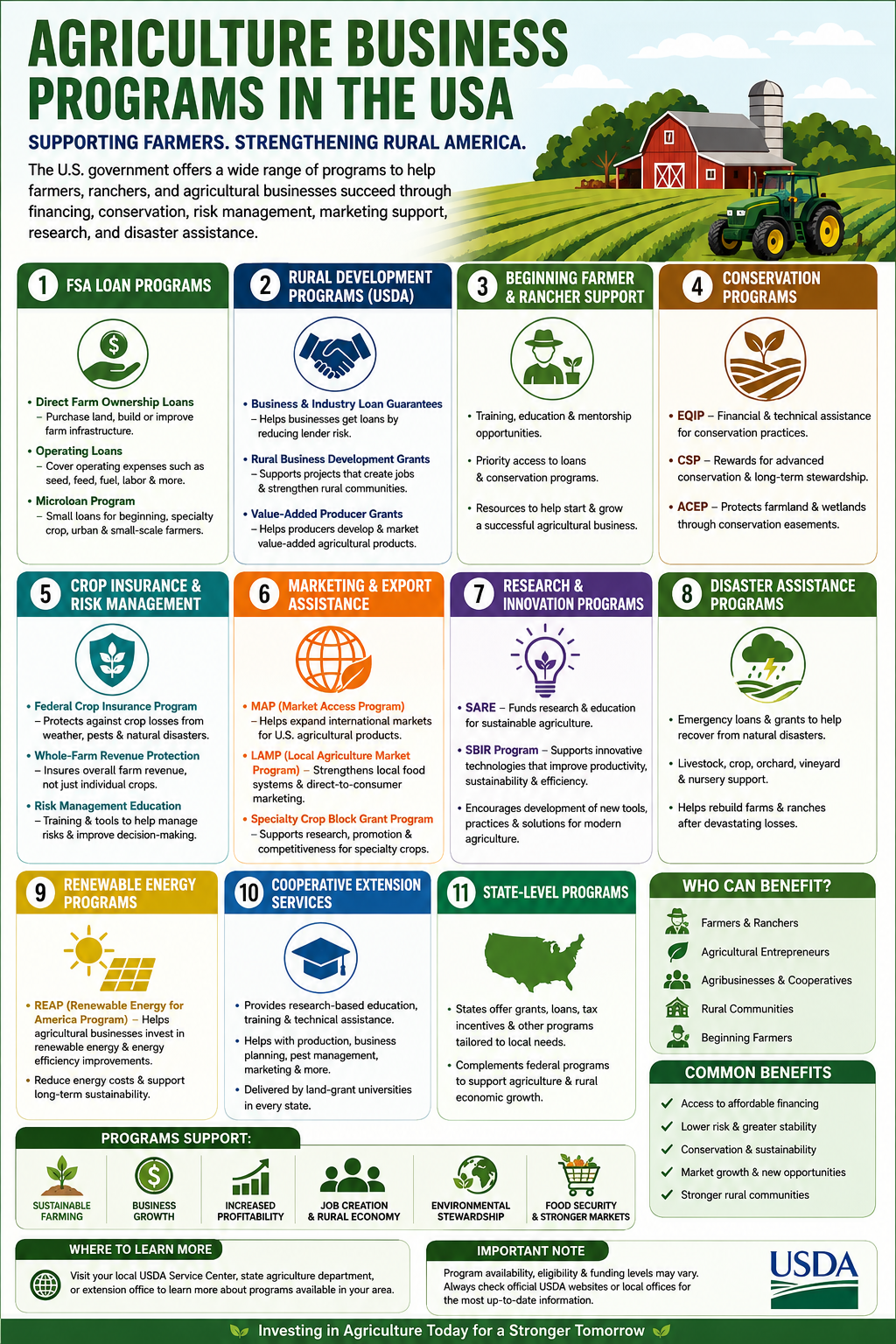
Table of Contents
ToggleThe Importance of Agriculture Business Programs in the United States
Agriculture is a unique industry because its success often depends on factors beyond the control of producers. Farmers must contend with droughts, floods, hurricanes, pests, diseases, fluctuating commodity prices, international trade policies, and changing consumer preferences. Unlike many businesses that can adjust production quickly in response to market conditions, agricultural operations often require months or years of planning and investment before products reach the market.
Agriculture business programs exist to reduce these risks and create opportunities for growth. They provide financial resources that help producers purchase land, acquire equipment, improve infrastructure, and manage operational expenses. They also encourage sustainable farming practices that protect natural resources while maintaining productivity.
Understanding the USDA’s Role in Agricultural Business Development
The United States Department of Agriculture (USDA) serves as the primary federal agency responsible for administering agricultural business programs. Through multiple agencies and departments, the USDA provides financial assistance, technical expertise, conservation support, disaster relief, research funding, and educational resources.
Several USDA agencies play key roles in supporting agricultural businesses. The Farm Service Agency (FSA) provides loans and financial assistance programs. The Natural Resources Conservation Service (NRCS) oversees conservation initiatives. USDA Rural Development supports economic growth in rural communities. The Risk Management Agency (RMA) administers crop insurance programs, while the Agricultural Marketing Service (AMS) helps producers access domestic and international markets.
USDA Farm Service Agency (FSA) Programs
The Farm Service Agency is one of the most important sources of financial assistance for farmers and agricultural entrepreneurs. FSA programs are particularly valuable for beginning farmers, small-scale producers, and operations that may have difficulty obtaining financing through conventional lenders.
Direct Farm Ownership Loans
Purchasing farmland is one of the largest investments an agricultural entrepreneur can make. Land prices in many parts of the United States have increased significantly over the years, creating substantial barriers for new and expanding farmers. The USDA’s Direct Farm Ownership Loan Program helps address this challenge by providing financing for the purchase, enlargement, or improvement of agricultural properties.
These loans can be used to buy farmland, construct buildings, improve water systems, develop irrigation infrastructure, and make other capital improvements that enhance productivity. The program is particularly beneficial for beginning farmers who may not qualify for traditional bank financing due to limited credit history or insufficient collateral.
Direct Farm Ownership Loans often feature favorable interest rates and flexible repayment terms, making farm ownership more attainable for qualified applicants. By supporting land acquisition and infrastructure development, these loans contribute to the long-term stability and growth of agricultural businesses.
Farm Operating Loans
Operating a farm requires substantial working capital throughout the year. Producers must purchase seed, fertilizer, feed, fuel, equipment parts, pesticides, livestock, and other essential inputs before generating income from their harvests or livestock sales.
Farm Operating Loans provide financial resources to cover these expenses and maintain business operations. The funds can also be used for labor costs, insurance premiums, equipment maintenance, and marketing expenses. Access to operating capital helps producers manage cash flow and maintain productivity during periods when revenue may be limited.
For many farms, operating loans are critical tools that support day-to-day business functions and enable continued growth despite seasonal income fluctuations.
USDA Microloan Program
The Microloan Program was developed to meet the needs of smaller agricultural operations that may not require large amounts of financing. This program is particularly popular among specialty crop growers, urban farmers, organic producers, direct-market operations, and beginning farmers.
The application process is generally simpler than traditional loan programs, making financing more accessible to individuals with limited borrowing experience. Microloans can be used for a variety of purposes, including equipment purchases, livestock acquisition, infrastructure improvements, and operational expenses.
The program encourages entrepreneurship and innovation within agriculture by helping small-scale producers establish and expand their businesses.
USDA Rural Development Programs
Agricultural success depends heavily on the strength of rural communities. USDA Rural Development programs focus on improving economic opportunities, infrastructure, and business growth throughout rural America.
Business and Industry Loan Guarantee Program
Access to affordable financing can be a major obstacle for agricultural businesses seeking expansion. The Business and Industry Loan Guarantee Program encourages private lenders to provide loans by reducing the financial risk associated with lending.
Under this program, the USDA guarantees a portion of eligible loans, making lenders more willing to finance agricultural projects. Businesses can use funds for land acquisition, equipment purchases, facility construction, modernization projects, and working capital needs.
This program supports economic development while helping agricultural enterprises grow, create jobs, and improve competitiveness.
Rural Business Development Grants
Rural Business Development Grants provide financial support for projects that strengthen rural economies and promote entrepreneurship. Agricultural businesses can use grant funding for strategic planning, workforce training, technology implementation, feasibility studies, and market development initiatives.
Unlike loans, grants generally do not require repayment, making them highly attractive sources of funding. These grants often support projects that improve operational efficiency, encourage innovation, and create new economic opportunities in rural communities.
Value-Added Producer Grants
Value-added agriculture involves transforming raw agricultural commodities into products with higher market value. Examples include converting milk into cheese, processing fruits into jams, producing packaged meat products, or creating specialty grain-based foods.
The Value-Added Producer Grant Program helps agricultural producers develop and market these products by providing funding for planning activities and working capital expenses. Businesses can use grants to conduct market research, develop business plans, launch new products, and expand processing capabilities.
Value-added strategies allow producers to increase profit margins, diversify income streams, and reduce dependence on commodity markets. For many agricultural entrepreneurs, these grants provide a pathway toward greater financial stability and business growth.
Beginning Farmer and Rancher Assistance Programs
One of the biggest concerns facing American agriculture is the aging farmer population. Encouraging new entrants into the industry is essential for maintaining long-term agricultural productivity and food security.
Beginning farmers often face significant barriers, including high land prices, limited access to capital, lack of experience, and difficulty securing financing. To address these challenges, several programs provide targeted support for new producers.
The Beginning Farmer and Rancher Development Program offers education, training, and mentorship opportunities that help participants build essential business and production skills. Topics often include financial management, marketing, business planning, risk management, and sustainable farming practices.
In addition to educational support, beginning farmers frequently receive priority access to certain USDA loan programs and conservation initiatives. These advantages help new producers establish viable businesses and contribute to the future of American agriculture.
Conservation Programs for Agricultural Businesses
Environmental sustainability has become increasingly important within modern agriculture. Conservation programs encourage producers to adopt practices that protect natural resources while maintaining profitability.
Environmental Quality Incentives Program (EQIP)
The Environmental Quality Incentives Program provides financial and technical assistance for conservation projects on agricultural land. Producers receive support for implementing practices that improve soil health, water quality, air quality, and wildlife habitat.
Common EQIP-funded projects include irrigation system upgrades, nutrient management plans, erosion control measures, livestock waste management systems, and conservation tillage practices. These improvements often enhance operational efficiency while reducing environmental impacts.
By sharing the costs of conservation investments, EQIP helps producers adopt sustainable practices that might otherwise be financially challenging.
Conservation Stewardship Program (CSP)
The Conservation Stewardship Program rewards producers who go beyond basic conservation requirements and implement advanced resource management practices. Participants receive financial incentives for maintaining and enhancing conservation efforts across their operations.
CSP encourages continuous improvement in areas such as soil health, water conservation, biodiversity, energy efficiency, and climate resilience. The program supports long-term stewardship while helping producers achieve environmental and economic objectives.
Agricultural Conservation Easement Program (ACEP)
Farmland loss due to urban development remains a significant concern in many regions of the United States. The Agricultural Conservation Easement Program helps protect agricultural land by providing financial assistance for conservation easements.
These agreements limit non-agricultural development while allowing landowners to continue farming. By preserving productive farmland, ACEP supports agricultural sustainability and protects valuable natural resources.
Crop Insurance and Risk Management Programs
Agricultural businesses face numerous risks that can threaten profitability and long-term viability. Crop insurance and risk management programs help producers navigate uncertainty and recover from unexpected losses.
Federal Crop Insurance Program
The Federal Crop Insurance Program provides protection against production losses caused by drought, floods, storms, pests, diseases, and other covered events. Producers can select coverage options that match their specific needs and risk tolerance.
Crop insurance helps stabilize farm income and provides financial security during difficult production years. Without this protection, many farms would face significant financial hardship following major losses.
Whole-Farm Revenue Protection
Whole-Farm Revenue Protection offers a unique approach by insuring overall farm revenue rather than individual crops. This coverage is particularly valuable for diversified farms that produce multiple commodities.
The program supports specialty crop growers, organic producers, and direct-market operations by providing flexible protection tailored to modern agricultural business models.
Risk Management Education Programs
Risk management involves more than insurance. Producers must also develop strategies for financial planning, marketing, production management, and disaster preparedness.
Risk Management Education Programs provide training and resources that help agricultural businesses identify risks and make informed decisions. These programs improve business resilience and support long-term success.
Agricultural Marketing and Export Assistance Programs
Producing agricultural commodities is only one part of running a successful business. Effective marketing is equally important for profitability and growth.
Market Access Program (MAP)
The Market Access Program helps agricultural organizations promote U.S. products in international markets. Through partnerships with trade associations and cooperatives, MAP supports advertising campaigns, trade missions, and market research activities.
International exports represent major revenue opportunities for many agricultural sectors, including grains, dairy products, meat, fruits, and specialty crops.
Local Agriculture Market Program (LAMP)
The Local Agriculture Market Program strengthens local and regional food systems by supporting direct marketing channels and supply chain development.
Funding may support food hubs, farmers markets, community-supported agriculture programs, and local food distribution networks. These initiatives help producers connect directly with consumers and retain a larger share of food dollars.
Specialty Crop Block Grant Program
Specialty crop producers face unique challenges related to production, marketing, and competition. The Specialty Crop Block Grant Program funds projects that improve competitiveness through research, education, promotion, and innovation.
Industries benefiting from these grants include fruit, vegetable, nut, nursery, and horticultural producers.
Agricultural Research and Innovation Programs
Innovation continues to transform modern agriculture. Advances in technology, biotechnology, automation, and data analytics are helping producers increase efficiency and sustainability.
Sustainable Agriculture Research and Education (SARE)
SARE supports research projects that address real-world agricultural challenges. Grants fund studies related to soil health, climate adaptation, integrated pest management, renewable energy, and sustainable production systems.
Many successful farming practices have emerged from research supported by SARE funding.
Small Business Innovation Research (SBIR) Program
The SBIR Program helps businesses develop innovative technologies that improve agricultural productivity and sustainability. Funded projects often involve precision agriculture tools, robotics, artificial intelligence applications, sensors, and advanced crop management systems.
These innovations help producers reduce costs, improve yields, and respond more effectively to changing market and environmental conditions.
Disaster Assistance Programs for Farmers and Ranchers
Natural disasters can have devastating impacts on agricultural businesses. Droughts, floods, hurricanes, wildfires, and severe storms can destroy crops, livestock, infrastructure, and equipment.
USDA disaster assistance programs help producers recover from these events by providing financial aid, emergency loans, and technical support. Livestock assistance programs compensate producers for losses related to grazing shortages, feed costs, and animal mortality.
Specialized programs also support orchard owners, vineyard operators, and nursery businesses that experience damage to trees, vines, or perennial crops. Disaster assistance plays a critical role in helping agricultural businesses rebuild and continue operations after catastrophic events.
Renewable Energy and Sustainability Programs
Renewable Energy for America Program (REAP)
Energy expenses represent a significant cost for many agricultural businesses. The Renewable Energy for America Program helps producers invest in renewable energy technologies and energy-efficiency improvements.
Eligible projects include solar panels, wind turbines, biomass systems, geothermal technologies, and energy-saving equipment upgrades. These investments reduce utility expenses, improve sustainability, and enhance long-term profitability.
As renewable energy adoption continues to grow, REAP remains an important resource for agricultural businesses seeking to lower operating costs and reduce environmental impacts.
The Role of Cooperative Extension Services
Cooperative Extension Services provide valuable educational resources to agricultural producers across the United States. Operated through land-grant universities, extension programs connect farmers with research-based information and practical expertise.
Extension agents assist producers with business planning, production management, pest control, financial analysis, marketing strategies, and technology adoption. They also offer workshops, field demonstrations, and training programs that support professional development.
For many agricultural entrepreneurs, extension services serve as trusted sources of information and guidance.
State-Level Agriculture Business Programs
In addition to federal initiatives, state governments offer a variety of agriculture business programs tailored to regional needs and priorities. These programs may include grants, low-interest loans, export assistance, specialty crop funding, conservation incentives, and workforce development initiatives.
Because agricultural industries vary significantly from one state to another, state-level programs often focus on specific commodities, production systems, or economic development goals. Producers should regularly consult state departments of agriculture to identify opportunities that complement federal assistance programs.
Future Trends in U.S. Agriculture Business Programs
Agriculture business programs continue to evolve as new challenges and opportunities emerge. Future initiatives are likely to focus heavily on climate-smart agriculture, carbon sequestration, regenerative farming practices, renewable energy adoption, precision agriculture technologies, and supply chain resilience.
Artificial intelligence, automation, robotics, remote sensing, and advanced data analytics are expected to play increasingly important roles in agricultural production. Government programs will likely continue supporting these innovations through grants, research funding, and technical assistance.
Additionally, sustainability and environmental stewardship will remain key priorities as policymakers seek to balance agricultural productivity with resource conservation. Programs that reward carbon reduction, water conservation, and biodiversity protection are expected to expand in the coming years.
Frequently Asked Questions (FAQs)
What are agriculture business programs?
Agriculture business programs are government-supported initiatives that provide loans, grants, technical assistance, conservation incentives, and risk management tools for farmers and agribusiness owners.
Who qualifies for USDA agriculture programs?
Eligibility varies by program, but farmers, ranchers, agricultural cooperatives, rural businesses, beginning farmers, and agricultural entrepreneurs may qualify.
Are grants available for agricultural businesses?
Yes. Several USDA and state programs offer grants for business development, value-added production, conservation projects, renewable energy investments, and marketing initiatives.
What is the USDA Microloan Program?
The Microloan Program provides smaller loans with simplified application requirements for beginning farmers, specialty crop producers, urban farmers, and small agricultural businesses.
How do conservation programs benefit farms?
Conservation programs provide financial assistance for practices that improve soil health, water quality, energy efficiency, and environmental sustainability.
What is the Value-Added Producer Grant Program?
This program helps producers create and market higher-value products derived from agricultural commodities, increasing profitability and market opportunities.
Does the USDA provide disaster assistance?
Yes. The USDA offers multiple disaster assistance programs that help producers recover from weather-related losses and natural disasters.
Where can farmers find information about available programs?
Farmers can visit local USDA Service Centers, Cooperative Extension offices, state agriculture departments, or official USDA websites for current program information.
References
- USDA Farm Service Agency (FSA): https://www.fsa.usda.gov
- USDA Rural Development: https://www.rd.usda.gov
- USDA Natural Resources Conservation Service (NRCS): https://www.nrcs.usda.gov
- USDA Risk Management Agency (RMA): https://www.rma.usda.gov
- USDA Sustainable Agriculture Research and Education (SARE): https://www.sare.org
- USDA Agricultural Marketing Service (AMS): https://www.ams.usda.gov
- National Institute of Food and Agriculture (NIFA): https://www.nifa.usda.gov
Disclaimer
Program Clarity is an independent informational website and is not affiliated with any government agency. This article is for educational purposes only. Program rules and availability may change. Always verify details with official authorities.