
Higher education continues to be one of the most significant investments individuals make in their future. Whether attending a community college, four-year university, graduate school, or vocational training program, educational expenses can quickly become overwhelming. Tuition, fees, housing, textbooks, transportation, and living expenses often create financial challenges for students and their families. Fortunately, federal financial aid programs help millions of students access higher education each year through grants, loans, scholarships, and work-study opportunities.
The starting point for obtaining most forms of federal student aid is the Free Application for Federal Student Aid (FAFSA). Every year, millions of students complete the FAFSA to determine their eligibility for financial assistance. However, many prospective applicants are uncertain about whether they qualify. Questions regarding income limits, citizenship status, dependency rules, academic performance requirements, and enrollment criteria often create confusion and discourage students from applying.
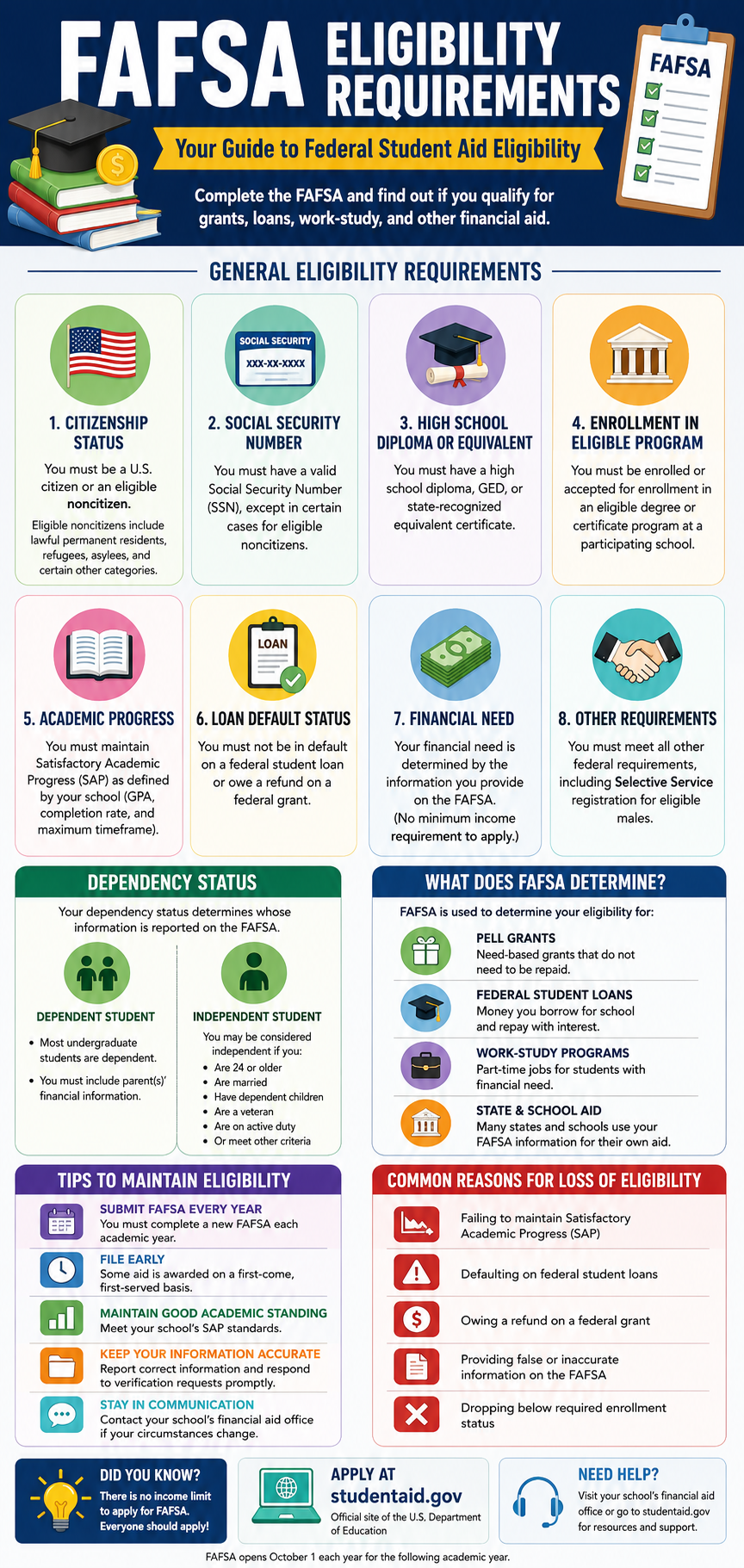
Table of Contents
ToggleThe good news is that FAFSA eligibility is broader than many people realize. There is no strict income cutoff that prevents students from applying, and various forms of aid are available for students from different financial backgrounds. Understanding the requirements before submitting an application can improve your chances of receiving financial assistance and help you avoid common mistakes that may delay or reduce your aid package.
What Is FAFSA ?
The Free Application for Federal Student Aid, commonly known as FAFSA, is the official form used by the U.S. Department of Education to determine a student’s eligibility for federal financial aid programs. FAFSA serves as the gateway to numerous financial resources that can significantly reduce the cost of attending college.
Completing the FAFSA allows students to be considered for federal grants, federal student loans, work-study opportunities, state financial aid programs, and institutional scholarships offered by colleges and universities. Many schools use FAFSA information to create customized financial aid packages that help students cover educational expenses.
Overview of FAFSA Eligibility Requirements
To qualify for federal student aid through FAFSA, applicants must meet several general eligibility requirements established by federal law. These requirements focus on citizenship status, educational qualifications, enrollment plans, academic progress, and financial standing.
Although individual aid programs may have additional criteria, most students must satisfy the following basic requirements:
- Be a U.S. citizen or eligible noncitizen
- Possess a valid Social Security Number in most cases
- Have earned a high school diploma, GED, or equivalent credential
- Be enrolled or accepted into an eligible degree or certificate program
- Maintain satisfactory academic progress
- Not be in default on qualifying federal student loans
- Not owe repayments on federal grants
- Meet other applicable federal requirements
Meeting these requirements does not automatically guarantee financial aid, but it allows students to be considered for available programs.
Citizenship and Residency Requirements
U.S. Citizens
Citizenship status is one of the first factors evaluated during the FAFSA process. Federal student aid programs are primarily designed to assist U.S. citizens and certain categories of eligible noncitizens. Students who are U.S. citizens by birth or naturalization generally satisfy this eligibility requirement and may apply for federal aid through FAFSA.
When completing the FAFSA, students must provide identifying information that allows the government to verify citizenship status through federal databases. In many cases, verification occurs automatically. However, if discrepancies arise, students may be asked to submit supporting documentation such as a birth certificate, passport, certificate of citizenship, or certificate of naturalization.
Accurate information is critical during this stage of the application process. Even minor errors involving names, dates of birth, or Social Security Numbers can cause delays. Students should carefully review all information before submission to ensure that it matches official government records.
Eligible Noncitizens
Federal financial aid is also available to certain noncitizens who meet specific immigration requirements. Eligible noncitizens typically include lawful permanent residents, refugees, asylees, individuals granted humanitarian protections, and certain other immigration categories recognized by federal law.
Students in these categories must provide valid documentation demonstrating their eligibility status. The Department of Education verifies immigration records through federal agencies to determine whether an applicant qualifies for aid.
Understanding immigration-related eligibility rules is particularly important because requirements can be complex. Students who are unsure about their status should consult their college’s financial aid office or review official federal guidance before submitting an application.
International Students
Most international students studying in the United States do not qualify for federal student aid through FAFSA. However, this does not necessarily mean they have no financial assistance options. Many colleges offer institutional grants, scholarships, and tuition assistance programs specifically designed for international students.
Although federal aid may not be available, students should research alternative funding sources provided by educational institutions, nonprofit organizations, and private scholarship programs.
Social Security Number Requirements
For most applicants, a valid Social Security Number is required when completing the FAFSA. The Social Security Number serves as a key identifier that allows federal agencies to verify personal information and financial records.
Students should ensure that their legal name, date of birth, and Social Security Number match exactly across all official records. Errors can lead to processing delays, requests for additional documentation, and potential complications during verification.
Parents of dependent students may also need to provide identifying information depending on the student’s dependency status and family circumstances.
Maintaining accurate records and reviewing information carefully before submission can help prevent common FAFSA processing issues.
Educational Qualification Requirements
High School Diploma or Equivalent
Federal student aid is intended for individuals pursuing postsecondary education. Therefore, students generally must demonstrate that they have completed secondary education through an approved pathway.
Most applicants satisfy this requirement by obtaining a high school diploma from an accredited institution. Alternatively, students may qualify through a GED certificate, state-recognized equivalent credential, or approved homeschooling documentation.
The purpose of this requirement is to ensure that recipients possess the educational foundation necessary to succeed in college-level coursework.
Homeschool Students
Homeschooled students may also qualify for federal financial aid. However, they must comply with state homeschooling regulations and provide appropriate documentation when requested.
Many homeschooled students successfully receive federal aid each year, provided they meet all other eligibility requirements.
Enrollment Requirements
Enrollment in an Eligible Program
One of the most important FAFSA eligibility requirements involves enrollment status. Students must be enrolled or accepted for enrollment in an eligible degree, diploma, or certificate program at a participating institution.
Federal aid is generally available only for programs that lead to recognized educational credentials. This includes associate degrees, bachelor’s degrees, graduate degrees, professional programs, and qualifying vocational certifications.
The institution itself must also participate in federal student aid programs. Most accredited colleges and universities meet this requirement, but students should verify participation before making enrollment decisions.
Regular Student Status
Federal regulations require applicants to be enrolled as regular students pursuing an educational credential. Individuals taking classes for personal enrichment or recreational purposes without seeking a degree or certificate may not qualify for federal financial aid.
This distinction ensures that aid funds support students actively working toward educational and career goals.
Part-Time and Full-Time Enrollment
Many students mistakenly believe they must attend school full-time to qualify for aid. In reality, part-time students may also receive federal assistance. However, enrollment status often affects award amounts.
Students enrolled full-time typically receive larger aid packages, while part-time students may receive prorated awards based on the number of credits taken. Understanding these differences can help students plan their educational schedules effectively.
Understanding Financial Need
How Financial Need Is Determined
Financial need plays a major role in determining eligibility for many federal aid programs. The FAFSA collects detailed financial information that helps calculate a student’s ability to contribute toward educational expenses.
The federal government uses a formula that considers numerous factors, including household income, assets, family size, tax information, and other financial circumstances. The result is known as the Student Aid Index (SAI).
Colleges use the Student Aid Index to evaluate financial need and determine aid eligibility. Lower SAIs generally indicate greater financial need and may result in larger grant awards.
There Is No FAFSA Income Limit
One of the most common myths surrounding FAFSA is the belief that families earning above a certain amount are automatically disqualified. This misconception prevents many students from applying.
In reality, there is no maximum income limit for filing the FAFSA. Students from virtually all income levels can submit an application and potentially qualify for some form of aid.
While higher-income families may not qualify for certain need-based grants, they may still be eligible for federal loans, merit scholarships, and institutional financial assistance.
Why Every Student Should Apply
Many students underestimate the value of completing the FAFSA. Even if a family expects limited need-based aid, submitting the application can unlock access to scholarships, work-study opportunities, unsubsidized loans, and school-specific grants.
Because FAFSA is often required for consideration of institutional aid, skipping the application could result in missed opportunities worth thousands of dollars.
Dependency Status and FAFSA Eligibility
What Is Dependency Status?
Dependency status determines whether students must report parental financial information on the FAFSA. This classification significantly affects aid calculations and eligibility outcomes.
Most traditional undergraduate students are considered dependent and must include information about their parents’ finances.
Independent Students
Certain students qualify as independent for FAFSA purposes. Independent students generally report only their own financial information and, if applicable, that of their spouse.
Students may qualify as independent if they:
- Are 24 years old or older
- Are married
- Have dependent children
- Are veterans
- Serve on active military duty
- Meet other qualifying criteria established by federal regulations
Independent status can substantially impact financial aid calculations and may increase eligibility for need-based assistance.
Academic Progress Requirements
Understanding Satisfactory Academic Progress
Receiving financial aid is not a one-time qualification. Students must continue meeting academic standards to remain eligible.
Federal regulations require colleges to evaluate Satisfactory Academic Progress (SAP). These standards ensure that students are making meaningful progress toward completing their educational programs.
SAP evaluations typically consider three key areas:
Grade Point Average
Students must maintain a minimum cumulative GPA established by their institution. Falling below this threshold can jeopardize aid eligibility.
Course Completion Rate
Students must successfully complete a certain percentage of attempted coursework. Excessive withdrawals, failures, or incomplete courses can negatively affect progress evaluations.
Maximum Timeframe
Federal aid is generally limited to a specific timeframe. Students cannot continue receiving aid indefinitely while pursuing the same credential.
Consequences of Failing SAP
Students who fail to meet SAP standards may receive warnings, probationary status, or suspension of financial aid eligibility.
Many schools offer appeal procedures for students facing exceptional circumstances such as illness, family emergencies, or personal hardships. Understanding institutional policies can help students protect their financial aid status.
Federal Student Loan Eligibility Requirements
Federal student loans are among the most popular forms of financial assistance available through FAFSA. To qualify, students must satisfy general FAFSA eligibility requirements and maintain enrollment in eligible programs.
Federal loans offer several advantages over private loans, including flexible repayment plans, deferment options, income-driven repayment programs, and potential forgiveness opportunities.
Students in default on existing federal loans may lose eligibility until they resolve outstanding obligations.
Pell Grant Eligibility Requirements
The Federal Pell Grant is one of the most valuable forms of financial aid because it does not require repayment.
Eligibility is primarily based on financial need as determined through FAFSA calculations. Students with lower Student Aid Index values generally receive larger Pell Grant awards.
Because Pell Grants provide direct financial assistance without creating debt, they are often considered a cornerstone of federal student aid programs.
Students should submit FAFSA as early as possible to maximize their opportunities for receiving grant assistance.
Common Reasons Students Lose FAFSA Eligibility
Although many students initially qualify for aid, certain actions can result in the loss of eligibility.
Common reasons include:
- Failing to maintain satisfactory academic progress
- Defaulting on federal student loans
- Owing repayments on federal grants
- Providing inaccurate information on FAFSA
- Failing verification requirements
- Dropping below required enrollment levels
Understanding these risks can help students protect their financial aid throughout their educational careers.
Tips for Maintaining FAFSA Eligibility
Submit FAFSA Every Year
Financial aid eligibility is reassessed annually. Students must complete a new FAFSA each academic year to continue receiving aid.
File Early
Many aid programs operate on limited funding. Submitting FAFSA early can improve access to grants and scholarships before resources are exhausted.
Maintain Strong Academic Performance
Consistently meeting GPA and course completion requirements helps ensure continued eligibility for federal aid.
Keep Financial Records Organized
Students should retain copies of tax documents, FAFSA confirmations, financial aid letters, and verification materials.
Proper organization simplifies future applications and reduces processing delays.
Communicate With Your Financial Aid Office
Students experiencing financial hardship, family emergencies, or significant life changes should contact their financial aid office promptly. Schools often have procedures to review special circumstances and adjust aid eligibility when appropriate.
Frequently Asked Questions
Who is eligible to apply for FAFSA?
Students who are U.S. citizens or eligible noncitizens, possess the required educational credentials, and plan to enroll in an eligible program generally qualify to submit FAFSA.
Is there an income limit for FAFSA?
No. There is no maximum income limit that prevents students from filing FAFSA.
Can part-time students receive federal aid?
Yes. Part-time students may qualify for federal aid, although award amounts may differ from those received by full-time students.
Do graduate students qualify for FAFSA?
Yes. Graduate and professional students can use FAFSA to apply for federal student loans and other eligible aid programs.
What is the Student Aid Index (SAI)?
The Student Aid Index is a calculation used to determine a student’s financial need and eligibility for certain forms of federal aid.
Can I lose FAFSA eligibility?
Yes. Students may lose eligibility due to poor academic performance, federal loan default, grant repayment obligations, or failure to meet verification requirements.
Should high-income families complete FAFSA?
Absolutely. Many forms of aid, including federal loans and institutional scholarships, may still be available regardless of income level.
How often must FAFSA be completed?
Students must submit a new FAFSA each academic year to maintain eligibility for federal financial aid.
References
- https://studentaid.gov
- https://fsapartners.ed.gov
- https://financialaidtoolkit.ed.gov
- https://www.bestcolleges.com/resources/fafsa/
- https://www.forbes.com/advisor/student-loans/fafsa-income-limits/
- https://www.nerdwallet.com/article/loans/student-loans/fafsa-requirements
- https://www.collegeboard.org
Disclaimer
Program Clarity is an independent informational website and is not affiliated with any government agency. This article is for educational purposes only. Program rules and availability may change. Always verify details with official authorities.