Introduction
Paying for higher education is one of the biggest financial challenges students face today. Tuition fees, books, accommodation, transportation, and other educational expenses can quickly become overwhelming. Fortunately, federal scholarships provide an excellent opportunity for students to reduce or even eliminate these costs without taking on student loan debt.
Unlike loans, federal scholarships do not need to be repaid, making them one of the most valuable forms of financial assistance available. They are funded by government agencies or supported through federally sponsored programs designed to help deserving students pursue higher education regardless of their financial background.
Many students mistakenly believe that federal scholarships are only available to top-performing students or those with exceptional athletic abilities. In reality, there are numerous federal scholarship opportunities based on academic achievement, financial need, career goals, military service, public service, research interests, and many other factors.
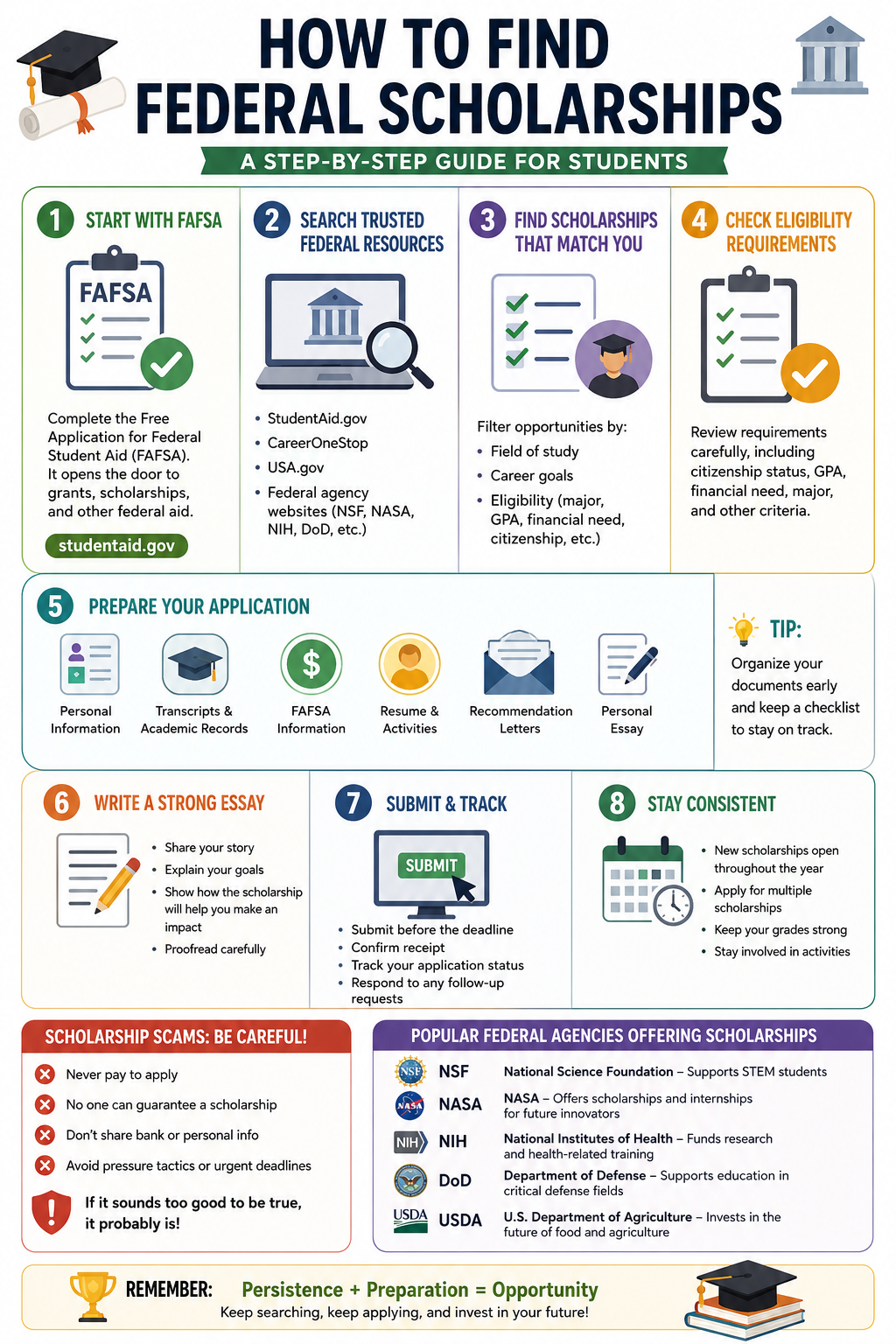
Learning how to find federal scholarships requires more than simply searching online. Students need to understand where legitimate scholarships are listed, how eligibility requirements work, how the Free Application for Federal Student Aid (FAFSA) connects to federal funding, and how to avoid scholarship scams.
This comprehensive guide explains everything you need to know about finding federal scholarships, locating trustworthy resources, understanding eligibility requirements, and preparing a successful scholarship search strategy.
What Are Federal Scholarships?
Federal scholarships are financial awards supported directly or indirectly by the United States federal government. These scholarships are intended to help eligible students pay for college or university expenses without requiring repayment.
Federal scholarships differ from:
- Student loans
- State scholarships
- Institutional scholarships
- Private scholarships
- Employer-sponsored scholarships
Although relatively few scholarships are awarded directly by federal agencies, many federal departments sponsor educational funding programs, fellowships, grants, and scholarship initiatives for students pursuing specific careers or serving particular communities.
Federal scholarship opportunities often prioritize:
- Financial need
- Academic excellence
- STEM education
- Healthcare professions
- Education careers
- Military families
- Public service
- Research
- Agriculture
- Environmental sciences
Why Federal Scholarships Matter
Federal scholarships provide several advantages over other funding sources.
Reduce Student Debt
Every scholarship dollar received is money that does not need to be borrowed. Graduating with less debt gives students greater financial freedom after college.
Support Career Development
Many federally sponsored scholarships encourage students to enter high-demand careers such as:
- Teaching
- Nursing
- Engineering
- Cybersecurity
- Scientific research
- Public health
- Agriculture
Some programs also include internships, mentorships, and professional development opportunities.
Improve College Affordability
Federal scholarships can cover expenses such as:
- Tuition
- Mandatory fees
- Housing
- Meal plans
- Books
- Laboratory fees
- Technology expenses
- Research costs
Federal Scholarships vs Federal Grants
Many students confuse scholarships with grants.
Although both forms of aid generally do not require repayment, there are important differences.
| Federal Scholarships | Federal Grants |
|---|---|
| Often merit-based | Usually need-based |
| May require essays or applications | Often awarded automatically after FAFSA |
| Can focus on specific careers | Primarily based on financial need |
| May involve service commitments | Usually no service obligation |
| Awarded by agencies or organizations | Primarily distributed through colleges |
Examples of federal grants include:
- Federal Pell Grant
- TEACH Grant
- Iraq and Afghanistan Service Grant
- Federal Supplemental Educational Opportunity Grant (FSEOG)
Understanding FAFSA Before Searching for Scholarships
One of the biggest mistakes students make is skipping the FAFSA.
The Free Application for Federal Student Aid (FAFSA) is the starting point for most federal financial aid.
Many scholarship programs also require FAFSA completion because it helps determine financial need.
Completing FAFSA may qualify students for:
- Federal grants
- Federal work-study
- Federal student loans
- Institutional scholarships
- Need-based scholarships
- State financial aid
Even students who believe they will not qualify should complete the FAFSA because many scholarships use FAFSA information during the selection process.
Official FAFSA website:
https://studentaid.gov/h/apply-for-aid/fafsa
Types of Federal Scholarships
Federal scholarships come in many forms depending on the sponsoring agency and educational objectives.
Academic Merit Scholarships
These scholarships reward students with outstanding academic performance.
Selection factors may include:
- GPA
- Standardized test scores
- Class ranking
- Academic achievements
- Leadership
STEM Scholarships
The federal government actively supports education in:
- Science
- Technology
- Engineering
- Mathematics
Students entering these fields may find scholarships sponsored by agencies including:
- National Science Foundation (NSF)
- Department of Defense
- NASA
- Department of Energy
These programs often encourage research and innovation.
Healthcare Scholarships
Healthcare professionals remain in high demand across the United States.
Federal healthcare scholarship programs support careers including:
- Nursing
- Medicine
- Dentistry
- Public health
- Pharmacy
- Behavioral health
Some programs require recipients to work in underserved communities after graduation.
Education Scholarships
Future teachers may qualify for federally supported financial aid programs encouraging graduates to teach in high-need schools.
These scholarships help address teacher shortages nationwide.
Military Scholarships
Military families often qualify for federal educational assistance.
Scholarship opportunities may be available for:
- Veterans
- Active-duty service members
- Reservists
- National Guard members
- Military spouses
- Dependents
Public Service Scholarships
Students planning careers in government service may qualify for scholarships supporting fields such as:
- Criminal justice
- Homeland security
- Emergency management
- Public administration
- Intelligence studies
Where to Find Legitimate Federal Scholarships
Finding trustworthy scholarship opportunities is essential.
Many websites advertise scholarships that either no longer exist or are scams.
Below are the best official sources.
Federal Student Aid Website
The Federal Student Aid website is the most authoritative source for federal financial aid information.
Students can learn about:
- Federal grants
- Federal loans
- Work-study
- Scholarship resources
- FAFSA
This website also links students to additional federal programs.
Official website:
CareerOneStop Scholarship Finder
CareerOneStop is sponsored by the U.S. Department of Labor.
It includes thousands of scholarships searchable by:
- State
- Occupation
- Education level
- Background
- Military status
This is one of the most reliable scholarship databases available.
Website:
USA.gov Education Resources
USA.gov provides official government information on education funding, grants, scholarships, and financial aid.
Students can locate verified federal resources without relying on third-party websites.
Website:
Individual Federal Agencies
Many government agencies sponsor educational funding related to their missions.
Examples include:
National Science Foundation (NSF)
Supports research and STEM education.
National Institutes of Health (NIH)
Provides scholarships, internships, and research opportunities.
Department of Energy (DOE)
Supports students interested in engineering, physics, environmental science, and energy research.
NASA
Offers scholarships, fellowships, internships, and educational programs for STEM students.
Department of Defense (DoD)
Sponsors numerous scholarships in cybersecurity, engineering, mathematics, and defense-related fields.
College Financial Aid Offices
Your college’s financial aid office is one of the best resources for identifying federally funded scholarships available specifically through your institution.
Financial aid counselors can explain:
- Eligibility requirements
- Deadlines
- FAFSA verification
- Scholarship combinations
- Renewal requirements
How to Search Efficiently
Searching randomly wastes time.
Instead, organize your search using categories.
Search based on:
- Major
- Degree level
- Career goals
- State
- Income level
- Veteran status
- Disabilities
- Ethnicity (where applicable)
- Community service
- Research interests
Maintain a spreadsheet tracking:
- Scholarship name
- Deadline
- Website
- Requirements
- Award amount
- Status
This prevents missing important deadlines.
How to Determine Eligibility
Every scholarship has unique requirements.
Common eligibility factors include:
Citizenship
Many federal scholarships require applicants to be:
- U.S. citizens
- Permanent residents
- Eligible non-citizens
Enrollment Status
Applicants may need to be:
- Full-time students
- Part-time students
- Undergraduate students
- Graduate students
- Professional students
Academic Performance
Some scholarships require minimum GPAs such as:
- 3.0
- 3.25
- 3.5
Others evaluate overall academic achievement rather than a strict GPA requirement.
Financial Need
Need-based scholarships typically evaluate:
- Family income
- Household size
- FAFSA data
- Expected Student Aid Index (SAI)
Field of Study
Certain scholarships are limited to students pursuing degrees in specific disciplines, such as:
- Nursing
- Computer Science
- Engineering
- Agriculture
- Education
- Environmental Science
- Public Health
- Mathematics
Selecting scholarships aligned with your intended major significantly increases your chances of success.
Build a Scholarship Search Schedule
Successful applicants treat scholarship searching like a regular commitment rather than a one-time activity.
Consider setting aside dedicated time each week to:
- Search for newly posted federal scholarship opportunities.
- Review eligibility requirements carefully.
- Update your scholarship tracking spreadsheet.
- Gather required documents such as transcripts or recommendation letters.
- Monitor application deadlines.
- Complete applications well before the due date.
Consistent effort throughout the year often leads to better results than rushing to submit multiple applications close to deadlines.
How to Prepare a Strong Federal Scholarship Application
Finding the right scholarship is only the first step. A well-prepared application greatly improves your chances of receiving federal financial aid. Carefully read all instructions, confirm your eligibility, and submit your application before the deadline.
Before applying, create a checklist that includes:
- Scholarship deadline
- Required documents
- Essay requirements
- Recommendation letters
- FAFSA completion
- Submission confirmation
Submitting your application early gives you enough time to fix mistakes and avoid technical issues.
Documents You’ll Need
Most federal scholarship applications require supporting documents such as:
- Government-issued identification
- Academic transcripts
- FAFSA Submission Summary (if required)
- Resume or CV
- Financial documents (for need-based scholarships)
- Recommendation letters
Prepare these documents in advance to simplify the application process.
Writing a Strong Scholarship Essay
A scholarship essay helps reviewers understand your goals and achievements beyond your grades.
To write an effective essay:
- Begin with an engaging introduction.
- Share personal experiences and accomplishments.
- Explain your educational and career goals.
- Describe how the scholarship will help you succeed.
- Proofread carefully before submitting.
Customize each essay for the specific scholarship instead of using the same essay for every application.
Recommendation Letters
Many scholarship programs require recommendation letters from teachers, professors, employers, or mentors.
Choose recommenders who know your abilities well and can provide detailed examples of your academic performance, leadership, or community involvement.
Request recommendation letters several weeks before the application deadline.
Common Mistakes to Avoid
Avoid these common errors when applying:
- Missing deadlines
- Applying without meeting eligibility requirements
- Submitting incomplete applications
- Using generic essays
- Ignoring proofreading
Taking time to review your application can significantly improve your chances of success.
How to Avoid Scholarship Scams
Legitimate federal scholarships never charge application fees.
Be cautious of websites or organizations that:
- Guarantee scholarship awards
- Ask for payment
- Request sensitive financial information before selection
- Pressure you to apply immediately
Use trusted government resources such as StudentAid.gov, CareerOneStop, and USA.gov to verify scholarship opportunities.
Tips to Improve Your Chances
Increase your chances of winning by:
- Applying early
- Completing the FAFSA
- Maintaining good grades
- Participating in extracurricular activities
- Applying for multiple scholarships
- Tailoring each application to the scholarship requirements
Consistency and preparation often lead to better results.
Can International Students Apply?
Most federal scholarships are limited to U.S. citizens and eligible non-citizens. International students should explore university scholarships, private organizations, and exchange programs for additional funding opportunities.
Scholarship Renewal
Some federal scholarships are renewable each academic year if students:
- Maintain the required GPA
- Stay enrolled full-time
- Meet satisfactory academic progress standards
- Continue to satisfy program requirements
Always review the renewal conditions before accepting a scholarship.
Frequently Asked Questions (FAQs)
What are federal scholarships?
Federal scholarships are financial awards funded by the U.S. government or federal agencies to help eligible students pay for college without repayment.
Do I need to complete the FAFSA?
Yes. Many federal scholarships and grants require a completed FAFSA to determine financial need.
Are federal scholarships only for students with financial need?
No. Some scholarships are based on academic achievement, leadership, community service, or a specific field of study.
Can I receive more than one scholarship?
Yes. Many students receive multiple scholarships and grants, depending on their eligibility and their school’s financial aid policies.
Is it free to apply for federal scholarships?
Yes. Legitimate federal scholarship programs do not charge application fees.
Official Reference Links
- Federal Student Aid: https://studentaid.gov/
- FAFSA Application: https://studentaid.gov/h/apply-for-aid/fafsa
- CareerOneStop Scholarship Finder: https://www.careeronestop.org/Toolkit/Training/find-scholarships.aspx
- USA.gov Education: https://www.usa.gov/education
- National Science Foundation: https://www.nsf.gov/
- NASA STEM: https://www.nasa.gov/stem/
Disclaimer
Program Clarity is an independent informational website and is not affiliated with any government agency. This article is for educational purposes only. Program rules and availability may change. Always verify details with official authorities.