

Introduction
Whether you are planning to attend college, start a business, expand an existing company, conduct research, or recover from financial hardship, finding the right source of funding is one of the most important decisions you will make. Two of the most common funding options available are Grants vs. Loans. While both provide access to money, they work in very different ways and come with unique responsibilities, eligibility requirements, and long-term financial implications.
Many people mistakenly assume that grants and loans are interchangeable because they both provide financial support. In reality, they serve different purposes. Grants are typically awarded by governments, educational institutions, nonprofit organizations, or private foundations and generally do not require repayment if all conditions are met. Loans, on the other hand, are borrowed funds that must be repaid over time, usually with interest.
What Are Grants?
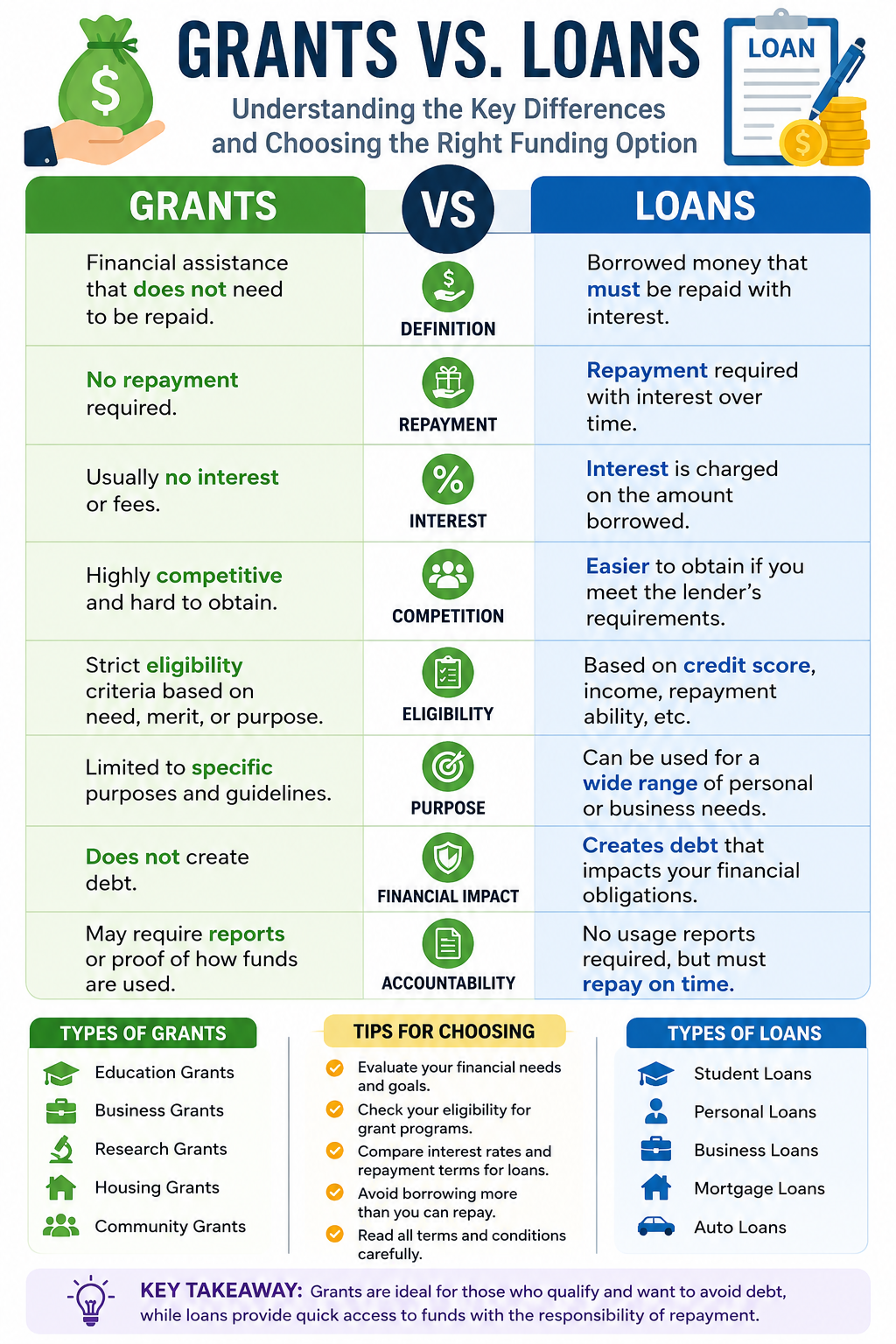
A grant is financial assistance provided by a government agency, educational institution, nonprofit organization, corporation, or private foundation. Unlike most forms of financing, grants generally do not have to be repaid, provided the recipient follows all terms and conditions.
Grants are designed to support specific objectives rather than generate profits for the funding organization. They often encourage education, scientific research, healthcare improvements, economic development, environmental conservation, small business innovation, disaster recovery, and community development.
Grant providers usually establish clear eligibility requirements. Applicants may need to demonstrate financial need, academic achievement, business potential, research value, or community impact. Some grants also require recipients to submit progress reports or use the funds only for approved purposes.
Because grants represent free financial assistance rather than borrowed money, they are highly competitive. Funding organizations frequently receive far more applications than available awards, making preparation and documentation essential.
Common Types of Grants
Grants are available across many sectors, each serving different funding purposes.
Educational Grants
Educational grants help students pay for tuition, books, housing, transportation, and other education-related expenses. Many are awarded based on financial need, while others recognize academic achievement or specific career goals.
Examples include:
- Federal education grants
- State-funded student grants
- Institutional grants
- Minority education grants
- STEM education grants
Small Business Grants
Governments and private organizations frequently offer grants to encourage innovation, job creation, technology development, and economic growth.
Business grants may support:
- Startup costs
- Research and development
- Rural businesses
- Women-owned businesses
- Veteran-owned businesses
- Minority-owned businesses
- Environmental projects
Unlike business loans, grant funds generally do not require repayment when used according to program guidelines.
Research Grants
Universities, healthcare institutions, and government agencies provide research grants to support scientific discoveries and technological innovation.
Research grants commonly fund:
- Medical studies
- Environmental research
- Engineering projects
- Agricultural innovation
- Social science research
- Public health initiatives
Housing Grants
Housing grants help eligible individuals improve living conditions or purchase homes. Programs may assist with home repairs, accessibility improvements, energy efficiency upgrades, or down payment assistance.
Community Development Grants
These grants support nonprofit organizations, municipalities, and community groups working to improve neighborhoods through education, healthcare, housing, environmental protection, workforce development, and public infrastructure.
What Are Loans?
A loan is money borrowed from a financial institution, government agency, credit union, online lender, or private lender that must be repaid according to agreed terms.
Loan repayment typically includes:
- Principal amount
- Interest charges
- Applicable fees
Loan agreements specify repayment schedules, interest rates, loan duration, payment frequency, and borrower responsibilities.
Unlike grants, loans provide broader access to funding because they are not limited by charitable or public funding objectives. However, borrowers assume legal responsibility for repayment regardless of financial circumstances unless special relief programs apply.
Common Types of Loans
Student Loans
Student loans help individuals finance higher education expenses.
These loans may cover:
- Tuition
- Books
- Housing
- Meal plans
- Transportation
- Educational equipment
Student loans often offer lower interest rates and flexible repayment options compared with many personal loans.
Personal Loans
Personal loans provide funding for various purposes, including:
- Medical expenses
- Emergency costs
- Weddings
- Home improvements
- Debt consolidation
- Major purchases
Most personal loans are unsecured, meaning they do not require collateral.
Business Loans
Business loans help entrepreneurs finance:
- Startup expenses
- Equipment purchases
- Inventory
- Payroll
- Marketing
- Expansion projects
- Commercial property
Business loans may be secured or unsecured depending on lender requirements.
Mortgage Loans
Mortgage loans finance residential property purchases and are repaid over many years through scheduled monthly payments.
Auto Loans
Auto loans allow consumers to purchase vehicles while repaying the balance through fixed monthly installments.
Grants vs. Loans: Key Differences
Although both provide financial assistance, they differ significantly in purpose, repayment, qualification, and financial impact.
| Feature | Grants | Loans |
|---|---|---|
| Repayment Required | Usually No | Yes |
| Interest Charges | None | Usually Yes |
| Financial Risk | Low | Higher |
| Competition | High | Moderate |
| Credit Check | Rarely | Often Required |
| Funding Source | Government, nonprofits, foundations | Banks, lenders, government |
| Purpose Restrictions | Usually Specific | Often Flexible |
| Long-Term Debt | None | Yes |
| Application Difficulty | Often Competitive | Depends on lender |
| Reporting Requirements | Sometimes Required | Regular repayments required |
Advantages of Grants
Grants offer numerous benefits that make them one of the most desirable funding sources.
No Repayment
The greatest advantage is that recipients generally do not have to repay awarded funds, reducing long-term financial obligations.
No Interest
Unlike loans, grants do not accumulate interest, making them a cost-effective funding option.
Reduced Financial Stress
Students and businesses receiving grants can focus on education or growth rather than monthly loan payments.
Encourages Innovation
Governments frequently use grants to promote technological advancement, healthcare improvements, environmental sustainability, and entrepreneurship.
Supports Underserved Communities
Many grant programs specifically target underrepresented groups, rural communities, women entrepreneurs, veterans, and nonprofit organizations.
Disadvantages of Grants
Despite their benefits, grants also present several challenges.
Highly Competitive
Many grant programs receive thousands of applications while funding only a limited number of recipients.
Strict Eligibility Requirements
Applicants must often meet detailed financial, educational, geographic, or organizational criteria.
Limited Funding
Grant amounts may not fully cover project costs, requiring recipients to seek additional funding.
Restricted Use
Grant money usually must be spent only on approved activities.
Extensive Documentation
Applications frequently require detailed proposals, budgets, financial records, and supporting documentation.
Advantages of Loans
Loans provide flexibility and accessibility for individuals and organizations that may not qualify for grants.
Greater Funding Availability
Loans are available throughout the year from numerous financial institutions.
Faster Approval
Many lenders process applications much more quickly than grant organizations.
Flexible Spending
Depending on the loan type, borrowers can often use funds for a wide variety of purposes.
Builds Credit History
Responsible repayment can improve a borrower’s credit profile over time.
Supports Large Purchases
Loans make significant investments such as homes, vehicles, education, and business expansion possible.
Disadvantages of Loans
Loans also create financial responsibilities that borrowers must carefully consider.
Interest Costs
Interest increases the total amount repaid over the life of the loan.
Debt Obligations
Borrowers remain legally responsible for repayment even if their financial circumstances change.
Credit Requirements
Many lenders evaluate credit scores, income, and repayment history before approving applications.
Possible Fees
Loans may include:
- Origination fees
- Late payment fees
- Prepayment penalties
- Collection costs
Financial Risk
Missed payments may damage credit scores and increase borrowing costs in the future.
Eligibility Requirements for Grants
Grant eligibility varies widely depending on the funding organization and program objectives.
Common requirements include:
- Demonstrated financial need
- Academic achievement
- Business ownership
- Research proposals
- Community impact
- Geographic location
- Industry focus
- Citizenship or residency requirements
- Organizational status for nonprofits
Applicants should carefully review all eligibility criteria before investing time in preparing an application.
Eligibility Requirements for Loans
Lenders primarily assess a borrower’s ability to repay the loan.
Common factors include:
- Credit score
- Income
- Employment history
- Existing debt
- Debt-to-income ratio
- Collateral (for secured loans)
- Business financial statements
- Tax returns
- Bank statements
Meeting these requirements improves approval chances and may help borrowers secure lower interest rates.
How to Apply for Grants
Applying for grants often involves a structured process.
- Identify suitable grant programs.
- Review eligibility requirements carefully.
- Gather financial and supporting documents.
- Prepare a detailed proposal or application.
- Develop a realistic project budget.
- Submit all required forms before deadlines.
- Respond promptly to additional information requests.
- Comply with reporting requirements if awarded funding.
A well-prepared application significantly improves the likelihood of success.
How to Apply for Loans
Loan applications are generally more straightforward.
Typical steps include:
- Determine how much funding you need.
- Compare lenders and loan options.
- Review interest rates and repayment terms.
- Gather financial documents.
- Submit the application.
- Undergo credit evaluation.
- Review the loan agreement carefully.
- Accept funds and begin repayment according to schedule.
Borrowers should always read the full loan agreement before signing.
When Should You Choose a Grant?
A grant may be the better choice when:
- You qualify for available funding programs.
- Your project meets grant objectives.
- You want to avoid long-term debt.
- Funding is intended for education, research, nonprofit work, or innovation.
- You can meet reporting and compliance requirements.
Because grants do not usually require repayment, they should generally be pursued before considering loans whenever practical.
When Should You Choose a Loan?
A loan may be more appropriate when:
- Funding is needed quickly.
- Grant opportunities are unavailable.
- You require more funding than grants provide.
- Your expenses fall outside grant guidelines.
- You have reliable income for repayment.
- You need flexible access to capital.
Loans can be valuable financial tools when used responsibly and matched to a realistic repayment plan.
Can You Use Both Grants and Loans?
Yes. Many individuals and organizations successfully combine grants and loans to meet funding needs.
For example:
- College students may receive grants that cover part of their tuition while using student loans for remaining expenses.
- Small businesses may secure innovation grants while financing equipment purchases through business loans.
- Homeowners may combine energy-efficiency grants with low-interest financing for larger renovation projects.
Using both funding sources strategically can reduce borrowing while ensuring sufficient financial support.
Common Mistakes to Avoid
Applicants and borrowers frequently make avoidable mistakes that reduce their chances of success or increase financial risk.
Some of the most common include:
- Missing application deadlines.
- Failing to meet eligibility requirements.
- Borrowing more than necessary.
- Ignoring interest rates.
- Overlooking repayment obligations.
- Submitting incomplete applications.
- Failing to maintain required documentation.
- Not comparing multiple funding options.
- Misusing grant funds.
- Neglecting long-term financial planning.
Careful preparation and research can help avoid these issues.
Tips for Choosing Between Grants and Loans
Choosing the right funding option depends on your goals, financial situation, and eligibility.
Consider the following tips:
- Always search for grants before borrowing.
- Compare multiple funding sources.
- Understand all repayment obligations.
- Calculate the total borrowing cost, including interest.
- Review all application requirements carefully.
- Maintain organized financial records.
- Avoid taking on unnecessary debt.
- Seek professional financial advice for large funding decisions.
- Read all terms and conditions before accepting funding.
A thoughtful approach can help you maximize financial assistance while minimizing long-term costs.
Frequently Asked Questions
Are grants really free money?
In most cases, yes. Grants generally do not require repayment if recipients comply with all program rules and use the funds for approved purposes.
Do all loans charge interest?
Most loans include interest, although some government-supported programs may offer subsidized or low-interest options.
Can I apply for both grants and loans?
Yes. Many students, businesses, researchers, and nonprofits use both grants and loans to finance their goals.
Do grants affect my credit score?
No. Receiving a grant does not typically impact your credit history because grants are not borrowed funds.
Can loan applications be denied?
Yes. Lenders may deny applications based on factors such as credit history, income, existing debt, or insufficient documentation.
Are business grants difficult to obtain?
Business grants are often highly competitive, but well-prepared applications that align with funding objectives have a stronger chance of success.
Should I always choose a grant over a loan?
If you qualify and the grant meets your funding needs, it is generally preferable because it usually does not require repayment. However, grants may not always provide enough funding or be available when needed.
References
- U.S. Department of Education – Federal Student Aid: https://studentaid.gov/
- Grants.gov – Federal Grant Opportunities: https://www.grants.gov/
- U.S. Small Business Administration (SBA): https://www.sba.gov/
- USA.gov – Government Benefits and Financial Assistance: https://www.usa.gov/
- Consumer Financial Protection Bureau (CFPB): https://www.consumerfinance.gov/
- Federal Trade Commission (FTC): https://www.ftc.gov/
- National Institutes of Health (NIH) Grants: https://grants.nih.gov/
- U.S. Department of Housing and Urban Development (HUD): https://www.hud.gov/
Disclaimer
Program Clarity is an independent informational website and is not affiliated with any government agency. This article is for educational purposes only. Program rules and availability may change. Always verify details with official authorities.