
Single parents face unique challenges when pursuing education. Balancing childcare responsibilities, work commitments, household expenses, and academic requirements can seem overwhelming. However, obtaining a degree, certification, or vocational qualification remains one of the most effective ways to improve financial stability and create better opportunities for both parents and their children. Education can open doors to higher-paying careers, increased job security, and greater professional growth, helping single-parent families build a stronger future.
Many single parents delay or abandon educational goals because they assume college or professional training is too expensive or time-consuming. While these concerns are understandable, numerous programs and resources exist specifically to support student parents. Governments, colleges, nonprofit organizations, employers, and community groups offer grants, scholarships, childcare assistance, flexible learning opportunities, and academic support services designed to make education more accessible.
The educational landscape has also changed significantly in recent years. Online learning, hybrid programs, evening classes, and accelerated degree options provide greater flexibility than ever before. These opportunities allow single parents to pursue academic goals without sacrificing family responsibilities. Whether someone is returning to school after many years, pursuing a first degree, seeking a career change, or obtaining additional professional certifications, there are resources available to help overcome common barriers.
Why Education Matters for Single Parents
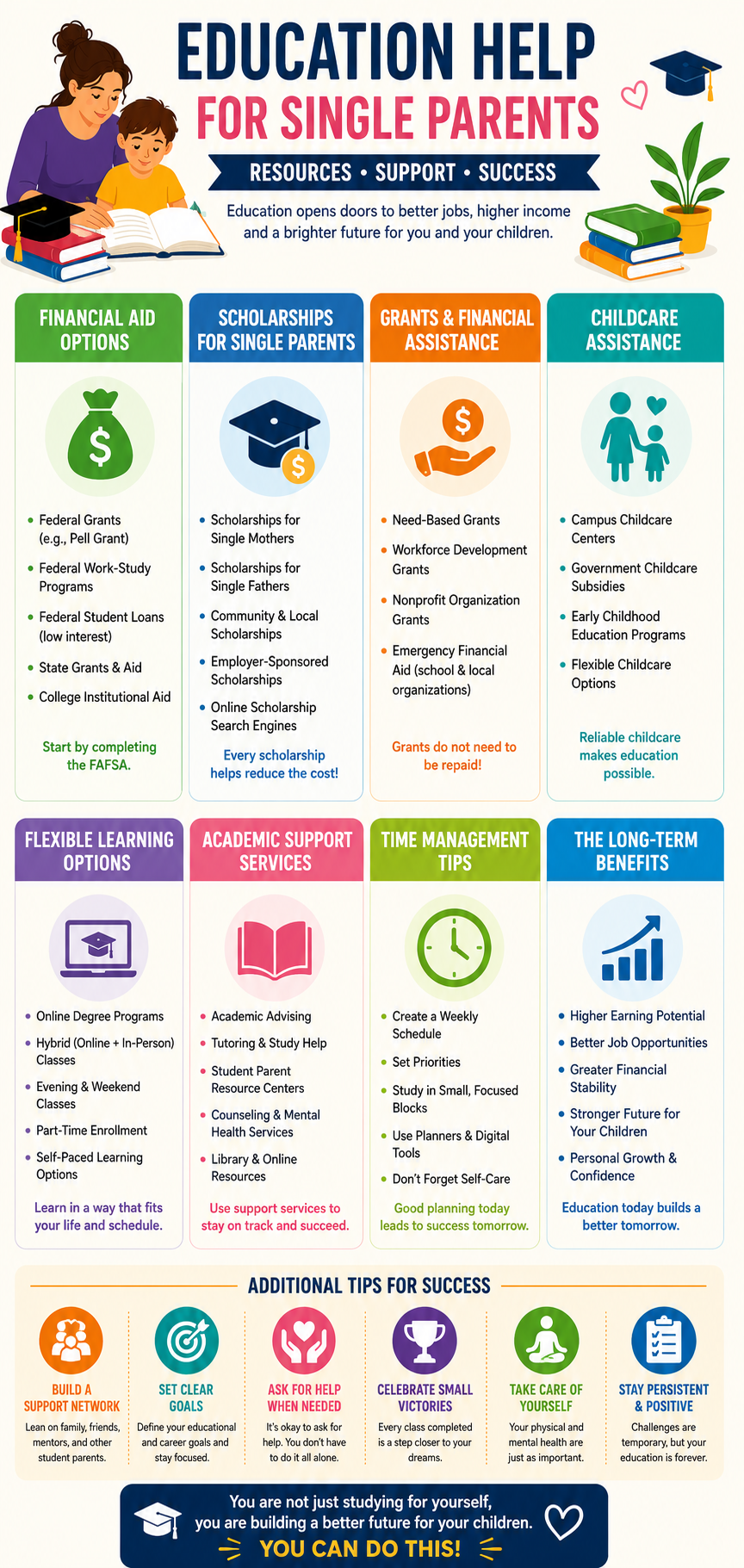
Education is often one of the most valuable investments a single parent can make. While the immediate challenges of attending school while raising children may seem daunting, the long-term rewards can be substantial. A college degree, technical certification, or vocational credential can significantly improve earning potential, increase employment opportunities, and provide access to careers that offer greater stability and benefits.
Many industries increasingly require specialized knowledge and credentials. Employers frequently seek candidates with advanced training, professional certifications, or higher education degrees. For single parents who want to move beyond entry-level positions or low-wage employment, education can provide a pathway toward meaningful career advancement. Increased income can improve housing stability, healthcare access, savings opportunities, and overall quality of life.
Education also has a profound impact on children. Children often model their behaviors and aspirations after their parents. When they see a parent studying, completing assignments, attending classes, and working toward long-term goals, they learn valuable lessons about discipline, perseverance, and the importance of education. Research consistently suggests that parental educational attainment positively influences children’s academic expectations and future educational outcomes.
Common Educational Challenges Faced by Single Parents
While education offers tremendous benefits, single parents often face obstacles that traditional students may not encounter. Understanding these challenges is important because it helps identify solutions and support systems that can improve educational success.
Financial Challenges
Financial concerns represent one of the biggest barriers to education for single parents. Unlike many traditional students, single parents are responsible not only for tuition and educational expenses but also for supporting an entire household. Rent or mortgage payments, utility bills, food costs, transportation expenses, healthcare needs, childcare fees, and other household obligations must all be managed alongside educational costs.
Even when tuition appears affordable, additional expenses such as textbooks, technology, internet access, transportation, laboratory fees, and school supplies can create financial strain. Many single parents worry about taking on student debt while already managing limited financial resources.
Fortunately, numerous grants, scholarships, and financial aid programs are specifically designed to address these concerns and reduce educational costs.
Time Constraints
Time management is another significant challenge. Single parents often balance multiple roles simultaneously, including caregiver, employee, student, and household manager. A typical day may involve preparing children for school, working a job, attending classes, helping with homework, completing household chores, and studying late into the evening.
Finding uninterrupted study time can be difficult, especially for parents of young children. Many student parents must learn to maximize small blocks of available time and develop highly organized schedules to meet academic requirements.
Childcare Responsibilities
Reliable childcare is essential for educational success. Parents cannot attend classes, complete internships, participate in study groups, or take examinations without dependable childcare arrangements. Unfortunately, childcare costs can be extremely expensive and may consume a substantial portion of a family’s income.
Unexpected childcare disruptions can also interfere with academic progress. Illnesses, school closures, and scheduling conflicts may create challenges that require flexibility and contingency planning.
Emotional and Mental Stress
Balancing education and parenting responsibilities can be emotionally demanding. Many single parents experience stress related to finances, academic performance, childcare arrangements, and household management. Feelings of guilt may arise when time spent studying reduces time available for family activities.
Maintaining emotional well-being is critical. Support networks, counseling services, and effective stress-management techniques can help student parents navigate these challenges successfully.
Financial Aid Programs for Single Parents
Financial aid serves as the foundation for many educational journeys. Understanding available assistance programs can significantly reduce costs and make higher education more accessible.
Federal Grants
Federal grants are among the most valuable forms of educational assistance because they generally do not require repayment. Eligibility is typically based on financial need, making these programs particularly beneficial for many single-parent households.
Grant funding may help cover:
- Tuition and fees
- Textbooks
- Educational supplies
- Technology requirements
- Other approved educational expenses
Students should complete all required financial aid applications as early as possible to maximize eligibility.
Work-Study Programs
Work-study programs provide opportunities for students to earn money while attending school. These positions are often designed to accommodate academic schedules, making them ideal for student parents.
Benefits include earning income while gaining professional experience. Work-study positions may also reduce the need for borrowing through student loans.
Federal Student Loans
Although grants and scholarships should generally be prioritized, federal student loans may help bridge funding gaps when necessary. Federal loans often provide lower interest rates and more flexible repayment options compared to many private loan alternatives.
Students should borrow carefully and only as much as necessary to avoid excessive debt after graduation.
Institutional Financial Aid
Many colleges and universities offer their own financial assistance programs. Institutional aid may include:
- Need-based grants
- Merit scholarships
- Tuition discounts
- Emergency assistance funds
- Parent-specific support programs
Speaking with a school’s financial aid office can help identify opportunities that may not be widely advertised.
Scholarships for Single Parents
Scholarships are highly valuable because they provide funding that generally does not require repayment. Many organizations recognize the unique challenges faced by single parents and offer scholarships specifically designed to support their educational goals.
Scholarships for Single Mothers
Numerous scholarship programs focus on assisting single mothers pursuing higher education. These awards may consider financial need, academic achievement, community involvement, career goals, and personal circumstances.
Some scholarships are intended for women returning to school after extended absences, while others support students pursuing specific fields such as healthcare, education, business, or technology.
Single mothers should apply broadly, as smaller scholarship awards can accumulate and significantly reduce educational expenses.
Scholarships for Single Fathers
Although fewer programs specifically target single fathers, many scholarship opportunities are available to parents regardless of gender. Single fathers should explore general scholarships, adult learner scholarships, workforce development awards, and community-based funding opportunities.
Persistence is important because many scholarships receive fewer applications than students assume.
Community-Based Scholarships
Local organizations frequently offer scholarships to residents pursuing education. Community foundations, civic groups, religious organizations, professional associations, and local businesses may provide educational funding opportunities.
Community scholarships often have less competition than national programs, increasing the likelihood of receiving an award.
Grants Specifically Designed for Student Parents
Grants provide financial assistance that typically does not require repayment, making them one of the most attractive funding sources for education.
Need-Based Educational Grants
Need-based grants are intended to help students with limited financial resources access educational opportunities. Since many single-parent households qualify as financially needy according to aid formulas, these grants can provide substantial support.
The amount awarded varies depending on income, family size, enrollment status, and educational costs.
Workforce Development Grants
Many government agencies provide grants to encourage training in high-demand occupations. These programs often support careers in:
- Healthcare
- Information technology
- Skilled trades
- Manufacturing
- Education
- Public service
Funding may cover tuition, books, certification exams, and training materials.
Nonprofit Educational Grants
Nonprofit organizations frequently support educational advancement among underserved populations, including single parents. These grants may assist with tuition, emergency expenses, childcare costs, transportation, and educational supplies.
Researching local nonprofit resources can reveal opportunities that are not widely publicized.
Childcare Assistance for Student Parents
Childcare remains one of the most significant concerns for single parents pursuing education. Fortunately, various programs help reduce costs and improve access to reliable childcare services.
Campus Childcare Centers
Many colleges and universities operate childcare centers for students. These facilities often provide convenient access and reduced rates compared to private childcare providers.
Campus childcare centers may offer:
- Flexible scheduling
- Educational programming
- Convenient locations
- Affordable pricing
- Priority enrollment for students
Because spaces may be limited, early application is recommended.
Government Childcare Subsidies
Government childcare assistance programs help qualifying families cover childcare expenses while parents attend school or work. Eligibility generally depends on income, family size, and educational or employment status.
These programs can substantially reduce out-of-pocket childcare costs and make school attendance more feasible.
Early Childhood Education Programs
Early childhood education programs can provide educational and developmental services for children while supporting parents’ educational pursuits. These programs often include learning activities, nutritional support, and family resources.
Participation can benefit both children and parents simultaneously.
Flexible Learning Options for Single Parents
Modern educational institutions increasingly recognize the needs of working adults and parents. Flexible learning options make it easier than ever to pursue education while maintaining family responsibilities.
Online Degree Programs
Online learning has transformed higher education accessibility. Students can attend classes, complete assignments, participate in discussions, and communicate with instructors from home.
Online programs provide several advantages:
- Flexible schedules
- Reduced commuting time
- Lower transportation costs
- Greater convenience
- Improved work-life balance
Many accredited colleges now offer complete degree programs entirely online.
Hybrid Programs
Hybrid learning combines online coursework with periodic in-person instruction. This model provides flexibility while preserving opportunities for face-to-face interaction and hands-on learning experiences.
Many student parents find hybrid programs offer the best balance between convenience and engagement.
Evening and Weekend Classes
Educational institutions frequently offer classes outside traditional daytime hours. Evening and weekend schedules allow parents to attend school while maintaining employment and managing childcare arrangements.
These options can significantly reduce scheduling conflicts.
Part-Time Enrollment
Part-time study allows students to progress toward educational goals at a manageable pace. Although completion may take longer, part-time enrollment can reduce stress and improve long-term success.
Many single parents find part-time schedules more compatible with family responsibilities.
Academic Support Services That Help Student Parents Succeed
Academic support services can make the difference between struggling and thriving in school.
Academic Advising
Academic advisors help students create educational plans, select courses, understand graduation requirements, and access campus resources. Regular meetings with advisors can prevent costly mistakes and improve academic outcomes.
Tutoring Services
Tutoring programs provide assistance with challenging coursework and difficult subjects. These services often improve grades, confidence, and retention rates.
Many colleges provide tutoring at little or no additional cost.
Student Parent Resource Centers
Some institutions maintain dedicated support offices for student parents. These centers may provide:
- Parenting resources
- Child-friendly study spaces
- Emergency assistance
- Peer support groups
- Referral services
These programs help create a more supportive educational environment.
Counseling and Mental Health Services
Mental health support is particularly valuable for student parents managing multiple responsibilities. Counseling services can help address stress, anxiety, burnout, and work-life balance concerns.
Seeking support is a sign of strength, not weakness.
Time Management Strategies for Single Parent Students
Successful student parents often develop exceptional organizational skills. Effective time management is essential for balancing academic, professional, and family responsibilities.
Create a Weekly Schedule
A structured schedule provides clarity and reduces stress. Parents should allocate dedicated time for classes, studying, work responsibilities, family activities, and personal care.
Written schedules improve accountability and help prevent conflicts.
Use Technology to Stay Organized
Digital calendars, reminder applications, and task-management tools can help track assignments, exams, appointments, and deadlines. Staying organized reduces the risk of missed responsibilities.
Establish Consistent Study Habits
Regular study sessions are often more effective than occasional marathon sessions. Many parents successfully study during early mornings, lunch breaks, children’s naps, or after bedtime.
Consistency promotes retention and reduces last-minute stress.
Prioritize Responsibilities
Not every task carries equal importance. Learning to distinguish between urgent and nonessential activities helps maximize productivity and focus.
Prioritization allows parents to direct energy toward activities that contribute most significantly to academic and family goals.
Long-Term Career Benefits of Education for Single Parents
The rewards of education often continue long after graduation.
Higher Earnings
Educational attainment is strongly associated with increased income. Higher earnings can improve housing stability, healthcare access, retirement savings, and overall financial security.
Better Employment Opportunities
Many careers require specialized credentials that can only be obtained through education or training programs. Earning these qualifications expands employment opportunities significantly.
Increased Job Security
Workers with advanced education frequently experience lower unemployment rates and greater career stability.
Professional Growth
Education creates opportunities for promotions, leadership roles, entrepreneurship, and specialized career paths that may not otherwise be accessible.
Positive Family Impact
Improved income, career stability, and educational achievement often create lasting benefits for children and future generations. The positive effects frequently extend far beyond the individual student.
Frequently Asked Questions
Can single parents receive financial aid for college?
Yes. Single parents often qualify for grants, scholarships, work-study programs, and other forms of financial assistance based on financial need and enrollment status.
Are there scholarships specifically for single mothers?
Yes. Many organizations offer scholarships designed specifically to support single mothers pursuing higher education.
Can single fathers qualify for educational assistance?
Absolutely. Single fathers may qualify for grants, scholarships, loans, workforce development funding, and various educational support programs.
Does financial aid cover childcare expenses?
Some programs and institutions offer childcare assistance or childcare-related support services. Availability varies by location and program.
Is online education suitable for single parents?
Online learning is often an excellent option because it provides flexibility and allows parents to study around family and work responsibilities.
Can part-time students receive grants and scholarships?
Many aid programs support part-time students, although eligibility requirements vary.
What is the best first step when returning to school?
Research educational programs, identify career goals, and complete financial aid applications as early as possible.
How can single parents avoid burnout while studying?
Building a support network, maintaining realistic expectations, using time-management strategies, and prioritizing self-care can help prevent burnout.
References
- Federal Student Aid (U.S. Department of Education) – https://studentaid.gov
- College Board – https://www.collegeboard.org
- National Center for Education Statistics – https://nces.ed.gov
- Scholarships.com – https://www.scholarships.com
- Education Commission of the States – https://www.ecs.org
- National Association of Student Financial Aid Administrators – https://www.nasfaa.org
- American Council on Education – https://www.acenet.edu
- Community College Research Center – https://ccrc.tc.columbia.edu
Disclaimer
Program Clarity is an independent informational website and is not affiliated with any government agency. This article is for educational purposes only. Program rules and availability may change. Always verify details with official authorities.