
Introduction
For millions of people around the world, obtaining a Green Card is one of the most important steps toward building a future in the United States. Whether someone wants to work permanently in America, reunite with family members, pursue educational opportunities, or eventually become a U.S. citizen, a Green Card serves as the foundation for long-term legal residency.
The term “Green Card” is commonly used, but many people do not fully understand what it means, what rights it provides, or how the application process works. Some assume it automatically grants citizenship, while others believe it guarantees permanent residence forever. In reality, a Green Card is a legal document that provides lawful permanent resident status, but it comes with specific rights, responsibilities, and renewal requirements.
Green Card Overview
| Feature | Details |
|---|---|
| Official Name | Permanent Resident Card |
| Common Name | Green Card |
| Purpose | Proof of lawful permanent residence in the U.S. |
| Issued By | U.S. Citizenship and Immigration Services (USCIS) |
| Validity | Usually 10 years (2 years for conditional cards) |
| Work Authorization | Yes |
| Travel Authorization | Yes, with certain restrictions |
| Path to Citizenship | Yes |
| Citizenship Required? | No |
| Renewal Required? | Yes |
What Is a Green Card?
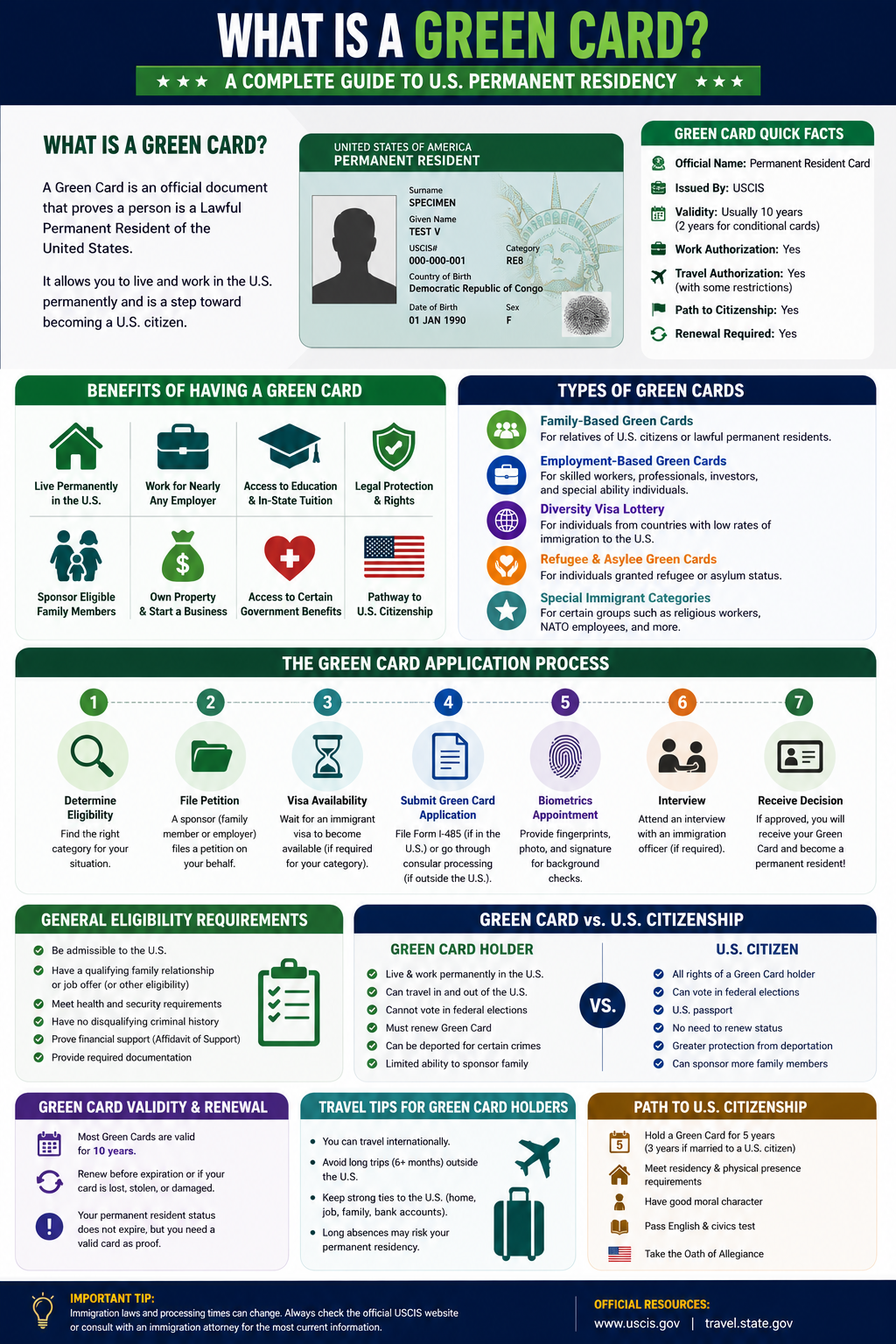
A Green Card is an identification card issued by the U.S. government that proves an individual has lawful permanent resident (LPR) status in the United States.
A Green Card allows a person who is not a U.S. citizen to live and work permanently in the country. It serves as evidence that the holder has been granted immigration benefits allowing them to establish long-term residence in America.
The card itself contains important information, including:
- Full legal name
- Date of birth
- Country of birth
- Alien registration number
- Photograph
- Card expiration date
- Fingerprint information
Although the card’s color has changed multiple times throughout history, it continues to be called a “Green Card” because earlier versions were green in color.
Today, the Green Card remains one of the most sought-after immigration documents in the world because it provides a pathway toward stability, employment opportunities, and eventual U.S. citizenship.
Why Is It Called a Green Card?
The term “Green Card” originated from the document’s appearance during the 1940s and 1950s. Early versions of the Alien Registration Receipt Card were printed on green-colored paper.
Over the decades, the design changed several times and featured different colors. However, the nickname remained popular among immigrants, attorneys, and government agencies.
Modern Permanent Resident Cards once again feature green security elements, making the nickname more accurate today than it was for many years.
What Does Permanent Resident Mean?
A lawful permanent resident is someone who has been authorized to reside permanently in the United States.
Permanent residency provides significant immigration benefits, including the ability to:
- Live anywhere in the United States
- Work for most employers
- Own property
- Attend schools and universities
- Access certain government benefits
- Sponsor eligible relatives
- Apply for U.S. citizenship later
Permanent residency is different from temporary visas such as:
- Tourist visas
- Student visas
- Temporary work visas
- Exchange visitor visas
Unlike temporary visa holders, Green Card holders are not required to leave the United States after a specific period, provided they continue meeting residency requirements.
Benefits of Having a Green Card
Obtaining a Green Card provides numerous advantages that make it one of the most valuable immigration statuses available.
Permanent Residence
One of the biggest benefits is the ability to live permanently in the United States.
Green Card holders do not need to continually renew temporary visas or worry about maintaining nonimmigrant status.
This creates long-term stability for individuals and families.
Employment Opportunities
Green Card holders can legally work in the United States without requiring employer-sponsored work authorization.
They may:
- Work full-time
- Work part-time
- Change employers freely
- Start businesses
- Become self-employed
Many jobs unavailable to temporary visa holders become accessible after obtaining permanent residency.
Educational Opportunities
Permanent residents often qualify for:
- Lower in-state tuition rates
- More scholarship opportunities
- Federal financial aid eligibility in certain situations
- Access to educational programs
This can significantly reduce college expenses.
Family Sponsorship
Green Card holders may sponsor certain relatives for immigration benefits.
Eligible family members may include:
- Spouses
- Unmarried children
Although sponsorship options are more limited than those available to U.S. citizens, they still provide valuable opportunities for family reunification.
Legal Protection
Permanent residents enjoy legal protections under U.S. law.
They can:
- Own property
- Open bank accounts
- Enter contracts
- Receive legal protections from discrimination
These rights help individuals build secure lives in the United States.
Pathway to Citizenship
Perhaps the most significant benefit is that a Green Card often serves as the first step toward becoming a U.S. citizen.
Most permanent residents can apply for naturalization after:
- Five years of permanent residency, or
- Three years if married to a U.S. citizen and meeting additional requirements
Refugee and Asylee Green Cards
Individuals granted refugee or asylum status may later apply for permanent residency.
These humanitarian pathways help protect individuals fleeing persecution or danger in their home countries.
Who Is Eligible for a Green Card?
Eligibility depends on the specific category being used.
Common qualifying situations include:
- Marriage to a U.S. citizen
- Family sponsorship
- Employment sponsorship
- Refugee status
- Asylum approval
- Diversity Visa selection
- Special immigrant categories
- Investment-based immigration
Applicants must also meet admissibility requirements established by U.S. immigration law.
Green Card Through Marriage
Marriage to a U.S. citizen is one of the most common ways to obtain permanent residency.
However, approval is not automatic.
Applicants must demonstrate:
- A genuine marriage
- Shared life together
- Supporting documentation
- Eligibility under immigration law
Immigration authorities carefully review applications to prevent fraud.
Evidence may include:
- Joint bank accounts
- Lease agreements
- Insurance policies
- Family photographs
- Communication records
Green Card Through Employment
Employer-sponsored Green Cards remain a major immigration pathway.
The process often involves:
- Employer sponsorship
- Labor certification (when required)
- Immigrant petition filing
- Visa availability
- Adjustment of status or consular processing
Depending on the category, the process can take several months or several years.
Green Card Through Family Sponsorship
Family-based immigration helps reunite relatives in the United States.
Sponsors must generally prove:
- Qualifying family relationship
- Financial ability to support the immigrant
- Compliance with immigration requirements
Documentation often includes:
- Birth certificates
- Marriage certificates
- Financial records
- Affidavits of support
Green Card Application Process
Although procedures vary, most applications follow similar stages.
Determine Eligibility
Applicants first identify the immigration category that applies to their situation.
Choosing the correct pathway is critical.
File the Appropriate Petition
Most Green Card cases require a petition filed by:
- A family member
- An employer
- The applicant themselves in limited situations
The petition establishes eligibility.
Wait for Visa Availability
Certain categories have annual limits.
Applicants may need to wait until an immigrant visa becomes available.
Waiting periods vary significantly depending on:
- Immigration category
- Country of birth
- Government processing times
Submit Green Card Application
Eligible applicants submit a permanent residency application through:
Adjustment of Status
For individuals already in the United States.
Consular Processing
For applicants outside the United States.
Biometrics Appointment
Applicants usually attend a biometrics appointment.
Government officials collect:
- Fingerprints
- Photographs
- Signatures
These are used for security checks.
Interview
Many applicants attend an interview.
Immigration officers review:
- Documentation
- Eligibility
- Background information
Marriage-based applications commonly require interviews.
Receive Decision
If approved, applicants receive:
- Permanent resident status
- Green Card documentation
Conditional Green Cards
Some individuals receive conditional permanent residence instead of standard permanent residence.
This commonly applies to:
- Marriage-based immigrants married less than two years
- Certain investor immigrants
Conditional Green Cards generally remain valid for two years.
Before expiration, holders must remove conditions by filing additional forms and supporting evidence.
Failure to remove conditions can result in loss of permanent resident status.
Green Card Renewal
Most Green Cards are valid for ten years.
Permanent resident status does not expire, but the card itself does.
Renewal may be necessary when:
- The card expires
- The card is lost
- The card is damaged
- Information changes
Maintaining a valid card helps avoid employment and travel complications.
Traveling With a Green Card
Green Card holders may generally travel internationally.
However, extended trips outside the United States can create problems.
Immigration officials may question whether a person has abandoned permanent residence if they remain outside the country for long periods.
Generally:
- Short trips rarely cause issues
- Extended absences require caution
- Very long absences may threaten residency status
Maintaining strong ties to the United States is important.
Can a Green Card Be Revoked?
Yes.
Permanent residency is a valuable status but is not guaranteed forever.
Reasons for losing Green Card status may include:
- Immigration fraud
- Serious criminal convictions
- National security concerns
- Abandonment of residency
- Certain immigration violations
Each case is evaluated individually.
Green Card vs. U.S. Citizenship
Many people mistakenly believe permanent residency and citizenship are the same.
They are not.
| Green Card Holder | U.S. Citizen |
|---|---|
| Can live permanently in U.S. | Yes |
| Can work permanently | Yes |
| Can vote in federal elections | No |
| Can obtain U.S. passport | No |
| Subject to deportation in some cases | Yes |
| Must renew card | Yes |
| Can sponsor more relatives | Limited |
Citizenship provides the highest level of immigration security and benefits.
How Long Does It Take to Get a Green Card?
Processing times vary significantly.
Factors include:
- Immigration category
- Country of birth
- Government workload
- Security checks
- Application completeness
Some applicants receive approval within months.
Others may wait several years.
Family preference and employment categories often experience longer delays.
Common Green Card Application Mistakes
Many applicants experience delays because of preventable errors.
Common mistakes include:
Incomplete Applications
Missing information often results in delays or requests for additional evidence.
Incorrect Documentation
Submitting outdated or inaccurate documents can slow processing.
Missing Deadlines
Failing to respond to government requests may lead to denial.
Providing False Information
Misrepresentation can cause serious immigration consequences, including denial and future inadmissibility.
Failure to Maintain Eligibility
Applicants must continue meeting requirements throughout the process.
Steps Toward U.S. Citizenship After Receiving a Green Card
Most permanent residents eventually pursue citizenship.
The naturalization process generally involves:
- Meeting residency requirements
- Demonstrating good moral character
- Passing English requirements
- Passing civics testing
- Completing interviews
- Taking the Oath of Allegiance
Citizenship offers additional rights and protections beyond permanent residency.
Frequently Asked Questions (FAQs)
What is the main purpose of a Green Card?
A Green Card proves that a person is a lawful permanent resident of the United States and may live and work there permanently.
Does a Green Card make you a U.S. citizen?
No. A Green Card grants permanent residency, while citizenship requires a separate naturalization process.
How long is a Green Card valid?
Most Green Cards are valid for 10 years. Conditional Green Cards are generally valid for 2 years.
Can Green Card holders work in the United States?
Yes. Permanent residents can legally work for most employers without additional work authorization.
Can Green Card holders travel internationally?
Yes. However, long absences outside the United States may create residency concerns.
Can a Green Card be revoked?
Yes. Certain criminal offenses, fraud, or abandonment of residency may result in loss of permanent resident status.
How long must I have a Green Card before applying for citizenship?
Most applicants must hold permanent residency for five years before applying for naturalization. Some spouses of U.S. citizens may qualify after three years.
Is a Green Card the same as a visa?
No. A visa allows entry into the United States, while a Green Card grants lawful permanent resident status.
Can Green Card holders sponsor family members?
Yes. Permanent residents can sponsor certain qualifying relatives for immigration benefits.
What happens if my Green Card expires?
Your permanent resident status generally remains valid, but you should renew the card to maintain proof of your status.
References
- U.S. Citizenship and Immigration Services (USCIS) – Green Card Information
- USCIS – Green Card Eligibility Categories
- U.S. Department of State – Immigrant Visas
- USCIS – Becoming a U.S. Citizen Through Naturalization
- U.S. Department of State – Diversity Visa Program
Disclaimer
Program Clarity is an independent informational website and is not affiliated with any government agency. This article is for educational purposes only. Program rules and availability may change. Always verify details with official authorities.