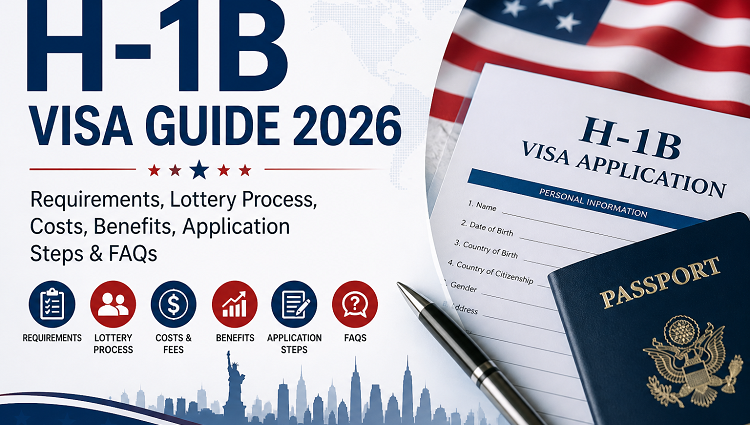
The H-1B visa is one of the most competitive and widely discussed employment visas in the United States. Every year, companies across America sponsor thousands of highly skilled foreign professionals through the H-1B visa program to fill specialized positions in industries such as information technology, engineering, healthcare, finance, artificial intelligence, cybersecurity, education, architecture, and scientific research. Because many U.S. companies require advanced technical expertise to remain competitive in the global economy, the H-1B visa has become an essential part of the American workforce system.
For international professionals, obtaining an H-1B visa can open the door to life-changing opportunities. Many individuals use the H-1B visa to gain international work experience, earn higher salaries, work with cutting-edge technologies, build global professional networks, and eventually pursue permanent residency in the United States. For some people, the H-1B visa becomes the first step toward a long-term future in America.
At the same time, the H-1B process is not simple. Applicants must deal with strict government rules, annual visa caps, lottery selection systems, employer sponsorship requirements, documentation procedures, visa interviews, and immigration compliance obligations. Even highly qualified candidates are not guaranteed selection because the number of applications usually exceeds the number of available visas.
Understanding how the H-1B visa works is extremely important for both employers and foreign workers. Proper preparation, accurate documentation, and awareness of immigration regulations can significantly improve the chances of approval.
What Is an H-1B Visa?
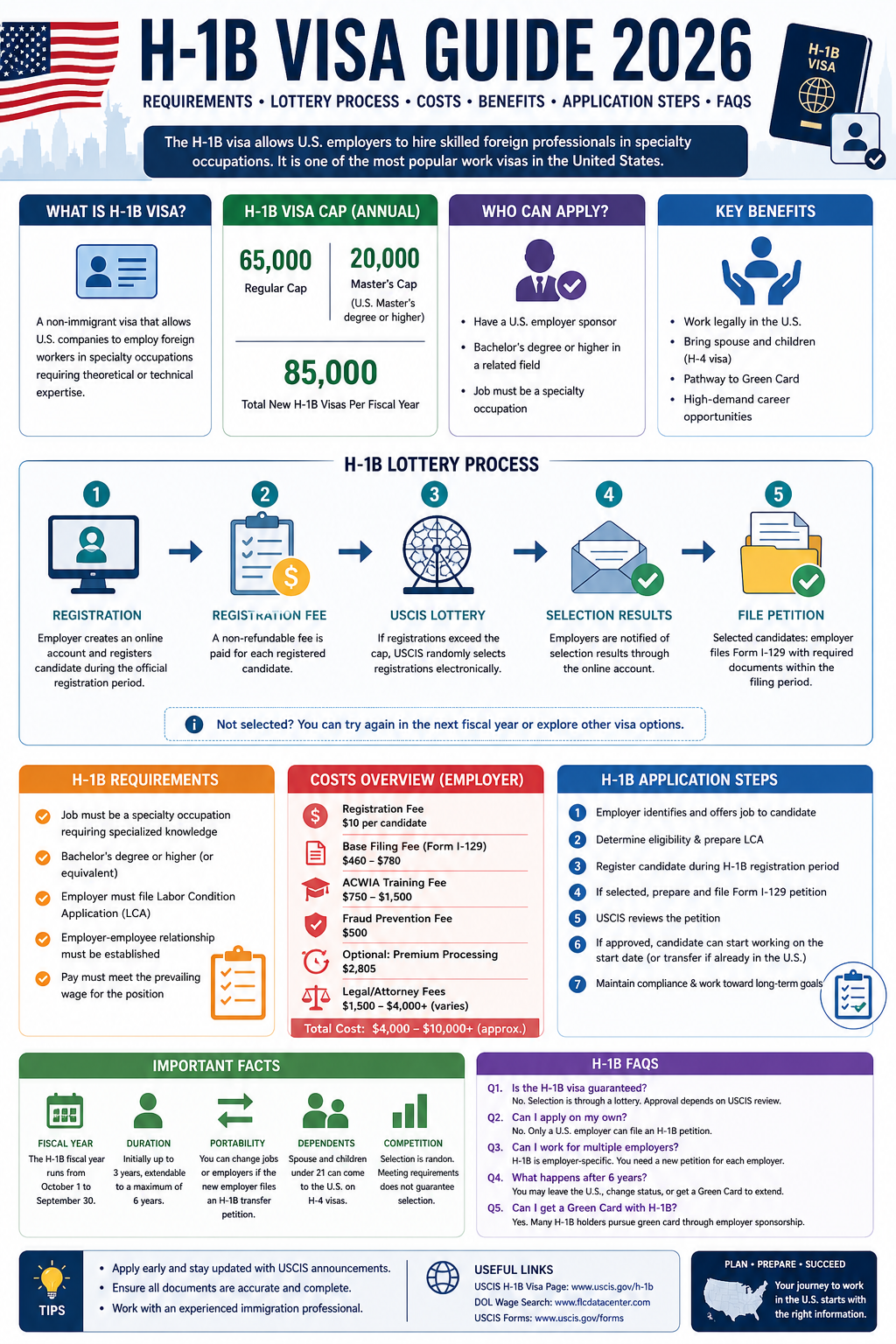
The H-1B visa is a non-immigrant work visa that allows U.S. employers to hire foreign professionals for specialty occupations requiring advanced knowledge, technical expertise, and professional education. The visa category was created to help American businesses employ skilled workers in areas where highly qualified talent may not be readily available within the local labor market.
Unlike tourist visas or visitor permits, the H-1B visa specifically authorizes employment in the United States. The visa holder may legally work only for the sponsoring employer and in the specific role approved by the United States Citizenship and Immigration Services (USCIS). If an H-1B worker changes employers, the new company must file a new petition before employment can officially continue.
One of the most important features of the H-1B visa is that it supports dual intent. This means a visa holder may legally work temporarily in the United States while simultaneously pursuing permanent residency through a green card process. Many temporary visa categories require applicants to maintain non-immigrant intent, but the H-1B visa offers greater flexibility for professionals who wish to establish long-term careers in America.
The H-1B visa is most commonly associated with the technology industry because many software engineers, developers, cybersecurity analysts, AI specialists, cloud architects, and data scientists use this immigration pathway. However, the program is also available for many other professional sectors, including medicine, engineering, finance, accounting, telecommunications, architecture, education, biotechnology, and scientific research.
Why the H-1B Visa Is Important
The H-1B visa plays a major role in supporting innovation, productivity, and economic growth in the United States. Many industries depend heavily on specialized technical knowledge that may not always be available in sufficient numbers within the domestic workforce. The H-1B program allows businesses to recruit qualified professionals from around the world and remain competitive in global markets.
Technology companies are among the largest users of the H-1B system. Companies such as Google, Microsoft, Amazon, Apple, Meta, Intel, Oracle, and IBM frequently sponsor highly skilled international professionals. These companies require expertise in areas such as software engineering, artificial intelligence, cloud computing, cybersecurity, machine learning, and data analytics.
However, the H-1B visa is not limited to large technology corporations. Hospitals use the program to hire physicians and healthcare specialists. Universities sponsor professors and researchers. Financial institutions recruit analysts and quantitative experts. Manufacturing firms employ engineers and technical consultants. Startups also rely on international talent to compete with larger companies.
The H-1B visa also contributes to entrepreneurship and innovation. Many immigrants who originally entered the United States through employment-based visas later became successful entrepreneurs, researchers, inventors, and business leaders. Skilled foreign workers continue contributing to scientific advancement, technology development, medical research, and startup creation.
For international professionals, the H-1B visa provides access to one of the world’s largest and most advanced job markets. Professionals working in the United States often gain exposure to advanced technologies, global business practices, and high-performing corporate environments. In many cases, salaries in the United States are significantly higher than those in developing countries, making the visa financially attractive as well.
H-1B Visa Eligibility Requirements
To qualify for an H-1B visa, both the sponsoring employer and the foreign worker must satisfy several legal and regulatory conditions. USCIS carefully reviews every petition to ensure that all requirements are met.
The H-1B visa is intended only for legitimate specialty occupations requiring advanced knowledge and educational qualifications. As a result, documentation quality and accuracy are extremely important.
Employee Eligibility Requirements
The foreign worker must possess the education, training, and expertise required for the offered position. In most cases, applicants must hold at least a bachelor’s degree or higher in a field directly related to the job.
For example, a software engineering position may require qualifications in computer science, information technology, software engineering, or another technical discipline. A financial analyst role may require a background in finance, economics, statistics, mathematics, or accounting.
Applicants must also demonstrate practical knowledge and specialized expertise relevant to the occupation. USCIS may review academic transcripts, educational certificates, professional licenses, resumes, recommendation letters, employment records, and project experience to evaluate qualifications.
Certain professions require additional licensing or certifications. Healthcare workers, lawyers, pharmacists, architects, and teachers may need state licenses depending on job requirements and location.
In some situations, formal education may be substituted with work experience. Immigration regulations generally recognize three years of specialized professional experience as equivalent to one year of college-level education. This rule benefits experienced professionals who possess strong technical expertise but may not hold traditional university degrees.
Employer Eligibility Requirements
The employer must offer a legitimate specialty occupation position requiring advanced knowledge and educational qualifications. USCIS evaluates whether the job normally requires at least a bachelor’s degree or equivalent expertise.
The employer must also establish a valid employer-employee relationship. This means the company must demonstrate its ability to supervise, direct, hire, pay, and manage the employee.
Employers are also responsible for complying with wage regulations. They must pay at least the prevailing wage for the occupation and location. This requirement protects both U.S. workers and foreign employees from unfair wage practices.
Before filing the H-1B petition, the employer must submit a Labor Condition Application (LCA) to the U.S. Department of Labor.
Department of Labor Information: https://www.dol.gov/agencies/whd/immigration/h1b
Understanding Specialty Occupations
A specialty occupation is a professional-level role requiring specialized theoretical and practical knowledge. USCIS uses this classification to determine whether a position qualifies for H-1B sponsorship.
Generally, the position must normally require:
- A bachelor’s degree or higher
- Specialized technical or professional knowledge
- Advanced expertise related to the field
Examples of common H-1B specialty occupations include:
- Software Engineer
- Artificial Intelligence Specialist
- Cybersecurity Analyst
- Mechanical Engineer
- Civil Engineer
- Data Scientist
- Financial Analyst
- Research Scientist
- University Professor
- Physician
- Pharmacist
- Cloud Solutions Architect
- Business Intelligence Analyst
- Biotechnology Researcher
H-1B Visa Application Process Step by Step
Understanding the H-1B application process is important for reducing delays and improving approval chances.
Receive a Job Offer
The process begins when a U.S. employer offers a qualifying specialty occupation position to a foreign professional. The company agrees to sponsor the employee for H-1B status.
The offered role must meet specialty occupation standards and prevailing wage requirements.
Labor Condition Application (LCA)
The employer submits a Labor Condition Application to the Department of Labor.
The LCA confirms:
- The employee will receive fair wages
- Working conditions comply with labor regulations
- Hiring the foreign worker will not negatively affect U.S. workers
After LCA approval, the employer may continue with the H-1B petition.
H-1B Electronic Registration
During the registration period, employers electronically register applicants through the USCIS system.
A registration fee applies for each candidate.
USCIS then conducts the annual lottery selection.
Filing Form I-129
If selected in the lottery, the employer files Form I-129 along with supporting evidence.
Common supporting documents include:
- Passport copies
- Educational certificates
- Degree evaluations
- Resume
- Experience letters
- Employment contracts
- LCA approval
- Detailed job description
Official Form I-129: https://www.uscis.gov/i-129
USCIS Petition Review
USCIS reviews the petition and supporting documentation.
The agency may:
- Approve the petition
- Deny the petition
- Issue a Request for Evidence (RFE)
RFEs request additional clarification or supporting documentation.
Visa Interview and Stamping
Applicants outside the United States usually attend a visa interview at a U.S. embassy or consulate.
If approved, the H-1B visa stamp is placed in the passport.
Entering the United States
After receiving the visa, the employee may travel to the United States and begin working according to the approved petition.
H-1B Visa Processing Time
Processing times vary depending on USCIS workload, service center operations, petition complexity, and whether premium processing is used.
Regular processing may take several months.
Premium processing is an optional expedited service that generally provides USCIS action within 15 business days.
Premium Processing Information: https://www.uscis.gov/forms/all-forms/how-do-i-request-premium-processing
Even with premium processing, delays may occur if USCIS issues a Request for Evidence.
H-1B Visa Duration and Extensions
The initial H-1B visa approval is generally valid for up to three years.
Extensions may allow a total stay of up to six years.
Certain individuals pursuing employment-based green cards may qualify for additional extensions beyond six years depending on immigration circumstances.
H-1B Visa Fees and Costs
Several government and legal fees may apply during the H-1B process.
Common costs include:
- Registration fee
- Form I-129 filing fee
- Fraud prevention fee
- ACWIA fee
- Public Law fee
- Premium processing fee
- Attorney fees
Employers are generally responsible for paying required government filing fees.
Benefits of the H-1B Visa
The H-1B visa offers numerous advantages for international professionals.
Career Opportunities
The visa allows professionals to work for leading U.S. companies and organizations.
Competitive Salaries
Many H-1B jobs involve specialized technical skills associated with strong compensation packages.
Professional Growth
Employees gain exposure to advanced technologies, global business environments, and international networking opportunities.
Green Card Pathway
The H-1B visa supports dual intent, making it easier to pursue permanent residency.
Family Benefits
Spouses and children may accompany the H-1B holder through H-4 dependent visas.
Tips to Improve H-1B Approval Chances
Develop Specialized Skills
Employers prioritize professionals with expertise in high-demand industries.
Maintain Strong Documentation
Keep educational records, certifications, resumes, and employment evidence organized.
Research Sponsoring Companies
Target employers with strong H-1B sponsorship histories.
USCIS Employer Data Hub: https://www.uscis.gov/tools/reports-and-studies/h-1b-employer-data-hub
Work With Immigration Professionals
Experienced immigration attorneys may help reduce filing errors and improve petition quality.
Frequently Asked Questions (FAQs)
What is the minimum qualification for an H-1B visa?
Most applicants require at least a bachelor’s degree or equivalent work experience related to the specialty occupation.
Can I apply for an H-1B visa without a job offer?
No. A U.S. employer must sponsor the petition.
Is the H-1B lottery random?
Yes. USCIS conducts a random electronic selection process when registrations exceed available visa numbers.
How long can I stay in the United States on H-1B status?
Generally up to six years, with possible extensions in some green card situations.
Can my spouse work in the United States?
Certain H-4 spouses may qualify for employment authorization.
Can I switch employers on an H-1B visa?
Yes. Another employer may file an H-1B transfer petition.
What happens if my H-1B petition is denied?
Applicants may explore re-filing, appeals, or alternative immigration options depending on the situation.
Does the H-1B visa lead to a green card?
Many professionals use the H-1B visa as a pathway toward permanent residency.
What is premium processing?
Premium processing is an expedited USCIS service providing faster petition review for an additional fee.
Are universities subject to the H-1B cap?
Many universities and nonprofit research organizations are cap-exempt.
Official Resources
USCIS H-1B Specialty Occupations: https://www.uscis.gov/working-in-the-united-states/h-1b-specialty-occupations
US Department of Labor H-1B Information: https://www.dol.gov/agencies/whd/immigration/h1b
US Department of State Visa Information: https://travel.state.gov/content/travel/en/us-visas/employment/temporary-worker-visas.html
USCIS Premium Processing: https://www.uscis.gov/forms/all-forms/how-do-i-request-premium-processing
USCIS Employer Data Hub: https://www.uscis.gov/tools/reports-and-studies/h-1b-employer-data-hub
Disclaimer
Program Clarity is an independent informational website and is not affiliated with any government agency. This article is for educational purposes only. Program rules and availability may change. Always verify details with official authorities.