
Affordable housing remains one of the most pressing challenges in the United States. With rent prices rising steadily and wages struggling to keep pace, millions of individuals and families find themselves spending a disproportionate share of their income on housing. This imbalance creates financial stress, limits opportunities for upward mobility, and increases the risk of homelessness. To address these issues, the federal government has developed a wide range of housing assistance programs aimed at supporting low-income households and vulnerable populations.
At the center of these efforts is the U.S. Department of Housing and Urban Development, which designs policies, distributes funding, and oversees housing programs nationwide. These programs are implemented locally through Public Housing Authorities (PHAs), nonprofit organizations, and state agencies, ensuring that assistance reaches those who need it most.
This comprehensive guide explores federal housing assistance in detail, including how it works, the different program types, eligibility requirements, application processes, benefits, challenges, and strategies for improving your chances of approval.
Understanding Federal Housing Assistance
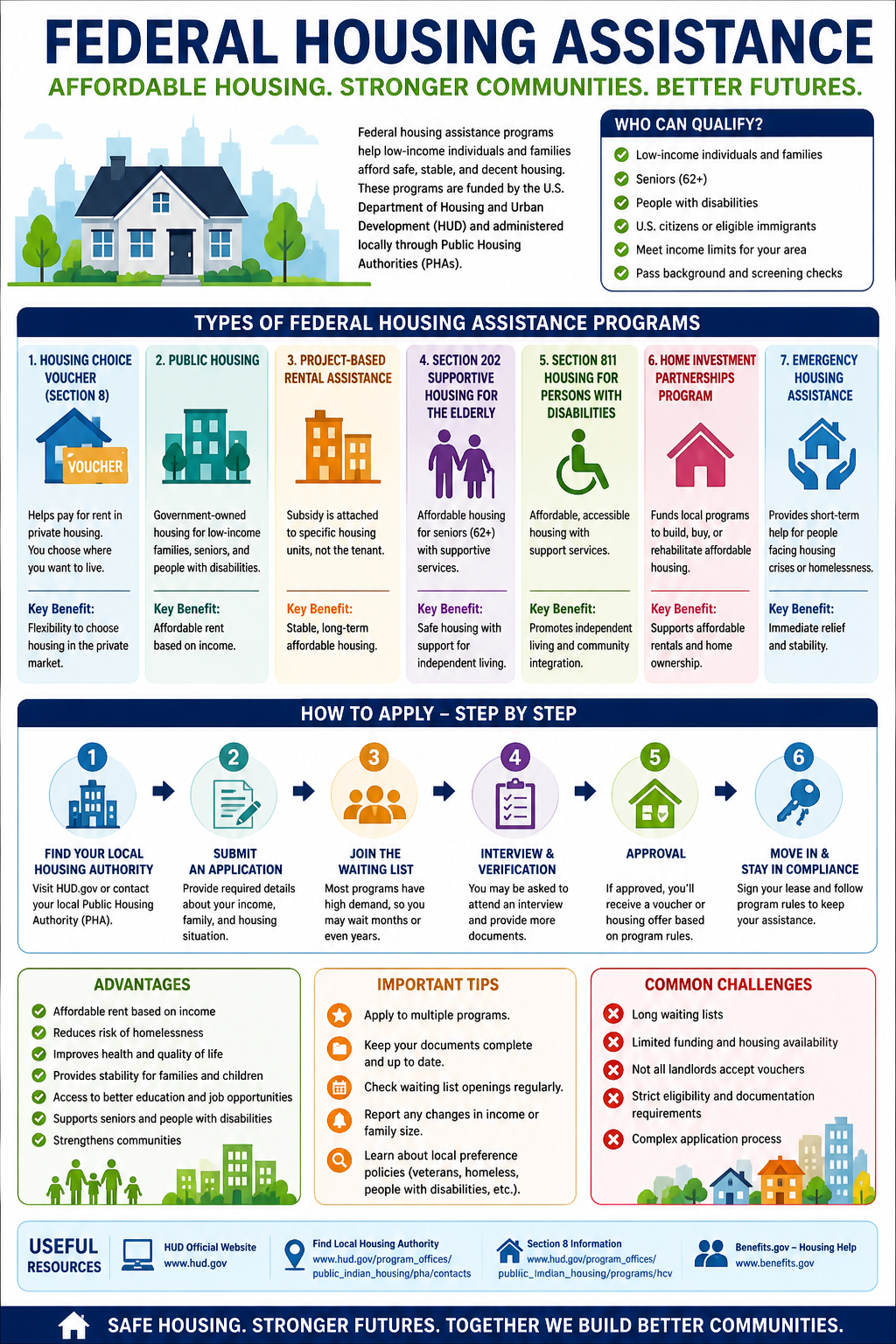
Federal housing assistance is not a single program but rather a network of initiatives designed to make housing more affordable and accessible. These programs operate under the principle that no household should be forced to spend an unsustainable portion of its income on rent. In most cases, assistance ensures that recipients pay around 30% of their income toward housing, with the government covering the remaining cost within defined limits.
The structure of these programs reflects the complexity of the housing market. Some programs provide direct subsidies to tenants, allowing them to choose housing in the private market. Others provide government-owned housing units or fund private developers to create affordable housing options. Still others focus on specific populations, such as seniors or individuals with disabilities, offering supportive services in addition to housing.
This multi-layered approach allows federal housing assistance to address a wide range of needs, from temporary financial hardship to long-term housing instability.
The Growing Need for Housing Assistance
Over the past decade, the demand for affordable housing has increased significantly due to several economic and social factors. Rising urbanization, population growth, stagnant wages, and limited housing supply have all contributed to higher rent prices across the country.
In many major cities, the gap between income and housing costs has widened to the point where even middle-income households struggle to afford rent. Low-income families are particularly affected, often forced to choose between paying for housing and meeting other basic needs such as food, healthcare, and education.
Housing instability also has broader societal impacts. Children in unstable housing situations often experience disruptions in education, while adults may face challenges maintaining steady employment. By providing stable housing, federal assistance programs play a crucial role in supporting not just individuals, but entire communities.
Major Types of Federal Housing Assistance Programs
Housing Choice Voucher Program (Section 8)
The Housing Choice Voucher Program, commonly referred to as Section 8, is one of the most flexible and widely used forms of housing assistance. Unlike traditional public housing, this program allows recipients to choose their own housing in the private market, including apartments, townhouses, and single-family homes.
Under this program, participants receive a voucher that subsidizes their rent. The tenant typically pays about 30% of their income toward housing, while the government pays the remaining portion directly to the landlord. This arrangement provides both affordability and flexibility, enabling families to live in neighborhoods that best suit their needs.
However, while Section 8 offers significant benefits, it also comes with challenges. Not all landlords accept vouchers, and in high-demand areas, finding suitable housing within program limits can be difficult. Additionally, waiting lists for vouchers are often long, sometimes spanning several years.
Public Housing
Public housing is another cornerstone of federal housing assistance. Unlike the voucher program, public housing involves government-owned properties managed by local housing authorities. These properties range from apartment complexes to scattered-site homes and are available to eligible low-income families, seniors, and individuals with disabilities.
Residents in public housing pay rent based on their income, making it one of the most affordable housing options available. While public housing provides stability and affordability, it may offer less flexibility compared to voucher programs, as tenants must live in designated units.
Despite its limitations, public housing continues to serve millions of Americans, providing a stable environment for those who might otherwise struggle to secure housing.
Project Based Rental Assistance
Project-Based Rental Assistance (PBRA) differs from tenant-based programs in that the subsidy is attached to specific housing units rather than individuals. This means that if a tenant moves out of a subsidized unit, they typically lose the assistance.
These programs are often used in partnership with private developers to create affordable housing complexes. They play a critical role in increasing the overall supply of affordable housing, particularly in areas where demand is high.
Section 202 Supportive Housing for the Elderly
The Section 202 program is specifically designed to support low-income seniors aged 62 and older. In addition to providing affordable housing, this program often includes supportive services that help seniors maintain independence.
These services may include transportation, housekeeping, and access to healthcare resources. By combining housing with supportive services, Section 202 helps seniors age in place while maintaining a high quality of life.
Section 811 Housing for Persons with Disabilities
Section 811 focuses on providing affordable and accessible housing for individuals with disabilities. The program emphasizes independent living, offering housing options that are integrated into the community rather than isolated.
In addition to housing, participants may receive supportive services that help them manage daily activities and maintain independence. This approach not only improves quality of life but also promotes social inclusion.
HOME Investment Partnerships Program
The HOME program provides funding to states and local governments to support a wide range of housing activities. These include building new housing, rehabilitating existing properties, and offering rental assistance or homebuyer support.
One of the key strengths of the HOME program is its flexibility, allowing local governments to tailor solutions to their specific housing needs.
Emergency Housing Assistance
Emergency housing programs are designed to provide immediate relief to individuals and families facing housing crises. These programs became particularly important during economic downturns and public health emergencies.
They may include short-term rental assistance, eviction prevention programs, and temporary shelter options. While not always long-term solutions, these programs play a vital role in preventing homelessness.
Eligibility Requirements
Eligibility for federal housing assistance depends on several factors, with income being the most important. Applicants are typically classified into categories such as low-income, very low-income, and extremely low-income based on their earnings relative to the area median income (AMI).
Family composition is another key factor. Programs may prioritize families with children, seniors, or individuals with disabilities. Citizenship or eligible immigration status is also required, and applicants must provide documentation to verify their eligibility.
Background checks are commonly conducted to assess rental history and criminal records. While having a criminal record does not automatically disqualify an applicant, certain offenses may impact eligibility.
Application Process
Applying for federal housing assistance can be a lengthy and competitive process. The first step is identifying your local Public Housing Authority, which manages applications and waiting lists.
Once you locate the appropriate PHA, you can submit an application. This typically involves providing detailed information about your income, household size, and housing history. Accuracy is critical, as errors or omissions can delay processing or result in denial.
After submitting your application, you will likely be placed on a waiting list. Due to high demand, wait times can vary significantly, ranging from several months to several years. Some PHAs periodically open and close their waiting lists, so it is important to stay informed.
If your application reaches the top of the list, you will be contacted for an interview and required to provide additional documentation. Once approved, you will receive housing assistance in the form of a voucher or placement in a housing unit.
Advantages of Federal Housing Assistance
| Advantage | Explanation | Real-Life Impact |
|---|---|---|
| Affordable Rent | Rent is based on income (usually 30%) | Families save money for food, healthcare, and education |
| Financial Stability | Reduces housing cost burden | Less stress and better budgeting |
| Prevention of Homelessness | Provides safety net during hardship | Keeps families off the streets |
| Flexibility (Section 8) | Choose housing in private market | Better living conditions and neighborhoods |
| Support for Vulnerable Groups | Special programs for seniors & disabled | Improved quality of life |
| Access to Better Opportunities | Stable housing improves job and education chances | Long-term economic growth |
| Community Stability | Reduces frequent moving | Stronger neighborhoods |
| Health Benefits | Stable housing improves physical & mental health | Lower healthcare costs |
Federal housing assistance offers numerous benefits that extend beyond affordability. By reducing housing costs, these programs allow families to allocate more of their income toward other essential needs such as education, healthcare, and savings.
Stable housing also contributes to better physical and mental health outcomes. Children in stable housing environments are more likely to succeed academically, while adults are better able to maintain steady employment.
In addition, programs like Section 8 provide flexibility, allowing participants to choose housing that meets their needs and preferences.
Challenges and Limitations
Despite their benefits, federal housing assistance programs face several challenges. The most significant issue is limited funding, which results in long waiting lists and restricted availability.
Another challenge is the variability in landlord participation, particularly in voucher programs. In some areas, landlords may be reluctant to accept vouchers due to administrative requirements or misconceptions about the program.
Additionally, strict eligibility criteria and documentation requirements can make the application process complex and time-consuming.
Strategies to Improve Your Chances of Approval
To increase your chances of receiving housing assistance, it is important to take a proactive approach. Applying to multiple programs can improve your odds, as different programs have different eligibility criteria and waiting lists.
Keeping your documentation organized and up to date is also essential. Missing or outdated information can delay your application or result in denial.
Staying informed about waiting list openings and program updates can help you apply at the right time. Additionally, understanding local preferences—such as priority for veterans or individuals experiencing homelessness—can give you an advantage.
The Future of Federal Housing Assistance
As housing affordability continues to be a major concern, federal housing assistance programs are likely to evolve. Policymakers are exploring ways to increase funding, expand housing supply, and improve program efficiency.
Innovations such as public-private partnerships and technology-driven application systems are helping to streamline processes and reach more people. While challenges remain, these efforts aim to create a more equitable and accessible housing system.
Frequently Asked Questions (FAQs)
What is the main purpose of federal housing assistance?
The primary goal is to make housing affordable for low-income individuals and families while ensuring safe and stable living conditions.
How long does it take to receive housing assistance?
The timeline varies widely depending on location and demand. It can take months or even years in high-demand areas.
Can I work while receiving housing assistance?
Yes, employment is allowed. Your rent contribution will adjust based on your income.
Is housing assistance available nationwide?
Yes, but availability and program details vary by location.
What happens if I move?
In voucher programs, you may be able to transfer your assistance to a new location, depending on program rules.
Are there programs for seniors and disabled individuals?
Yes, programs like Section 202 and Section 811 are specifically designed for these groups.
Can I apply for multiple programs at once?
Yes, applying to multiple programs is often recommended to increase your chances.
Reference Links
- https://www.hud.gov
- https://www.hud.gov/program_offices/public_indian_housing
- https://www.benefits.gov
- https://www.usa.gov/housing-help
Disclaimer
Program Clarity is an independent informational website and is not affiliated with any government agency. This article is for educational purposes only. Program rules and availability may change. Always verify details with official authorities.