

Freelancing has transformed from a marginal form of work into a dominant force in the modern global economy. Millions of professionals across fields such as writing, graphic design, software development, digital marketing, consulting, and online services now earn their income independently rather than through traditional employment structures. This shift has been accelerated by digital platforms, remote work technologies, and the growing demand for flexible, project-based expertise. However, despite its advantages, freelancing introduces structural challenges that cannot be ignored. Income instability, lack of employer-provided benefits, limited access to financial services, and the need for continuous self-management create a complex environment for independent workers.
Recognizing both the opportunities and risks associated with freelancing, governments worldwide have developed a wide range of programs aimed at supporting freelancers and self-employed individuals. These programs are not limited to financial aid; they encompass training, legal support, tax incentives, healthcare access, and international business facilitation. Understanding how these government programs function, and how to effectively access them, is essential for freelancers who want to build sustainable and scalable careers.
The Role of Government
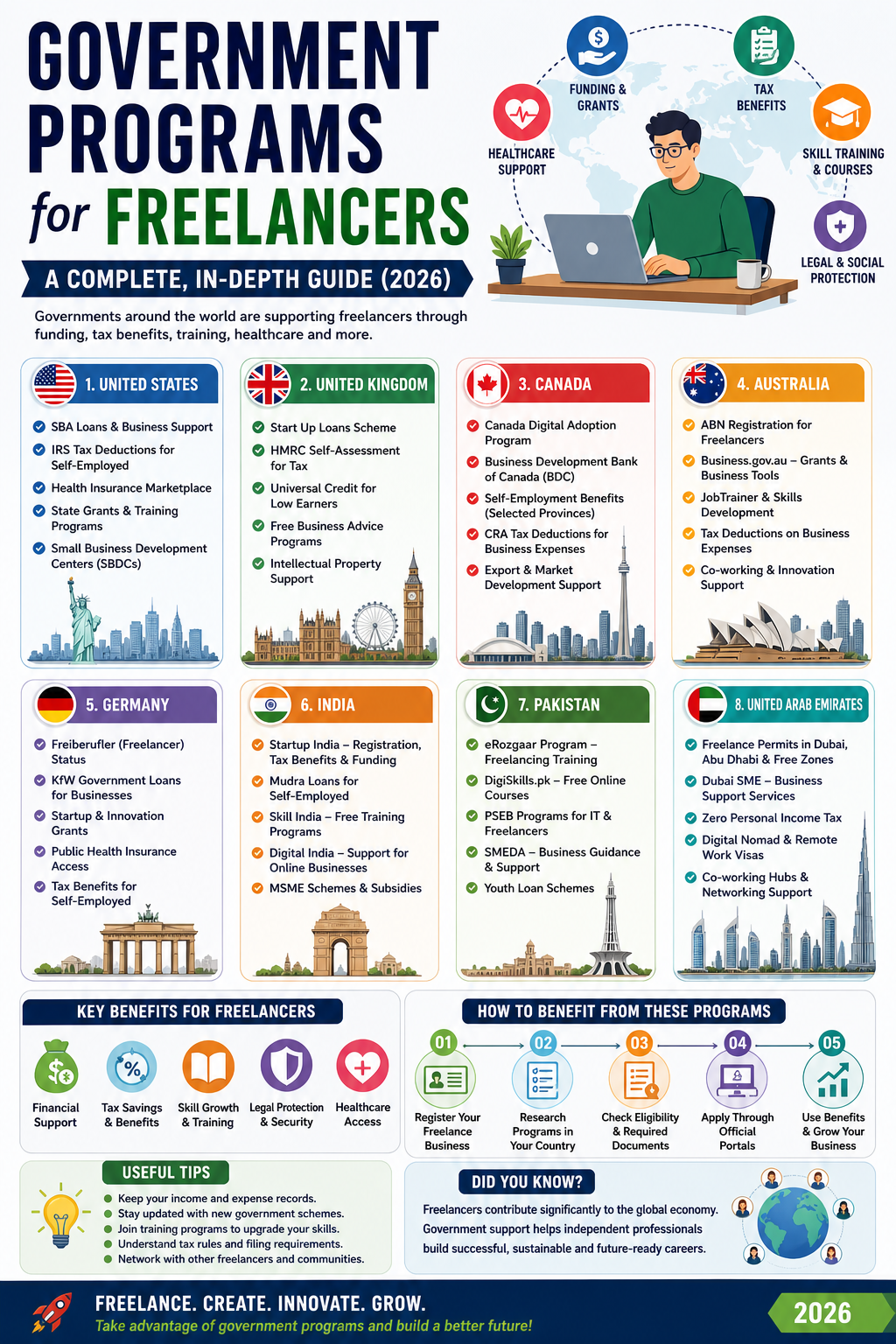
Government involvement in the freelance economy is rooted in broader economic goals. Freelancers contribute significantly to national productivity, innovation, and export revenue, especially in the digital sector. However, because freelancers operate outside traditional employment systems, they often lack access to institutional protections. Governments step in to bridge this gap by creating frameworks that provide both opportunity and security.
The role of government programs is not merely to provide short-term financial relief but to establish long-term economic stability. These programs are designed to encourage entrepreneurship, reduce unemployment, and support the growth of small businesses. Freelancers, in many cases, represent the early stage of business development. A solo freelancer today may evolve into a startup founder or agency owner tomorrow. By supporting freelancers, governments are effectively investing in future enterprises.
Core Challenges Faced by Freelancers
To fully appreciate the importance of government programs, it is necessary to examine the structural challenges freelancers face in detail. Unlike salaried employees, freelancers operate without a safety net, which exposes them to multiple risks that can affect both their income and long-term career growth.
One of the most pressing challenges is income volatility. Freelancers typically rely on project-based work, which means their earnings can fluctuate significantly from month to month. This unpredictability makes financial planning difficult and increases vulnerability during economic downturns. Government grants and income support programs are specifically designed to mitigate this issue by providing temporary financial stability.
Another major challenge is the absence of traditional employment benefits. Health insurance, retirement plans, and paid leave are standard in full-time employment but must be independently managed by freelancers. Governments address this gap through social protection programs that extend healthcare coverage, pension schemes, and even unemployment assistance to self-employed individuals.
Access to credit is also a persistent issue. Financial institutions often view freelancers as high-risk borrowers due to inconsistent income streams. Government-backed loan programs help overcome this barrier by offering favorable terms and reducing the risk for lenders. This enables freelancers to invest in tools, training, and business expansion.
Skill development is another critical area. The freelance market is highly competitive and constantly evolving, particularly in digital industries. Without continuous learning, freelancers risk becoming obsolete. Government-funded training programs ensure that freelancers can upgrade their skills and remain competitive in global markets.
Financial Assistance
Financial support is one of the most direct and impactful forms of government assistance. These programs are designed to provide freelancers with the capital needed to sustain and grow their businesses. Among these, grants are particularly valuable because they do not require repayment. Governments often allocate grant funding to specific sectors such as technology, creative industries, and digital services. Freelancers who can demonstrate innovation or economic impact are more likely to secure these funds.
In addition to grants, government-backed loans provide another important source of financing. While loans must be repaid, they typically offer lower interest rates and more flexible repayment terms than traditional bank loans. This makes them accessible to freelancers who might otherwise struggle to secure funding. These loans can be used for a variety of purposes, including purchasing equipment, launching new services, or expanding into new markets.
Subsidies and financial incentives also play a role in supporting freelancers. These may include partial reimbursement for business expenses, discounts on software or training programs, and incentives for hiring additional workers. Such measures reduce operational costs and improve profitability.
Tax Policies and Financial Relief
Taxation is a critical aspect of freelancing, and government policies in this area can significantly influence financial outcomes. Many governments offer tax relief programs specifically designed for self-employed individuals. These programs recognize that freelancers bear the full burden of business expenses and therefore allow deductions for costs such as equipment, internet services, office space, and professional development.
In some cases, governments provide reduced tax rates for small businesses or introduce simplified tax regimes to ease administrative burdens. Tax credits for innovation, digital work, or export services further incentivize freelancers to expand their activities. These policies not only improve cash flow but also encourage reinvestment into business growth.
Understanding and utilizing these tax benefits requires careful record-keeping and financial planning. Freelancers who maintain accurate documentation of their income and expenses are better positioned to maximize their tax advantages and comply with regulatory requirements.
Training and Skill Development Initiatives
Skill development is a cornerstone of long-term success in freelancing. Governments invest heavily in training programs to ensure that their workforce remains competitive in a rapidly changing global economy. These programs are often offered at low or no cost and cover a wide range of disciplines, including digital marketing, programming, graphic design, content creation, and business management.
Training initiatives are particularly important in developing countries, where freelancing is seen as a pathway to economic growth and international income generation. By equipping freelancers with in-demand skills, governments enable them to access global markets and compete with professionals from more developed economies.
Many training programs also include certification, which adds credibility to a freelancer’s profile and increases their chances of securing high-value clients. In addition to technical skills, these programs often emphasize soft skills such as communication, time management, and client relationship management, which are essential for building a sustainable freelance career.
Social Protection and Long Term Security
One of the most significant developments in government support for freelancers is the expansion of social protection programs. These initiatives aim to provide a safety net similar to that available to traditional employees. Health insurance schemes allow freelancers to access medical services without bearing the full cost, while retirement plans enable them to save for the future.
Unemployment assistance for freelancers is another emerging area. Although traditionally limited to salaried workers, some governments have introduced programs that provide temporary income support during periods of low work availability. These measures are particularly important during economic crises, when freelance opportunities may decline sharply.
By integrating freelancers into social protection systems, governments are addressing one of the most fundamental weaknesses of independent work. This not only improves individual well-being but also contributes to overall economic stability.
Business Development and Growth Programs
Freelancers who aim to scale their operations can benefit from government-sponsored business development programs. These initiatives provide mentorship, networking opportunities, and access to resources that support business expansion. Incubators and accelerators, for example, offer structured programs that guide freelancers through the process of transforming their services into scalable enterprises.
Business registration support is another important aspect. Many freelancers operate informally, which can limit their access to funding and legal protections. Governments simplify the registration process and offer incentives to encourage formalization. This allows freelancers to operate more professionally and access a wider range of opportunities.
Mentorship programs connect freelancers with experienced professionals who can provide guidance on strategy, pricing, client acquisition, and growth. These relationships can significantly accelerate career development and reduce the learning curve associated with freelancing.
Government Programs in Major Countries for Freelancers
Freelancing has become a major part of the global workforce. Many governments now support freelancers through tax benefits, grants, training programs, startup funding, healthcare options, and legal protections. These programs help independent workers grow their income, improve skills, and run sustainable businesses. Below is an explanation of government programs in major countries for freelancers.
Comparison Table
| Country | Main Freelancer Programs | Key Benefits |
|---|---|---|
| USA | SBA, tax deductions | Loans, growth support |
| UK | Start Up Loans, Universal Credit | Funding, income support |
| Canada | BDC, digital adoption | Grants, tax savings |
| Australia | ABN, Business.gov.au | Legal setup, training |
| Germany | Freiberufler, KfW | Loans, healthcare |
| India | Startup India, Mudra | Funding, skills |
| Pakistan | DigiSkills, eRozgaar | Free training |
| UAE | Freelance permits | Tax-free income |
International Opportunities and Export Support
Freelancers increasingly work with clients from around the world, making international trade a key component of the freelance economy. Governments support this trend through export promotion programs that facilitate access to global markets. These programs may include training on international business practices, assistance with payment systems, and guidance on legal compliance.
In countries like Pakistan, freelancing is actively promoted as a source of foreign exchange. Initiatives such as digital skills training and freelance facilitation centers are designed to help individuals connect with international clients and increase their earning potential. By supporting cross-border work, governments not only benefit freelancers but also strengthen their national economies.
Strategic Approach to Utilizing Government Programs
Accessing government programs requires more than simply meeting eligibility criteria. Freelancers must adopt a strategic approach to maximize the benefits available to them. This begins with thorough research to identify relevant programs and understand their requirements. Because many programs have limited funding, early application is often crucial.
Preparation is equally important. Freelancers should maintain detailed financial records, develop clear business plans, and build strong portfolios that demonstrate their skills and achievements. These elements not only improve the chances of approval but also position freelancers for long-term success.
Combining multiple programs can further enhance outcomes. For example, a freelancer might use a grant to fund initial operations, participate in training programs to upgrade skills, and take advantage of tax incentives to improve cash flow. This integrated approach allows freelancers to build a strong and resilient business model.
Frequently Asked Questions (FAQs)
What are government programs for freelancers?
They are initiatives designed to support independent workers through financial aid, training, tax benefits, and social protection.
Can freelancers receive government grants?
Yes, many governments offer grants for startups, digital services, and creative industries.
Are freelancers eligible for loans?
Yes, government-backed loans are specifically designed to support small businesses and self-employed individuals.
Do freelancers get tax benefits?
Freelancers can claim deductions for business expenses and may qualify for tax incentives.
Are training programs free?
Many government programs offer free or subsidized training in high-demand skills.
Can freelancers access healthcare programs?
In some countries, freelancers can enroll in government-supported health insurance schemes.
How can freelancers find available programs?
They should check official government websites and small business support agencies.
Are these programs competitive?
Yes, many programs have limited funding and require strong applications.
Reference Links
- https://www.sba.gov
- https://www.gov.uk
- https://www.canada.ca
- https://digiskills.pk
- https://www.irs.gov
Disclaimer
Program Clarity is an independent informational website and is not affiliated with any government agency. This article is for educational purposes only. Program rules and availability may change. Always verify details with official authorities.