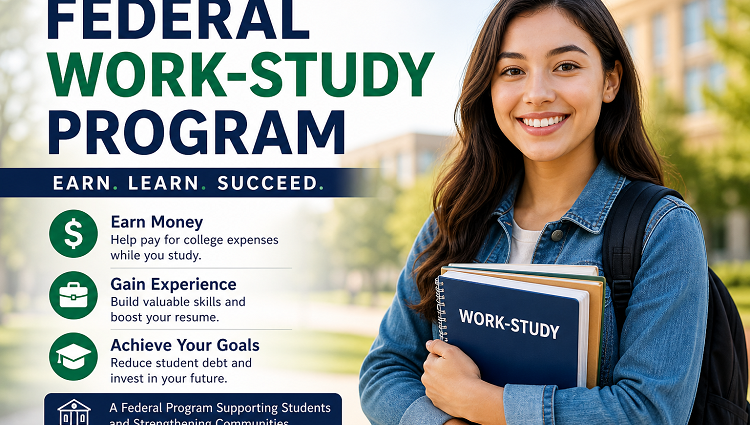
The Federal Work-Study (FWS) Program is a structured, need-based financial aid initiative that enables students in the United States to earn money through part-time employment while completing their education. Unlike loans that create long-term repayment obligations or grants that are awarded without effort, work-study sits in a practical middle space: it requires consistent work, but in return, it offers income, professional exposure, and reduced reliance on borrowing. For many students, especially those from low- to moderate-income backgrounds, the program plays a decisive role in making higher education financially manageable and professionally rewarding.
At its core, the Federal Work-Study Program is designed not only to ease the immediate financial burden of tuition and living costs, but also to integrate work experience into the academic journey. The program is funded by the federal government and administered through participating colleges and universities, which means each institution has some control over how funds are distributed and how jobs are structured. This combination of federal support and institutional flexibility allows the program to serve a wide range of students across different academic disciplines.
Structure and Intent
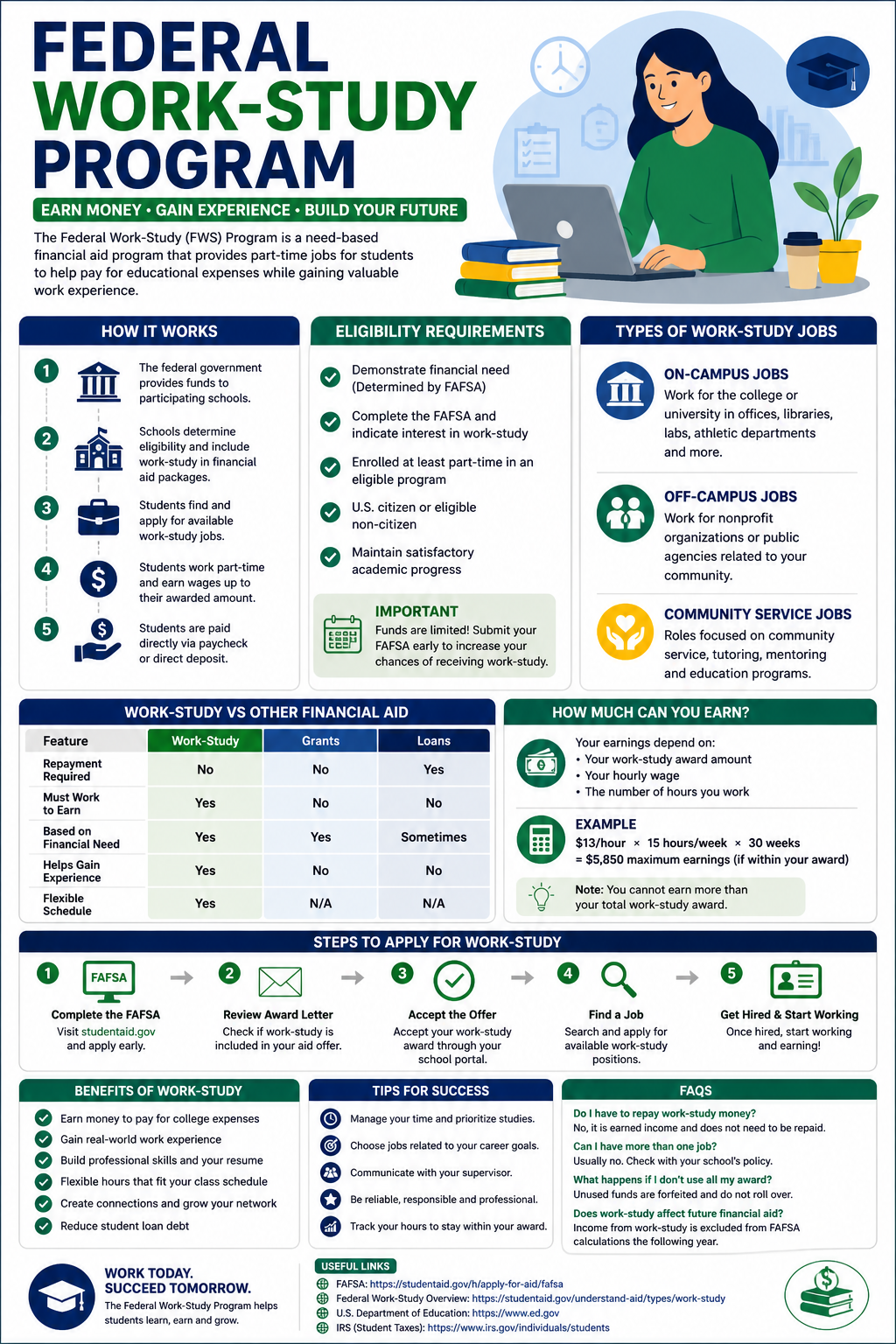
To fully benefit from work-study, it is important to understand how the system operates beyond the surface level. The federal government allocates a specific amount of funding each year to participating institutions based on various factors, including enrollment size and demonstrated financial need among students. These institutions then divide the funds among eligible students, incorporating work-study awards into financial aid packages.
However, receiving a work-study award does not guarantee immediate income. The award represents the maximum amount a student is allowed to earn through the program during a specific academic period. Students must actively secure employment, work scheduled hours, and earn wages incrementally. This distinction is critical because many students mistakenly assume that work-study functions like a grant, when in reality it functions more like a capped earning opportunity.
The broader intent of the program extends beyond financial assistance. It aims to encourage responsibility, improve time management, and provide exposure to professional environments. Many roles are intentionally designed to align with academic majors, allowing students to build relevant experience that can strengthen future job applications or graduate school prospects.
Eligibility Criteria
Eligibility for the Federal Work-Study Program is determined primarily through financial need, which is calculated using the information provided in the Free Application for Federal Student Aid (FAFSA). The FAFSA evaluates factors such as household income, family size, number of family members in college, and overall cost of attendance. The result is a standardized measure known as the Student Aid Index (SAI), which institutions use to determine how much financial assistance a student requires.
Students must also meet general federal aid requirements, including being enrolled in an eligible degree or certificate program and maintaining satisfactory academic progress. Citizenship status is another requirement; only U.S. citizens or eligible non-citizens qualify for federal work-study funding. While these criteria are relatively straightforward, the competitive nature of the program means that not all eligible students will receive an award, particularly at institutions with limited funding.
Timing plays a crucial role in eligibility outcomes. Students who submit their FAFSA early are significantly more likely to receive work-study funding because institutions often allocate resources on a first-come, first-served basis. This makes early application one of the most effective strategies for securing participation in the program.
Job Acquisition Process
Applying for federal work-study begins with completing the FAFSA and indicating interest in the program. Once a student receives a financial aid offer that includes work-study, the next step is to formally accept the award through the institution’s financial aid portal. At this stage, the process transitions from financial aid to employment, requiring students to search for available positions.
Most colleges provide job listings through internal portals, career centers, or departmental announcements. These listings include both on-campus and off-campus opportunities, often categorized by skill requirements, schedules, and job responsibilities. Students are expected to prepare application materials such as resumes and, in some cases, cover letters. Interviews may be conducted, particularly for roles that involve specialized skills or responsibilities.
Securing a position is often the most competitive part of the process. Popular roles, especially those with flexible hours or relevance to specific majors, tend to fill quickly. Students who approach the process professionally by submitting strong applications and preparing for interviews have a clear advantage. Once hired, they can begin working and earning wages according to their schedule and award limit.
Types of Jobs and Their Academic Relevance
| Type of Federal Work-Study | Description | Common Examples | Main Benefits |
|---|---|---|---|
| On-Campus Jobs | Jobs located within the college or university campus. | Library assistant, bookstore worker, office helper | Flexible schedule, convenient location |
| Off-Campus Jobs | Jobs with approved organizations outside campus. | Nonprofits, schools, hospitals, government offices | Real-world experience, networking |
| Community Service Jobs | Jobs focused on helping the public or community. | Tutoring, food banks, literacy programs | Leadership skills, community impact |
| Career-Related Jobs | Positions connected to the student’s major or career path. | IT support, finance office, media assistant | Resume building, practical experience |
| Research Assistant Jobs | Jobs helping professors with academic research. | Data entry, lab help, surveys | Faculty connections, research skills |
| Clerical/Admin Jobs | Office support roles in departments. | Filing, answering phones, scheduling | Communication and office skills |
| Remote/Virtual Jobs | Online work-study jobs done remotely. | Virtual tutoring, data entry, social media | Work from home, flexible hours |
Federal work-study jobs are typically divided into on-campus, off-campus, and community service roles, each offering distinct advantages and experiences. On-campus jobs are the most accessible and widely available. These positions often include roles in libraries, administrative offices, laboratories, and student service departments. Because they are located within the academic environment, they offer unmatched convenience and flexibility.
Off-campus jobs, on the other hand, are usually affiliated with nonprofit organizations or public agencies. These roles can provide exposure to real-world work environments beyond the campus setting, making them particularly valuable for students interested in public service, healthcare, or social work. Community service positions form a specialized category within work-study, focusing on activities that benefit local communities. These roles frequently involve tutoring, mentoring, or supporting educational programs.
The academic relevance of a work-study job can significantly enhance its value. For example, a computer science student working in an IT support role gains hands-on technical experience, while a business student working in an administrative office develops organizational and communication skills. Choosing a job aligned with one’s field of study transforms work-study from a financial tool into a career-building opportunity.
Earnings, Work Limits, and Payment Structure
Earnings in the Federal Work-Study Program are determined by several factors, including the student’s award amount, hourly wage, and number of hours worked. Wages must meet at least the federal minimum wage, but many institutions offer higher rates depending on the complexity of the job and local labor standards.
Students are typically allowed to work between 10 and 20 hours per week during the academic term. This limit is intentionally designed to ensure that employment does not interfere with academic responsibilities. The total amount a student can earn is capped by their work-study award, which means careful tracking of hours is essential to avoid exceeding the limit.
Payments are usually distributed on a bi-weekly basis through direct deposit or paychecks. Unlike some forms of financial aid, work-study earnings are not automatically applied to tuition unless the student requests this arrangement. This gives students flexibility in how they use their income, whether for daily expenses, textbooks, or savings.
Strategic Advantages
The Federal Work-Study Program offers several advantages that extend beyond immediate financial relief. One of its most significant benefits is its minimal impact on future financial aid eligibility. Unlike regular employment income, work-study earnings are not heavily factored into FAFSA calculations, which helps preserve eligibility for need-based aid in subsequent years.
Another key advantage is the development of transferable skills. Students gain experience in communication, teamwork, problem-solving, and time management skills that are highly valued in the job market. Additionally, working within an academic or professional environment allows students to build relationships with supervisors, faculty members, and peers, creating networking opportunities that can lead to internships or job offers.
The program also encourages financial discipline. By earning money gradually, students become more aware of budgeting and spending habits. This practical exposure to financial management is an often-overlooked benefit that can have long-term positive effects.
Limitations and Practical Challenges
Despite its advantages, the Federal Work-Study Program is not without limitations. One of the primary challenges is the limited availability of funds. Because allocations are capped, many eligible students do not receive awards, particularly at institutions with high demand.
Another limitation is the requirement to actively work for earnings. Students who need immediate funds for tuition or housing may find work-study less helpful compared to grants or loans. Additionally, balancing work and academics requires discipline. Poor time management can lead to reduced academic performance, which in turn can jeopardize eligibility for financial aid.
Job availability can also vary significantly between institutions. Some schools offer a wide range of positions, while others have limited options, making it difficult for students to find roles that match their interests or schedules.
Comparing Work-Study with Traditional Employment
When compared to regular part-time jobs, work-study offers unique advantages, particularly in terms of flexibility and financial aid impact. Employers within the program understand the academic priorities of students and are generally more accommodating when it comes to scheduling. This contrasts with many off-campus jobs, where business needs may take precedence over academic commitments.
Additionally, the reduced impact on FAFSA calculations makes work-study a more strategic choice for students relying on need-based aid. However, regular jobs may offer higher wages or more hours, making them more suitable for students who need to maximize income in the short term.
Long-Term Value and Career Impact
The long-term value of participating in the Federal Work-Study Program lies in its ability to bridge the gap between education and employment. Students who use the program strategically can graduate with not only reduced debt but also meaningful work experience. This combination enhances employability and provides a competitive edge in the job market.
Employers often value candidates who have demonstrated the ability to balance work and academics, as it reflects discipline, responsibility, and adaptability. Work-study experience, particularly when aligned with a student’s major, can serve as a stepping stone to internships, graduate programs, or full-time positions.
Frequently Asked Questions (FAQs)
What is the main purpose of the Federal Work-Study Program?
The primary purpose is to help students with financial need earn money while gaining work experience during their education.
Is work-study guaranteed if I qualify?
No, funding is limited and awarded based on availability and financial need.
Can I choose my work-study job?
Yes, students apply for available positions and are hired through a selection process.
Do I have to repay work-study earnings?
No, the money you earn is yours to keep and does not require repayment.
How many hours can I work?
Most students work between 10 and 20 hours per week.
Does work-study affect future financial aid?
It has minimal impact compared to regular income, which is a significant advantage.
Can graduate students participate?
Yes, graduate and professional students may also qualify.
What happens if I do not use my award?
Unused funds are forfeited and do not carry over.
Reference Links
- FAFSA Application: https://studentaid.gov/h/apply-for-aid/fafsa
- Federal Work-Study Overview: https://studentaid.gov/understand-aid/types/work-study
- U.S. Department of Education: https://www.ed.gov
- IRS Student Tax Information: https://www.irs.gov
Disclaimer
Program Clarity is an independent informational website and is not affiliated with any government agency. This article is for educational purposes only. Program rules and availability may change. Always verify details with official authorities.