Cash assistance programs in the United States form a crucial part of the social safety net, providing direct financial support to individuals and families who are struggling to meet basic living expenses. Unlike programs that provide specific benefits such as food or healthcare, cash assistance offers flexible financial aid that recipients can use according to their most urgent needs, whether that includes paying rent, buying groceries, covering utility bills, or managing childcare costs.
For millions of low-income households, these programs act as a lifeline during periods of unemployment, underemployment, or financial instability. However, one of the most important and often misunderstood aspects of cash assistance is that it is not uniform across the country. Instead, benefits, eligibility rules, and program structures vary significantly from state to state, creating a complex system that can be difficult to navigate.
At the center of this system is the Temporary Assistance for Needy Families (TANF) program, which is funded by the federal government but administered at the state level. This structure allows states to design their own programs within federal guidelines, meaning that two families with identical financial situations may receive very different levels of assistance depending on where they live.
Some states offer relatively generous benefits and supportive services aimed at long-term stability, while others provide minimal payments with stricter requirements. These differences can affect not only the amount of assistance received but also how long families can receive benefits and what conditions they must meet to remain eligible.
Cash Assistance Programs in the United States
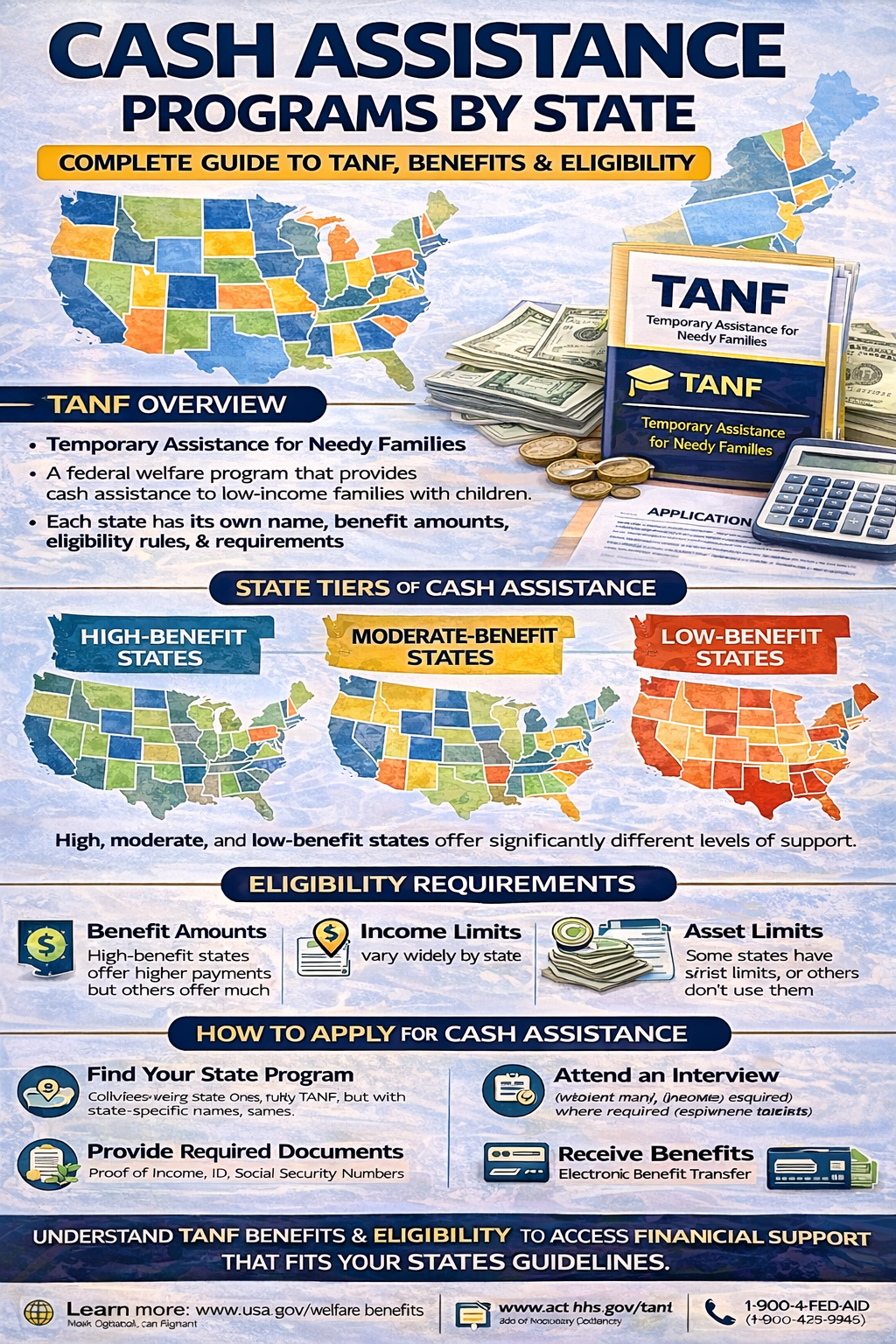
Cash assistance programs are designed to help individuals and families who lack sufficient income to meet basic needs. These programs are typically means-tested, meaning eligibility is based on income level, household size, and financial resources. According to official data, public assistance programs are intended to provide financial or in-kind support to those experiencing economic hardship and are a key component of poverty reduction strategies in the United States.
The most prominent cash assistance program is TANF, which replaced the older Aid to Families with Dependent Children (AFDC) program in the 1990s. TANF was created with a strong emphasis on promoting work, reducing dependency on government assistance, and encouraging family stability. As a result, TANF programs often combine direct financial assistance with work requirements, job training programs, and other services designed to help recipients achieve self-sufficiency over time.
Cash assistance provided through TANF can be used for a wide range of essential expenses. Unlike restricted benefits, recipients are generally free to allocate funds according to their needs, which makes cash assistance particularly valuable during emergencies or periods of financial uncertainty. This flexibility is one of the reasons why TANF remains a critical resource for families across the country.
The Structure of TANF and Why It Varies by State
The TANF program operates as a block grant system, meaning that the federal government provides a fixed amount of funding to each state, and states have considerable discretion in how those funds are used. This design was intended to give states flexibility to tailor programs to local needs, economic conditions, and policy priorities. However, it has also resulted in significant variation in how cash assistance is delivered.
Each state determines its own:
- Income eligibility thresholds
- Asset limits
- Monthly benefit amounts
- Work participation requirements
- Time limits for receiving benefits
- Sanctions for non-compliance
Because of these differences, the experience of receiving cash assistance can vary dramatically depending on geographic location. For example, a family living in a high-cost state like California may receive substantially higher benefits than a similar family in a lower-benefit state such as Mississippi or South Carolina. These differences reflect not only cost-of-living variations but also policy choices made by state governments.
Another important factor is how states allocate TANF funds. While the program is intended to provide direct cash assistance, many states use a significant portion of their funding for other purposes, such as childcare programs, job training initiatives, and administrative costs. This means that in some states, only a small percentage of TANF funds is actually distributed as direct cash payments to families.
Cash Assistance Programs by State
Alabama – Family Assistance (TANF)
Provides monthly cash to low-income families with children. Includes strict work requirements and relatively low benefit amounts.
Alaska – Alaska Temporary Assistance Program (ATAP)
Offers cash assistance plus strong employment services. Benefits are higher due to cost of living.
Arizona – Cash Assistance (CA)
Focuses on short-term support with strong job participation rules and lifetime limits.
Arkansas – Transitional Employment Assistance (TEA)
Provides cash assistance along with job training and employment support.
California – CalWORKs
One of the most generous programs. Offers cash aid, childcare, housing support, and job services.
Colorado – Colorado Works
Combines cash assistance with employment programs and supportive services.
Connecticut – Temporary Family Assistance (TFA)
Provides cash support with relatively higher benefits and access to additional services.
Delaware – Temporary Assistance for Needy Families
Standard TANF program with moderate benefits and work requirements.
Florida – Temporary Cash Assistance (TCA)
Offers limited benefits with strict time limits and strong work participation rules.
Georgia – Temporary Assistance for Needy Families
Provides low cash benefits and requires participation in work activities.
Hawaii – Temporary Assistance for Needy Families
Offers higher benefits due to high living costs, along with supportive services.
Idaho – Temporary Assistance for Families in Idaho (TAFI)
Focuses on work participation and short-term assistance.
Illinois – Temporary Assistance for Needy Families
Provides moderate benefits and additional employment services.
Indiana – TANF Cash Assistance
Includes employment requirements and moderate benefit levels.
Iowa – Family Investment Program (FIP)
Offers cash assistance with a strong focus on employment and self-sufficiency.
Kansas – Temporary Assistance for Needy Families
Provides limited benefits with strict work and time requirements.
Kentucky – Kentucky Transitional Assistance Program (KTAP)
Offers cash assistance and job training programs.
Louisiana – Family Independence Temporary Assistance Program (FITAP)
Provides low cash benefits and emphasizes employment.
Maine – Temporary Assistance for Needy Families
Offers moderate benefits with supportive services.
Maryland – Temporary Cash Assistance (TCA)
Provides cash aid and job support with relatively flexible rules.
Massachusetts – Transitional Aid to Families with Dependent Children (TAFDC)
One of the more supportive programs with higher benefits and services.
Michigan – Family Independence Program (FIP)
Provides cash assistance with work requirements and time limits.
Minnesota – Minnesota Family Investment Program (MFIP)
Combines cash and food assistance with employment services.
Mississippi – Temporary Assistance for Needy Families
Offers very low benefits and strict eligibility rules.
Missouri – Temporary Assistance (TA)
Provides limited cash assistance and work programs.
Montana – Temporary Assistance for Needy Families
Offers moderate benefits with employment services.
Nebraska – Aid to Dependent Children (ADC)
Provides cash assistance with work participation requirements.
Nevada – Temporary Assistance for Needy Families
Standard TANF structure with moderate benefits.
New Hampshire – Financial Assistance to Needy Families (FANF)
Offers moderate support and employment services.
New Jersey – Work First New Jersey (WFNJ)
Provides cash assistance along with job training and childcare support.
New Mexico – New Mexico Works
Offers cash assistance and employment programs.
New York – Family Assistance (FA)
Provides higher benefits and longer support periods compared to many states.
North Carolina – Work First Family Assistance
Focuses on short-term aid and employment requirements.
North Dakota – Temporary Assistance for Needy Families
Offers moderate benefits and work programs.
Ohio – Ohio Works First (OWF)
Provides cash assistance with strong work participation rules.
Oklahoma – Temporary Assistance for Needy Families
Offers limited benefits with strict requirements.
Oregon – Temporary Assistance for Needy Families
Provides moderate to higher benefits and supportive services.
Pennsylvania – Temporary Assistance for Needy Families
Includes both cash assistance and employment programs.
Rhode Island – Rhode Island Works
Offers moderate benefits with strict time limits.
South Carolina – Family Independence (FI)
Provides low benefits and strict work requirements.
South Dakota – Temporary Assistance for Needy Families
Offers limited cash assistance.
Tennessee – Families First
Focuses on short-term assistance and job readiness.
Texas – Temporary Assistance for Needy Families
Provides low benefits with strict eligibility rules.
Utah – Family Employment Program (FEP)
Combines cash assistance with employment services.
Vermont – Reach Up
Offers relatively supportive benefits and services.
Virginia – Temporary Assistance for Needy Families
Provides moderate benefits and job support.
Washington – WorkFirst
One of the more comprehensive programs with strong employment services.
West Virginia – WV Works
Provides cash assistance and employment programs.
Wisconsin – Wisconsin Works (W-2)
Focuses heavily on employment rather than direct cash payments.
Wyoming – POWER (Personal Opportunities With Employment Responsibilities)
Offers moderate benefits with work requirements.
Categories of Cash Assistance Across States
Although each state program is unique, cash assistance systems can generally be grouped into three broad categories based on the level of support provided.
High-Benefit States
High-benefit states typically provide larger monthly payments and more comprehensive support services. These states often have higher living costs and stronger commitments to social welfare programs. In these states, cash assistance is more likely to cover a meaningful portion of basic living expenses.
Examples include states like California, New York, Massachusetts, and Washington. In these states, benefit levels are higher, and recipients may have access to additional services such as housing assistance, job placement programs, and childcare support. These programs are often designed to provide both immediate relief and long-term pathways to financial independence.
Moderate-Benefit States
Moderate-benefit states offer a balanced approach, providing reasonable levels of assistance while maintaining stricter eligibility requirements and work expectations. These states aim to support families while also encouraging employment and self-sufficiency.
Examples include Illinois, Pennsylvania, Colorado, and Minnesota. In these states, benefit amounts are generally sufficient to provide partial support but may not fully cover living expenses. Recipients are often required to participate in work programs or training initiatives to continue receiving assistance.
Low-Benefit States
Low-benefit states provide significantly lower levels of cash assistance, often due to policy choices or budget limitations. In these states, benefits may cover only a small fraction of basic living costs, making it difficult for families to achieve financial stability.
In some Southern states, monthly benefits for a family of three may fall well below $400. These low benefit levels can create challenges for families trying to meet essential needs, particularly in areas with limited employment opportunities or higher living costs.
Eligibility Requirements and How They Differ
Eligibility for cash assistance programs depends on several factors, and these can vary widely between states.
Income Requirements
Each state sets its own income limits, which determine whether a household qualifies for assistance. These limits are typically based on a percentage of the federal poverty level but can vary significantly.
Asset Limits
Some states impose limits on the amount of savings or property a household can have, while others have eliminated asset limits to make programs more accessible.
Work Requirements
Most states require recipients to participate in work-related activities, such as employment, job training, or community service. These requirements are intended to promote self-sufficiency but can also create barriers for individuals facing challenges such as lack of childcare or transportation.
Time Limits
Federal law sets a general lifetime limit of five years for TANF benefits, but states can impose shorter limits or provide exceptions in certain cases.
Frequently Asked Questions (FAQs)
What is the main cash assistance program in the United States?
The primary program is Temporary Assistance for Needy Families (TANF), which provides financial support to low-income families with children.
Do cash assistance benefits vary by state?
Yes, benefits, eligibility requirements, and program rules vary significantly from one state to another.
How much cash assistance can I receive?
The amount depends on the state and household size. Payments can range from under $300 to over $700 per month.
Can single individuals receive cash assistance?
In some states, General Assistance programs provide support for individuals without children.
How long can I receive TANF benefits?
Most states follow a lifetime limit of five years, although some may have shorter limits or exceptions.
Reference Links
https://www.usa.gov/welfare-benefits
https://www.acf.hhs.gov/ofa/programs/tanf
https://www.nccp.org/publication/tanf-benefits-by-state/
https://www.census.gov/topics/income-poverty/public-assistance.html
Disclaimer
Program Clarity is an independent informational website and is not affiliated with any government agency. This article is for educational purposes only. Program rules and availability may change. Always verify details with official authorities.