
Introduction
The United States has long recognized the importance of family unity as a cornerstone of its immigration system. For decades, family-sponsored immigration has served as one of the primary pathways through which foreign nationals obtain lawful permanent residence in the country. Every year, hundreds of thousands of immigrants receive green cards through family relationships, allowing them to reunite with loved ones and establish permanent lives in the United States. Whether the goal is to bring a spouse, child, parent, or sibling to America, the Family Based Green Card immigration process plays a critical role in helping families stay together despite international borders.
A family-based green card is more than just an immigration document. It provides the recipient with lawful permanent resident status, granting the right to live and work in the United States indefinitely. Green card holders enjoy many of the same rights and protections as U.S. citizens, including employment opportunities, access to educational institutions, property ownership rights, and the ability to travel internationally. Over time, many family-sponsored immigrants become eligible to apply for U.S. citizenship, further strengthening their connection to the country and expanding their opportunities.
Despite its importance, the family-based immigration system can be confusing for many applicants. Immigration laws contain numerous categories, eligibility rules, financial requirements, and procedural steps that vary depending on the relationship between the sponsor and the beneficiary. Some relatives receive immigration benefits relatively quickly, while others may wait several years due to annual visa limits and processing backlogs. Understanding how the system works is essential for anyone considering family sponsorship.
What Is a Family Based Green Card?
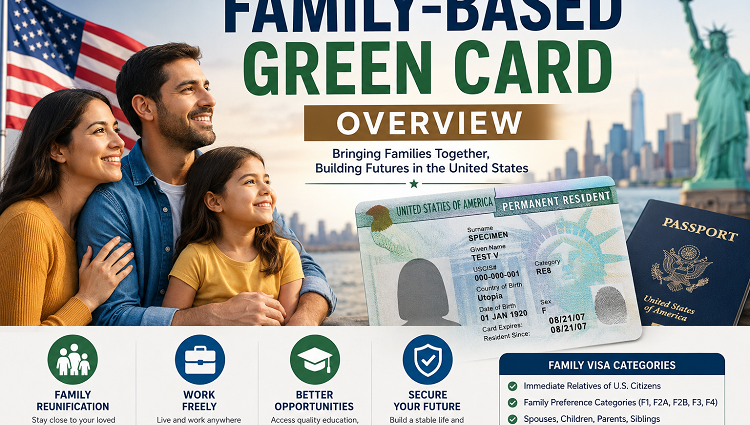
A family-based green card is a type of immigrant visa that ultimately grants lawful permanent resident status to a foreign national based on a qualifying family relationship with a U.S. citizen or lawful permanent resident. The purpose of this immigration category is to promote family reunification, which has remained one of the guiding principles of U.S. immigration policy for generations. Through this system, eligible relatives can legally immigrate to the United States and establish permanent residence alongside family members who already live in the country.
When an individual receives a family-based green card, they gain the legal right to reside permanently anywhere in the United States. Unlike temporary visas that require renewal or impose employment restrictions, a green card provides long-term stability. Permanent residents may work for almost any employer, start businesses, pursue higher education, purchase property, and access many public services available under federal and state laws. These benefits make the family-based green card one of the most sought-after immigration options available today.
Family Reunification in U.S. Immigration
Family reunification has been a central objective of American immigration law for many decades. Lawmakers have long recognized that strong family connections contribute to stable communities, economic growth, and successful immigrant integration. As a result, a substantial portion of immigrant visas issued each year are reserved for family-sponsored immigrants.
The philosophy behind family reunification is straightforward. Families provide emotional support, financial assistance, childcare, elder care, and other essential forms of stability that help individuals thrive. When families remain separated across international borders, both emotional and economic hardships can arise. By allowing close relatives to immigrate legally, the United States seeks to reduce these burdens and strengthen family units.
Family-sponsored immigrants often play important roles in their communities after arriving in the United States. Many establish businesses, contribute to local economies, pay taxes, and participate actively in civic life. Family support networks can also help newcomers adapt more quickly to American society by providing housing, employment connections, language assistance, and cultural guidance. These factors often contribute to successful long-term integration.
Types of Family-Based Green Cards
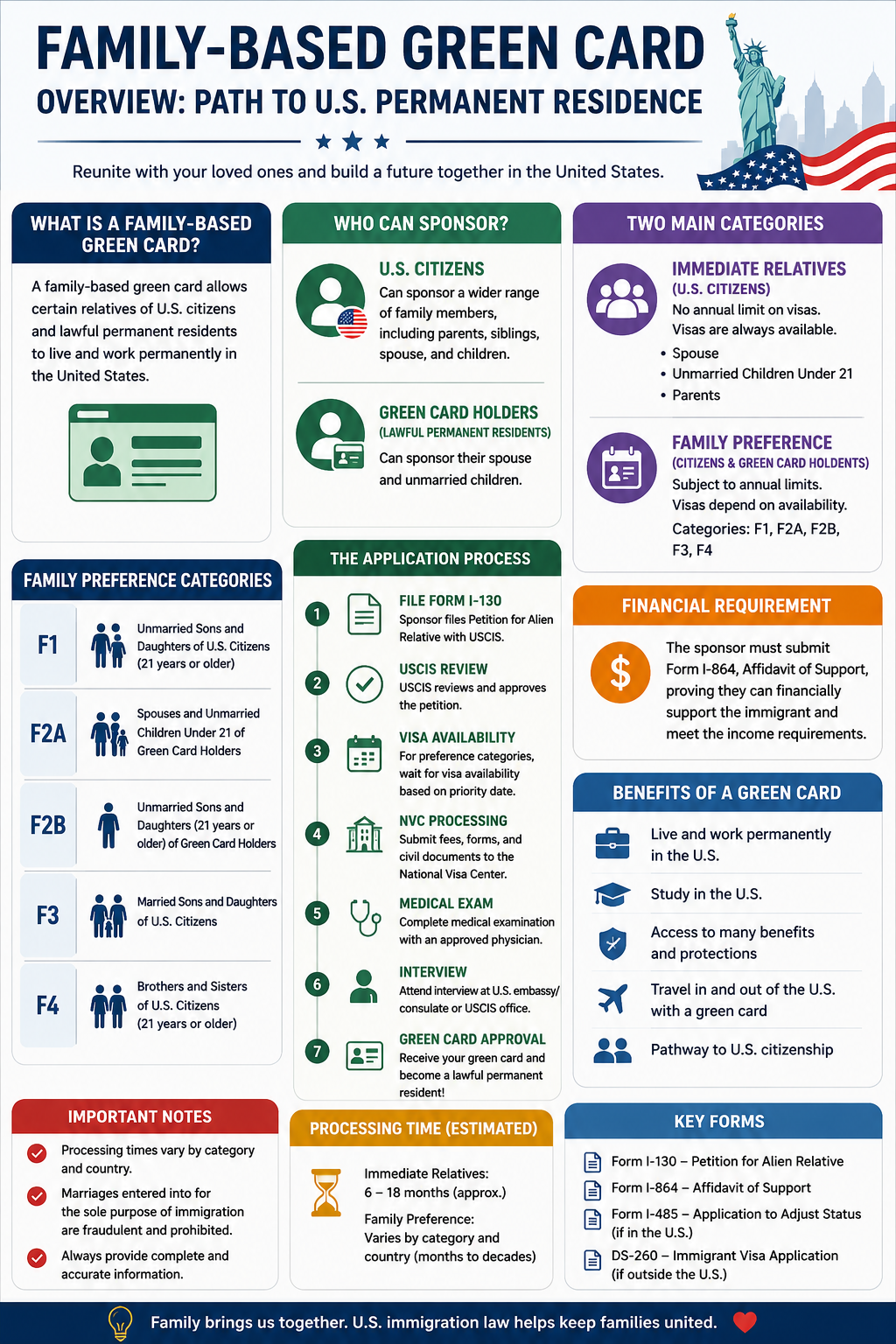
Family-based green cards fall into two broad categories: Immediate Relative Immigrant Visas and Family Preference Immigrant Visas. Understanding the difference between these categories is one of the most important steps in learning how family-sponsored immigration works.
Immediate Relative Green Cards
Immediate relatives receive special treatment under U.S. immigration law because they are considered the closest family members of U.S. citizens. One major advantage of this category is that there are no annual limits on the number of visas available. As a result, applicants generally avoid the lengthy waiting periods commonly associated with preference categories.
Spouse of a U.S. Citizen
A foreign national who is legally married to a U.S. citizen may qualify for a marriage-based green card. This category is one of the most common forms of family-sponsored immigration. However, because immigration fraud involving marriages has occurred in the past, USCIS carefully examines these applications to ensure the relationship is genuine.
Applicants must provide substantial evidence demonstrating that the marriage was entered into in good faith rather than solely for immigration benefits. Examples of acceptable evidence include joint bank accounts, mortgage documents, lease agreements, utility bills, photographs, travel records, insurance policies, and affidavits from friends and family members. Immigration officers may also conduct interviews to evaluate the authenticity of the relationship.
For many couples, obtaining a marriage-based green card represents the beginning of a new life together in the United States. Once approved, the immigrant spouse can work legally, pursue educational opportunities, and enjoy the security of permanent resident status.
Unmarried Children Under 21 of U.S. Citizens
Children under the age of 21 who are unmarried qualify as immediate relatives when sponsored by a U.S. citizen parent. This category reflects the government’s commitment to keeping nuclear families together. Because visas are immediately available, processing tends to move more quickly than in preference categories.
Parents seeking to sponsor children must provide evidence establishing the parent-child relationship. Common documents include birth certificates, adoption records, and legal custody documents where applicable. In certain situations, additional evidence may be required to verify eligibility.
Children who immigrate through this category gain access to educational opportunities, healthcare resources, and long-term stability in the United States. Many eventually become citizens through naturalization or derivative citizenship provisions.
Family Preference Categories
While immediate relatives of U.S. citizens benefit from unlimited visa availability, many other family members must immigrate through the Family Preference System. These categories are subject to annual numerical limits established by Congress, which means applicants often face waiting periods before a visa becomes available. Depending on the applicant’s country of birth and visa demand, these waits can range from several years to more than a decade.
Understanding how family preference categories work is essential because visa availability often determines how long the immigration process will take. Applicants in these categories receive a priority date when Form I-130 is filed, and that date essentially determines their place in line for a visa.
Unmarried Adult Sons and Daughters of U.S. Citizens
The F1 category is designed for unmarried sons and daughters of U.S. citizens who are 21 years of age or older. Although these individuals are children of American citizens, they are not considered immediate relatives because they have reached adulthood under immigration law.
This category allows families to remain connected even when children have grown into adulthood. Many beneficiaries in this category pursue higher education, professional careers, and family responsibilities while waiting for visa availability. Because annual visa numbers are limited, applicants often experience waiting periods that vary based on demand and country of origin.
One important consideration is marital status. If an applicant marries while waiting in the F1 category, they generally move into the F3 category, which has different visa availability rules and often longer waiting times. Therefore, life changes during the waiting period can significantly affect immigration timelines.
Spouses and Minor Children of Permanent Residents
The F2A category covers spouses and unmarried children under the age of 21 of lawful permanent residents. This category is especially important because permanent residents do not have the same sponsorship rights as U.S. citizens.
For many families, the F2A category provides a pathway to reunification while the sponsoring relative continues living and working in the United States. Although this category is subject to annual visa limits, it often experiences shorter waiting periods than several other family preference groups.
Applicants must demonstrate a valid qualifying relationship. Spouses must provide evidence of a genuine marriage, while children must establish the parent-child relationship through appropriate documentation. Immigration authorities carefully review supporting evidence to ensure eligibility requirements are satisfied.
Unmarried Adult Sons and Daughters of Permanent Residents
The F2B category applies to unmarried sons and daughters who are at least 21 years old and whose sponsoring parent is a lawful permanent resident.
This category exists because immigration law recognizes that family relationships remain important even after children become adults. However, because visa numbers are limited and demand remains high, applicants often face significant waiting periods before becoming eligible for permanent residency.
Beneficiaries in the F2B category must remain unmarried throughout the immigration process. Marriage generally results in the loss of eligibility because permanent residents cannot sponsor married children. In many cases, applicants who marry must wait until their sponsoring parent becomes a U.S. citizen before a new category becomes available.
Due to lengthy processing times, applicants should maintain updated records and monitor visa bulletin developments regularly. Careful planning can help families avoid unnecessary delays during the waiting period.
Married Sons and Daughters of U.S. Citizens
The F3 category allows U.S. citizens to sponsor married sons and daughters regardless of age. This category acknowledges that family relationships continue to play a vital role throughout adulthood, even after children establish their own families.
One advantage of the F3 category is that the beneficiary’s spouse and unmarried children may often immigrate as derivative beneficiaries. This means an entire family unit may be able to obtain permanent residency through a single petition.
However, because annual visa limits apply and demand is substantial, waiting periods can be lengthy. Applicants often remain on waiting lists for many years before a visa becomes available. During this time, maintaining accurate records and responding promptly to immigration requests becomes especially important.
Brothers and Sisters of U.S. Citizens
The F4 category allows U.S. citizens who are at least 21 years old to sponsor their siblings for permanent residency. This category reflects the importance of sibling relationships and recognizes that brothers and sisters often provide lifelong emotional and financial support to one another.
Among all family-based categories, F4 frequently experiences some of the longest waiting periods. High demand combined with annual visa limitations creates substantial backlogs. In some countries with particularly high immigration demand, waiting periods may extend for well over a decade.
Despite these challenges, many families successfully use the F4 category to reunite in the United States. Beneficiaries often spend years preparing documentation, monitoring visa bulletin updates, and planning their future immigration journey.
Who Can Sponsor a Family Member?
Not every individual residing in the United States has the legal authority to sponsor relatives for immigration benefits. Immigration law establishes specific requirements regarding who may serve as a sponsor and which family members qualify.
Sponsorship Rights of U.S. Citizens
U.S. citizens enjoy the broadest family sponsorship privileges available under immigration law. Citizens may sponsor:
- Spouses
- Parents
- Children under 21
- Adult unmarried children
- Married children
- Brothers and sisters
These extensive sponsorship rights make naturalization an attractive option for many permanent residents who wish to reunite with additional family members in the future.
Citizens sponsoring relatives must provide proof of citizenship, such as a U.S. passport, birth certificate, certificate of naturalization, or certificate of citizenship.
Sponsorship Rights of Lawful Permanent Residents
Permanent residents have more limited sponsorship authority. They may sponsor:
- Spouses
- Unmarried children under 21
- Adult unmarried children
Permanent residents cannot sponsor parents, married children, or siblings. To gain those rights, they must first become naturalized U.S. citizens.
Many green card holders begin family sponsorship processes while simultaneously working toward citizenship. Once naturalization occurs, pending petitions may sometimes be upgraded to categories with improved visa availability.
Understanding the Affidavit of Support
One of the most important aspects of family-based immigration is the financial sponsorship requirement. The U.S. government seeks to ensure that immigrants entering the country have adequate financial support and are unlikely to become dependent on public assistance programs.
To satisfy this requirement, most sponsors must submit Form I-864, Affidavit of Support.
The Affidavit of Support is not merely a formality. It is a legally enforceable contract between the sponsor and the federal government. By signing the form, the sponsor accepts financial responsibility for supporting the immigrant if necessary.
The sponsor generally must demonstrate income at or above a specified percentage of the Federal Poverty Guidelines. The required income level varies depending on household size and other factors. Income may be proven through tax returns, employment records, pay stubs, and other financial documentation.
When a sponsor’s income is insufficient, assets may sometimes be used to meet financial requirements. Alternatively, a qualified joint sponsor may agree to assume financial responsibility alongside the primary sponsor.
Because financial sponsorship plays a crucial role in immigration approval, applicants should carefully review all income requirements before filing.
Common Documentation Required for Family-Based Green Cards
Immigration authorities require extensive documentation to verify eligibility and establish the qualifying family relationship.
Common documents include:
- Birth certificates
- Marriage certificates
- Divorce decrees
- Adoption records
- Passports
- National identification cards
- Financial records
- Tax returns
- Employment verification letters
- Photographs
- Immigration records
The specific documentation required depends on the immigration category and individual circumstances. Applicants should ensure that all records are accurate, complete, and translated into English when necessary.
Failure to provide adequate documentation is one of the most common reasons for processing delays.
Family-Based Green Card Costs
The cost of obtaining a family-based green card varies depending on the immigration pathway and location of the applicant.
Potential expenses include:
- Form I-130 filing fees
- Form I-485 filing fees
- Consular processing fees
- Medical examination costs
- Biometrics fees
- Translation services
- Document procurement costs
- Attorney fees (if applicable)
Families should budget carefully before beginning the process because immigration expenses can accumulate over time.
Benefits of Family-Based Immigration
Family-sponsored immigration provides numerous long-term advantages beyond simply obtaining legal status.
Permanent residents gain the ability to work legally throughout the United States without employer sponsorship. They may pursue educational opportunities, establish businesses, invest in property, and travel internationally.
Family reunification also provides emotional benefits. Living near loved ones can improve quality of life, strengthen family relationships, and create valuable support systems during major life transitions.
For many immigrants, a family-based green card eventually becomes a pathway to U.S. citizenship, opening additional opportunities for civic participation and expanded immigration sponsorship rights.
Common Challenges in Family-Based Immigration
Despite its many benefits, family-based immigration is not without challenges.
Applicants often encounter lengthy processing times, extensive paperwork requirements, changing immigration policies, and financial sponsorship obligations. In preference categories, visa backlogs can create significant delays that require years of patience.
Other common challenges include:
- Missing documentation
- Requests for additional evidence
- Interview preparation
- Translation requirements
- Immigration history complications
- Criminal background issues
Thorough preparation and attention to detail can help families navigate these challenges successfully.
References
- USCIS Family-Based Immigration – https://www.uscis.gov/family
- USCIS Form I-130 – https://www.uscis.gov/i-130
- USCIS Green Card Eligibility – https://www.uscis.gov/green-card
- USCIS Form I-864 – https://www.uscis.gov/i-864
- USCIS Adjustment of Status – https://www.uscis.gov/i-485
- U.S. Department of State Visa Bulletin – https://travel.state.gov/content/travel/en/legal/visa-law0/visa-bulletin.html
- U.S. Department of State Immigrant Visas – https://travel.state.gov/content/travel/en/us-visas/immigrate.html
- USCIS Citizenship and Naturalization – https://www.uscis.gov/citizenship