
Filing a tax return is an annual responsibility for millions of taxpayers, yet many people worry about one possibility more than any other: being audited. The word “audit” often creates anxiety because it suggests that tax authorities will closely examine financial records, income sources, deductions, and tax calculations. While audits can be intimidating, understanding why they occur can help taxpayers prepare accurate returns and reduce the likelihood of attracting unwanted attention.
One of the biggest misconceptions about audits is that they happen randomly or only target wealthy individuals and large corporations. In reality, modern tax authorities rely heavily on advanced technology, sophisticated data-matching systems, statistical analysis, and compliance programs to identify tax returns that may contain errors, omissions, or unusual reporting patterns. Although some audits are selected randomly for research and compliance measurement purposes, most are chosen because specific factors indicate a higher probability of mistakes or underreported taxes.
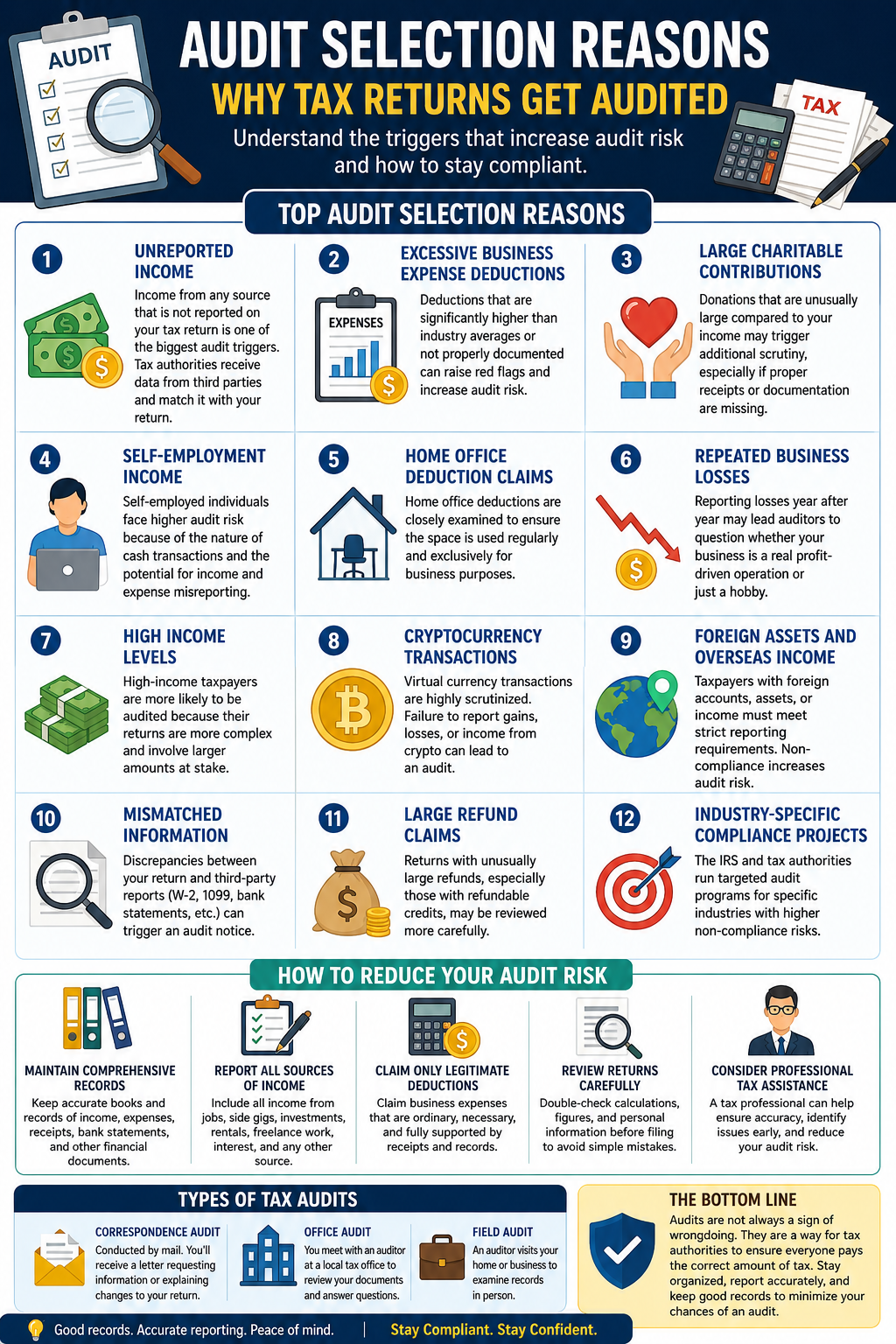
Understanding audit selection reasons is important for both individual taxpayers and business owners. Knowing what tax authorities look for allows taxpayers to improve recordkeeping, avoid common filing mistakes, and support deductions with proper documentation. While no taxpayer can completely eliminate the possibility of an audit, awareness of common audit triggers can significantly reduce risk.
What Is a Tax Audit?
A tax audit is an official examination of a taxpayer’s financial information and tax return conducted by a tax authority to verify that income, deductions, credits, and other tax-related items have been reported correctly. The primary purpose of an audit is to ensure compliance with tax laws and determine whether the correct amount of tax has been paid.
Contrary to popular belief, an audit does not automatically mean a taxpayer has done something wrong. Many audits result from routine verification procedures or simple discrepancies that require clarification. In some cases, taxpayers may even discover they are entitled to additional refunds after providing supporting documentation.
Audits can vary in scope and complexity. Some involve only a request for documents supporting a specific deduction or credit, while others require a detailed review of financial records spanning multiple years. The extent of the examination depends largely on the issues identified during the audit selection process.
How Tax Authorities Select Tax Returns for Audit
The audit selection process has evolved significantly over the years. Modern tax agencies no longer rely primarily on manual review. Instead, sophisticated computer systems analyze millions of tax returns and assign risk scores based on numerous factors.
These systems compare taxpayer information with data received from employers, financial institutions, brokerage firms, payment processors, government agencies, and other third parties. Returns that contain unusual patterns, inconsistencies, or reporting anomalies are often assigned higher risk scores and may be selected for further review.
Tax authorities also use statistical models that compare taxpayers with others in similar income brackets, industries, occupations, or geographic regions. If a return differs substantially from expected norms, it may trigger additional scrutiny.
While technology plays a major role in audit selection, human examiners still review many returns before deciding whether a formal audit is warranted. This combination of automated analysis and professional judgment helps tax authorities allocate enforcement resources efficiently while maintaining compliance across the tax system.
Common Audit Selection Reasons
Unreported Income
Unreported income remains one of the most significant reasons tax returns are selected for audit. Tax authorities receive copies of income reports from numerous sources, including employers, banks, brokerage firms, payment processors, retirement plan administrators, and online marketplaces. These reports are automatically compared against information reported on tax returns.
When income reported by third parties does not match the taxpayer’s return, the discrepancy often generates an alert within the tax authority’s compliance system. Even relatively small differences can attract attention because they may indicate broader reporting issues. For example, a taxpayer who forgets to include freelance income, interest earnings, investment gains, or rental income could face questions about the omission.
The growth of the gig economy has made income reporting more complex than ever before. Many individuals earn money through consulting work, online businesses, ride-sharing services, digital content creation, and freelance projects. Because many platforms now provide information directly to tax authorities, failing to report this income can significantly increase audit risk.
To reduce the likelihood of an audit, taxpayers should carefully review all income documents before filing and ensure every source of taxable income is accurately reported.
Excessive Business Expense Deductions
Business deductions are an essential component of the tax system because they allow businesses to reduce taxable income by claiming legitimate operating expenses. However, unusually large deductions relative to reported income often attract attention from tax authorities.
Audit selection systems frequently compare a business’s deductions against industry averages and historical trends. When deductions appear significantly higher than expected for a similar business, the return may be flagged for review. This does not necessarily mean the deductions are improper, but it does increase the likelihood that supporting documentation will be requested.
Expenses commonly examined include travel costs, vehicle expenses, office supplies, equipment purchases, consulting fees, marketing expenditures, and employee-related costs. Tax authorities generally expect taxpayers to maintain detailed records showing that each expense was ordinary, necessary, and directly related to business operations.
Businesses that keep organized financial records and retain receipts, invoices, contracts, and payment records are typically better positioned to defend deductions during an audit.
Large Charitable Contributions
Charitable contributions provide valuable tax benefits while supporting worthy causes. However, unusually large charitable deductions often receive additional scrutiny, particularly when the donation amount appears disproportionate to the taxpayer’s income level.
For example, if a taxpayer reports moderate income but claims exceptionally large charitable contributions, tax authorities may seek verification of the donations. This is especially common for non-cash contributions such as artwork, collectibles, vehicles, real estate, or other property whose value may be subject to interpretation.
Taxpayers claiming charitable deductions should maintain detailed records, including receipts, acknowledgment letters from charitable organizations, appraisal reports when required, and proof of payment. Proper documentation is often the key factor in successfully supporting charitable deduction claims during an audit.
Self-Employment Income
Self-employed individuals typically face greater audit exposure than traditional employees because they have more control over how income and expenses are reported. Unlike employees whose wages are reported directly by employers, self-employed taxpayers are responsible for tracking business revenue, deductible expenses, and tax obligations themselves.
This increased reporting responsibility creates more opportunities for errors, omissions, or misunderstandings. Tax authorities frequently examine self-employed taxpayers because cash transactions, business expenses, and income reporting can be difficult to verify without supporting records.
Common areas of review include home office deductions, vehicle expenses, travel costs, contractor payments, and business-related purchases. Taxpayers who maintain accurate accounting records and separate business finances from personal finances generally experience fewer audit-related issues.
Home Office Deduction Claims
The home office deduction is a legitimate tax benefit that allows eligible taxpayers to deduct certain expenses associated with business use of their home. However, because the deduction has historically been misunderstood and occasionally abused, it remains an area of interest for tax authorities.
To qualify, the space generally must be used regularly and exclusively for business purposes. A room that serves both personal and business functions may not meet the requirements. Tax authorities often review home office claims to verify that the deduction is calculated correctly and that the space qualifies under applicable rules.
Taxpayers claiming a home office deduction should retain floor plans, utility bills, mortgage statements, rent records, photographs, and other documents supporting the calculation.
Repeated Business Losses
Businesses occasionally experience losses, particularly during startup phases or economic downturns. However, reporting losses year after year may cause tax authorities to question whether the activity is truly a business or merely a hobby.
This issue commonly arises with activities such as farming, horse breeding, photography, crafting, online selling, and other ventures that combine personal enjoyment with potential profit. Tax authorities generally expect businesses to demonstrate a genuine profit motive and make reasonable efforts to become profitable over time.
When losses continue for multiple years, auditors may examine business plans, marketing efforts, financial records, and operational practices to determine whether the activity qualifies as a legitimate business.
High Income Levels
Taxpayers with higher incomes generally face greater audit rates than those with lower incomes. This does not mean high-income individuals are more likely to make mistakes; rather, their financial situations often involve greater complexity.
High-income taxpayers may have multiple income sources, extensive investments, business ownership interests, foreign assets, partnerships, trusts, and sophisticated tax planning strategies. These factors increase the number of items requiring review and create more opportunities for reporting discrepancies.
As a result, tax authorities often devote additional resources to examining high-income returns to ensure compliance with applicable tax laws.
Cryptocurrency Transactions
Cryptocurrency has become a major focus of tax enforcement efforts worldwide. Many taxpayers mistakenly assume digital asset transactions are difficult for tax authorities to track. In reality, reporting requirements and information-sharing agreements have significantly increased visibility into cryptocurrency activities.
Tax authorities frequently review returns involving cryptocurrency trading, mining, staking, decentralized finance activities, and non-fungible token transactions. Failure to report gains, losses, or income related to digital assets can increase audit risk substantially.
Because cryptocurrency taxation can be complex, taxpayers should maintain detailed transaction records and seek professional guidance when necessary.
Foreign Assets and Overseas Income
International tax compliance has become a growing enforcement priority. Tax authorities around the world increasingly cooperate through information-sharing agreements that provide access to financial account data held abroad.
Taxpayers with foreign bank accounts, offshore investments, overseas businesses, or foreign-source income often face additional reporting obligations. Failure to disclose these assets properly can result in severe penalties and significantly increase the likelihood of an audit.
Even taxpayers who pay taxes in another country may still have reporting obligations depending on their residency status and applicable tax laws. Accurate reporting and compliance with international disclosure requirements are essential.
Mismatched Information
One of the most common audit triggers involves discrepancies between taxpayer-reported information and third-party records. Information matching programs automatically compare tax returns with documents submitted by employers, banks, brokerage firms, payment processors, and other organizations.
When figures do not align, tax authorities may issue notices requesting clarification or initiate a more comprehensive review. Mismatches involving wages, interest income, dividend income, retirement distributions, and contractor payments are particularly common.
Carefully reviewing tax documents before filing can help identify and correct discrepancies before they attract attention.
Large Refund Claims
Returns claiming unusually large refunds often receive additional scrutiny. Tax authorities recognize that refund fraud remains a significant problem and therefore review certain refund claims more closely before releasing funds.
Large refunds may result from excessive withholding, refundable credits, business losses, or substantial deductions. While legitimate refunds are common, unusually large claims may prompt requests for additional verification or supporting documentation.
Taxpayers should ensure that refund-related information is accurate and fully supported by records.
Industry-Specific Compliance Projects
Tax authorities frequently conduct compliance initiatives targeting specific industries where reporting errors are historically common. Businesses operating within these industries may face higher audit rates even when they comply fully with tax laws.
Industries often targeted include construction, hospitality, healthcare, transportation, real estate, and cash-intensive retail operations. These sectors sometimes present unique compliance challenges that justify increased examination activity.
Business owners should stay informed about industry-specific reporting requirements and maintain thorough documentation supporting all financial transactions.
Additional Red Flags That May Increase Audit Risk
Several patterns frequently attract attention during the audit selection process:
Consistently Rounded Numbers
Tax returns showing numerous expenses reported as exact round figures may appear estimated rather than documented. While occasional rounded amounts are normal, excessive use of rounded numbers may raise questions regarding record accuracy.
Income and Lifestyle Inconsistencies
Tax authorities may notice situations where reported income appears inconsistent with visible spending patterns. Significant purchases, luxury assets, or large investments may attract attention if they seem difficult to support based on reported earnings.
Frequent Amendments
Repeatedly filing amended returns may suggest underlying reporting problems and could increase the likelihood of further review.
Missing Documentation
Taxpayers who cannot support deductions or credits with proper records often face challenges during examinations. Good recordkeeping remains one of the most effective ways to reduce audit-related risks.
How to Reduce Your Chances of Being Audited
Maintain Comprehensive Records
Accurate recordkeeping is perhaps the most effective defense against audit issues. Organized financial records not only support tax return entries but also demonstrate good-faith compliance efforts.
Important records include receipts, invoices, contracts, bank statements, payroll records, mileage logs, investment statements, and tax forms. Maintaining these documents throughout the year makes tax preparation significantly easier and reduces the likelihood of errors.
Report All Sources of Income
Every source of taxable income should be reported, regardless of amount. Taxpayers should carefully review all tax documents received and compare them against personal financial records before filing.
Claim Only Legitimate Deductions
Deductions should be based on actual expenses supported by documentation. Avoid estimating expenses or claiming deductions that cannot be substantiated if questioned.
Review Returns Carefully Before Filing
Simple mistakes can trigger notices and additional scrutiny. Reviewing calculations, verifying identification information, and ensuring consistency across forms can prevent many common filing errors.
Consider Professional Tax Assistance
Tax professionals can help identify potential issues, ensure compliance, and provide guidance regarding complex transactions. For business owners, investors, and self-employed individuals, professional assistance may reduce both filing errors and audit risk.
What Happens If You Are Selected for an Audit?
Receiving an audit notice does not automatically mean penalties or additional taxes will result. Many audits conclude with minimal changes or no changes at all.
The audit process generally begins with an official notice explaining the items under review. Taxpayers are typically asked to provide documentation supporting specific entries on their returns. Depending on the complexity of the issues involved, the audit may be conducted through correspondence, at a tax office, or at the taxpayer’s business location.
After reviewing the documentation, auditors will determine whether adjustments are necessary. Taxpayers generally have the opportunity to provide explanations, submit additional evidence, and appeal decisions if disagreements arise.
Cooperation, organization, and timely responses often contribute to a smoother audit experience.
Frequently Asked Questions (FAQs)
What is the most common audit trigger?
Unreported income is one of the most common reasons tax returns are selected for audit because tax authorities compare taxpayer returns with information received from third parties.
Are self-employed individuals audited more frequently?
Yes. Self-employed taxpayers often face greater scrutiny because they are responsible for reporting both income and deductible expenses.
Can large charitable donations trigger an audit?
Large charitable deductions may attract attention when they appear unusually high compared with reported income, especially if documentation is incomplete.
Does claiming a home office deduction increase audit risk?
Not necessarily. However, incorrect or unsupported home office claims may attract additional review.
Are cryptocurrency transactions taxable?
In many jurisdictions, cryptocurrency transactions may create taxable gains, losses, or income and generally must be reported accurately.
Can mathematical errors trigger an audit?
Simple calculation errors usually result in corrections or notices rather than full audits, but repeated mistakes may attract scrutiny.
How long should tax records be kept?
Most tax professionals recommend retaining records for at least three to seven years, depending on applicable tax laws and circumstances.
Can an audit result in a refund?
Yes. Although uncommon, some audits reveal overpayments and may result in additional refunds.
References
- IRS Audits Information Center
- IRS Small Business Recordkeeping Guide
- IRS Self-Employed Tax Center
- IRS Digital Assets Guidance
- IRS Taxpayer Bill of Rights
Disclaimer
Program Clarity is an independent informational website and is not affiliated with any government agency. This article is for educational purposes only. Program rules and availability may change. Always verify details with official authorities.