
Property taxes are one of the most common expenses associated with owning real estate in the United States. Whether you own a primary residence, vacation home, rental property, or commercial building, you are likely required to pay annual property taxes to your local government. These taxes help fund essential public services such as schools, police departments, road maintenance, fire protection, and community infrastructure.
Although property taxes can become expensive, many taxpayers can reduce their overall tax burden through the property tax deduction. This deduction allows eligible individuals to deduct qualifying property taxes from their taxable income when filing federal income tax returns. For homeowners and real estate investors, understanding how the property tax deduction works can lead to significant tax savings every year.
However, many taxpayers remain confused about eligibility rules, deduction limits, itemized deductions, and which expenses qualify under IRS regulations. Some people mistakenly believe all property-related expenses are deductible, while others miss valuable deductions because they do not understand the rules properly.
What Is a Property Tax Deduction?
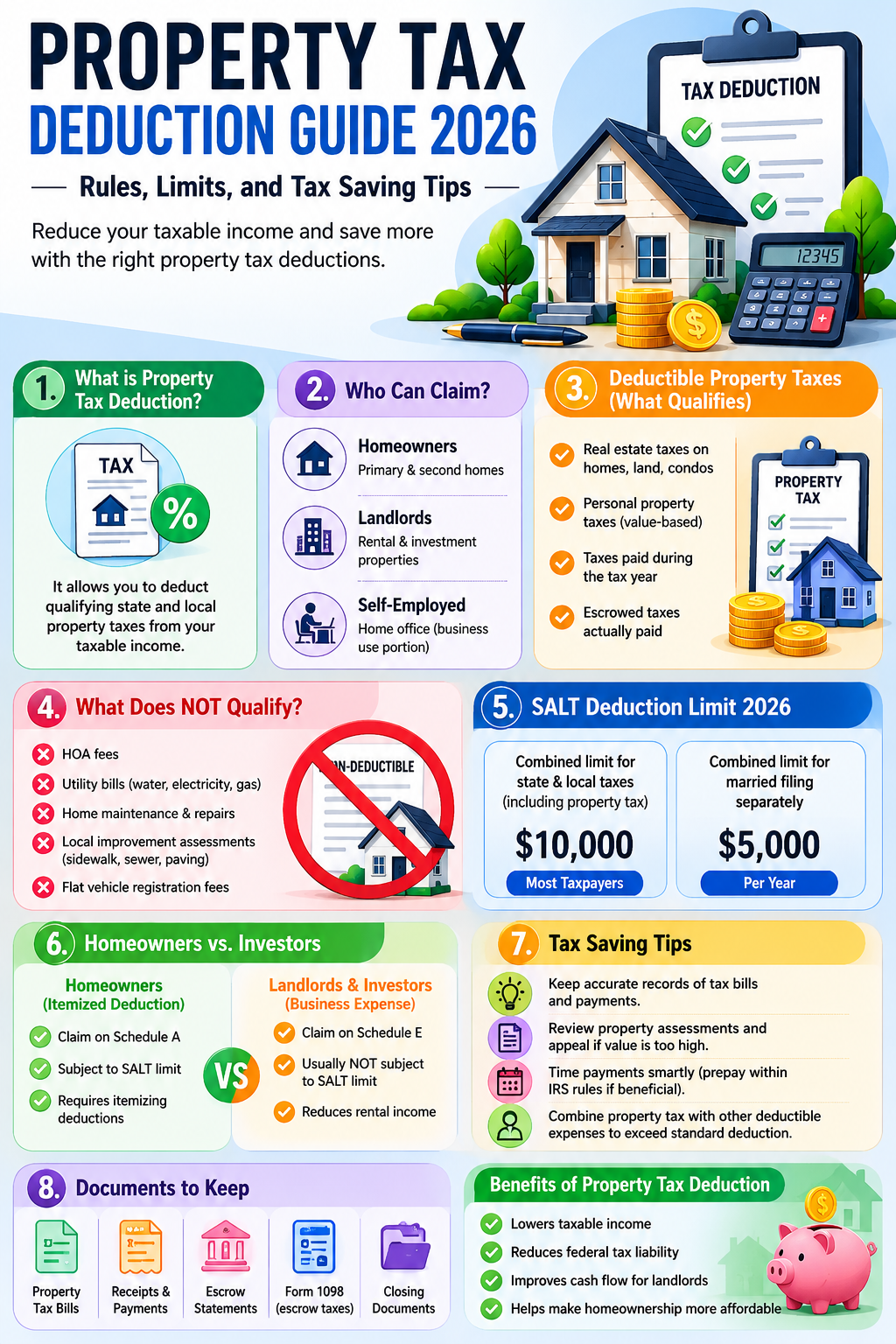
A property tax deduction is a federal tax benefit that allows eligible taxpayers to deduct certain real estate taxes paid during the year from their taxable income. The deduction applies to qualifying state and local property taxes imposed on real estate properties.
When a taxpayer claims deductions, taxable income decreases. Lower taxable income may reduce the total amount of federal income taxes owed. For homeowners with large annual property tax bills, this deduction can provide meaningful financial relief.
The property tax deduction is part of the broader State and Local Tax deduction category, commonly known as the SALT deduction. This category includes:
- Property taxes
- State income taxes
- Local income taxes
- Sales taxes
To claim the deduction for personal residences, taxpayers usually need to itemize deductions on Schedule A of Form 1040 rather than taking the standard deduction.
How Property Taxes Work
Property taxes are imposed by local governments based on the assessed value of a property. Local tax authorities evaluate properties regularly to determine their taxable value.
Several factors affect the amount of property taxes owed, including:
- Property location
- Market value
- Land size
- Home improvements
- Local tax rates
- School district funding
- Municipal services
For example, homes located in cities with higher property values often have larger annual property tax bills than homes in rural areas.
Property taxes may be paid:
- Annually
- Semi-annually
- Quarterly
- Through mortgage escrow accounts
Many homeowners pay taxes through escrow accounts managed by mortgage lenders. In these situations, the lender collects monthly payments and pays the tax authority when taxes are due.
Who Can Claim a Property Tax Deduction?
Not every taxpayer automatically qualifies for property tax deductions. Certain requirements must be met.
Property Ownership
The taxpayer must generally own the property and be legally responsible for paying the taxes.
Eligible properties may include:
- Primary residences
- Vacation homes
- Condominiums
- Land
- Rental properties
- Commercial buildings
Renters usually cannot deduct property taxes because they do not directly pay taxes to local authorities.
Taxes Must Be Paid
Only property taxes actually paid during the tax year may be deducted. Taxes that remain unpaid or deferred cannot generally be claimed until payment occurs.
Tax Must Be Assessed Uniformly
The IRS requires deductible property taxes to be charged uniformly against properties in the jurisdiction. Special assessments for local improvements may not qualify.
Standard Deduction vs Itemized Deductions
One of the most important decisions taxpayers face is whether to take the standard deduction or itemize deductions.
Standard Deduction
The standard deduction is a fixed amount that reduces taxable income automatically without listing individual deductible expenses.
Many taxpayers use the standard deduction because it simplifies tax filing.
Itemized Deductions
Itemized deductions allow taxpayers to deduct specific qualifying expenses individually.
Examples include:
- Mortgage interest
- Property taxes
- Charitable donations
- Medical expenses
- State taxes
Taxpayers should itemize deductions only if total deductions exceed the standard deduction amount.
For homeowners with large mortgage interest and high property taxes, itemizing may provide larger tax savings.
Understanding the SALT Deduction Limit
Property tax deductions fall under the State and Local Tax deduction category.
Current SALT Cap
Federal tax law currently limits the SALT deduction to:
- $10,000 for most taxpayers
- $5,000 for married filing separately
This means the combined total of deductible property taxes and state/local taxes cannot exceed the limit.
For example:
- State income tax: $6,000
- Property tax: $7,000
Total taxes paid equal $13,000, but only $10,000 may be deducted.
This limitation especially affects homeowners in states with high property taxes.
Deductible Property Taxes
Several types of property taxes may qualify for deductions.
Real Estate Property Taxes
Taxes imposed on real property based on assessed value are generally deductible.
Examples include taxes on:
- Houses
- Land
- Condominiums
- Vacation homes
- Rental properties
Personal Property Taxes
Certain personal property taxes may also qualify if based on value.
Examples include:
- Vehicle registration taxes based on car value
- Boat taxes
- RV taxes
Flat registration fees usually do not qualify.
Non Deductible Property Expenses
Not every charge related to property ownership qualifies for deductions.
HOA Fees
Homeowners association fees are generally not deductible for personal residences.
Utility Charges
Expenses such as:
- Water bills
- Electricity
- Internet
- Trash collection
are usually not deductible.
Local Improvement Assessments
Special charges for property improvements are generally non-deductible.
Examples include:
- Sidewalk construction
- Sewer installation
- Road paving
- Drainage systems
These expenses may sometimes increase the property’s cost basis instead.
Property Tax Deduction for Homeowners
Homeowners commonly claim deductions for property taxes paid on primary residences.
Primary Residence
Taxes paid on a main home may qualify if:
- The homeowner owns the property
- Taxes were paid during the year
- The taxpayer itemizes deductions
This deduction can help reduce annual tax liability significantly.
Second Homes
Property taxes on second homes may also qualify.
Examples include:
- Vacation houses
- Cabins
- Beach homes
- Seasonal condos
Special rules may apply if the property is rented for part of the year.
Property Tax Deduction for Rental Properties
Rental property owners receive different tax treatment than homeowners.
Rental Property Tax Rules
Property taxes paid on rental properties are generally deducted as business expenses on Schedule E.
This is important because rental property tax deductions are usually not limited by the SALT cap.
Landlords may deduct:
- Property taxes
- Insurance
- Repairs
- Mortgage interest
- Maintenance expenses
These deductions help reduce taxable rental income.
Benefits for Real Estate Investors
Real estate investors often own multiple properties with large annual tax bills.
Deducting property taxes can:
- Improve cash flow
- Reduce taxable profits
- Increase investment returns
- Offset rental income
Proper bookkeeping is extremely important for investors.
Home Office Property Tax Deduction
Self-employed individuals may qualify to deduct a portion of property taxes through the home office deduction.
Home Office Requirements
The office space must generally be:
- Used regularly for business
- Used exclusively for business
- The principal place of business
If the home office occupies 10% of the home, the taxpayer may deduct approximately 10% of qualifying property taxes as a business expense.
Escrow Accounts and Property Tax Deductions
Many homeowners pay taxes through escrow accounts.
How Escrow Works
Mortgage lenders collect money monthly and hold it in escrow until property taxes become due.
Deducting Escrow Payments
Taxpayers may deduct only the amount actually paid to the tax authority during the year.
Monthly escrow deposits themselves are not deductible until payment occurs.
Most lenders provide Form 1098 showing taxes paid through escrow accounts.
Common Property Tax Deduction Mistakes
Taxpayers frequently make mistakes when claiming deductions.
Deducting Non-Qualifying Fees
Some homeowners incorrectly deduct:
- HOA fees
- Utility bills
- Trash collection charges
- Home maintenance expenses
These costs generally do not qualify.
Claiming Taxes Not Paid
Only taxes paid during the tax year may be deducted.
Ignoring SALT Limits
Some taxpayers attempt to deduct more than the allowed federal SALT cap.
Poor Recordkeeping
Missing records can create problems during IRS audits.
Important records include:
- Tax bills
- Escrow statements
- Bank records
- Receipts
- Closing documents
Strategies to Maximize Property Tax Deductions
Proper planning can help taxpayers maximize legal deductions.
Maintain Organized Records
Keeping accurate documentation simplifies filing and supports deductions during audits.
Review Property Assessments
If property values appear too high, homeowners may appeal assessments to reduce future taxes.
Understand Deduction Rules
Understanding IRS regulations helps avoid errors and missed deductions.
Consult Tax Professionals
Professional guidance may help homeowners and investors maximize deductions legally.
Property Tax Deductions for New Homeowners
Homebuyers may deduct property taxes paid after purchasing the home.
During closing, taxes are usually prorated between buyer and seller based on ownership dates.
Important closing documents may include:
- Settlement statements
- Tax adjustments
- Escrow information
These records help determine deductible amounts accurately.
Property Tax Deductions vs Tax Credits
Many people confuse deductions and tax credits.
Tax Deduction
A deduction reduces taxable income.
For example, a $5,000 deduction lowers the amount of income subject to tax.
Tax Credit
A tax credit directly reduces taxes owed dollar-for-dollar.
Credits are generally more valuable than deductions.
Some states offer property tax credits in addition to deductions.
State Property Tax Relief Programs
Many states provide additional property tax relief programs.
Homestead Exemptions
Homestead exemptions reduce taxable value for primary residences.
Senior Citizen Tax Relief
Some states offer reduced property taxes for seniors with limited income.
Veteran Exemptions
Disabled veterans may qualify for property tax reductions.
Disability Exemptions
Certain states provide relief for disabled property owners.
Eligibility varies by location.
Benefits of Property Tax Deductions
Property tax deductions provide several important financial benefits.
Reduced Taxable Income
Lower taxable income may reduce federal taxes owed.
Improved Housing Affordability
Tax savings help offset housing costs.
Better Investment Cash Flow
Landlords may improve annual rental property profits.
Financial Flexibility
Lower tax burdens can improve overall financial stability.
Challenges of Property Tax Deductions
Despite their benefits, some limitations exist.
SALT Deduction Cap
Federal deduction limits reduce benefits for some taxpayers.
Complicated Rules
Investment properties and mixed-use properties often involve complex calculations.
High Property Taxes
In some states, taxes remain expensive even after deductions.
References
- IRS – Real Estate Tax Deduction Information
- IRS – Publication 530 Tax Information for Homeowners
- IRS – Schedule A Instructions
- USA.gov Tax Information
Frequently Asked Questions
Can I deduct property taxes if I take the standard deduction?
No. Property tax deductions for personal residences generally require itemizing deductions.
Are property taxes fully deductible?
Not always. The SALT deduction cap limits total deductible state and local taxes.
Can landlords deduct full property taxes?
Generally yes. Rental property taxes are business expenses and usually are not subject to SALT limits.
Are HOA fees deductible?
HOA fees for personal residences are usually not deductible.
Can I deduct taxes paid through escrow?
Yes, but only the amount actually paid to the tax authority qualifies.
Can property tax deductions increase refunds?
Possibly. Deductions reduce taxable income, which may lower taxes owed or increase refunds.
What documents should I keep?
You should keep:
- Tax bills
- Receipts
- Escrow statements
- Form 1098
- Closing documents
Should I hire a tax professional?
If you own multiple properties or investment real estate, professional tax guidance can help maximize deductions and avoid errors.
Disclaimer
Program Clarity is an independent informational website and is not affiliated with any government agency. This article is for educational purposes only. Program rules and availability may change. Always verify details with official authorities.