

Starting a business in the United States can be one of the most exciting and rewarding decisions for entrepreneurs. However, choosing the correct business structure is one of the most important steps because it affects taxes, legal protection, business credibility, and long-term growth. In 2026, the Limited Liability Company (LLC) remains one of the most popular business structures for freelancers, online entrepreneurs, startups, consultants, eCommerce sellers, and local businesses.
An LLC combines flexibility with legal protection, making it an ideal option for modern businesses. Whether you are starting a local service company, launching an online store, building a digital agency, or creating a side hustle, an LLC can provide a strong legal and financial foundation.
Many first-time entrepreneurs feel confused about LLC registration because every state has different fees, filing requirements, taxes, and compliance rules. Some business owners also struggle to understand the difference between LLCs, corporations, partnerships, and sole proprietorships.
Table of Contents
ToggleWhat Is an LLC?
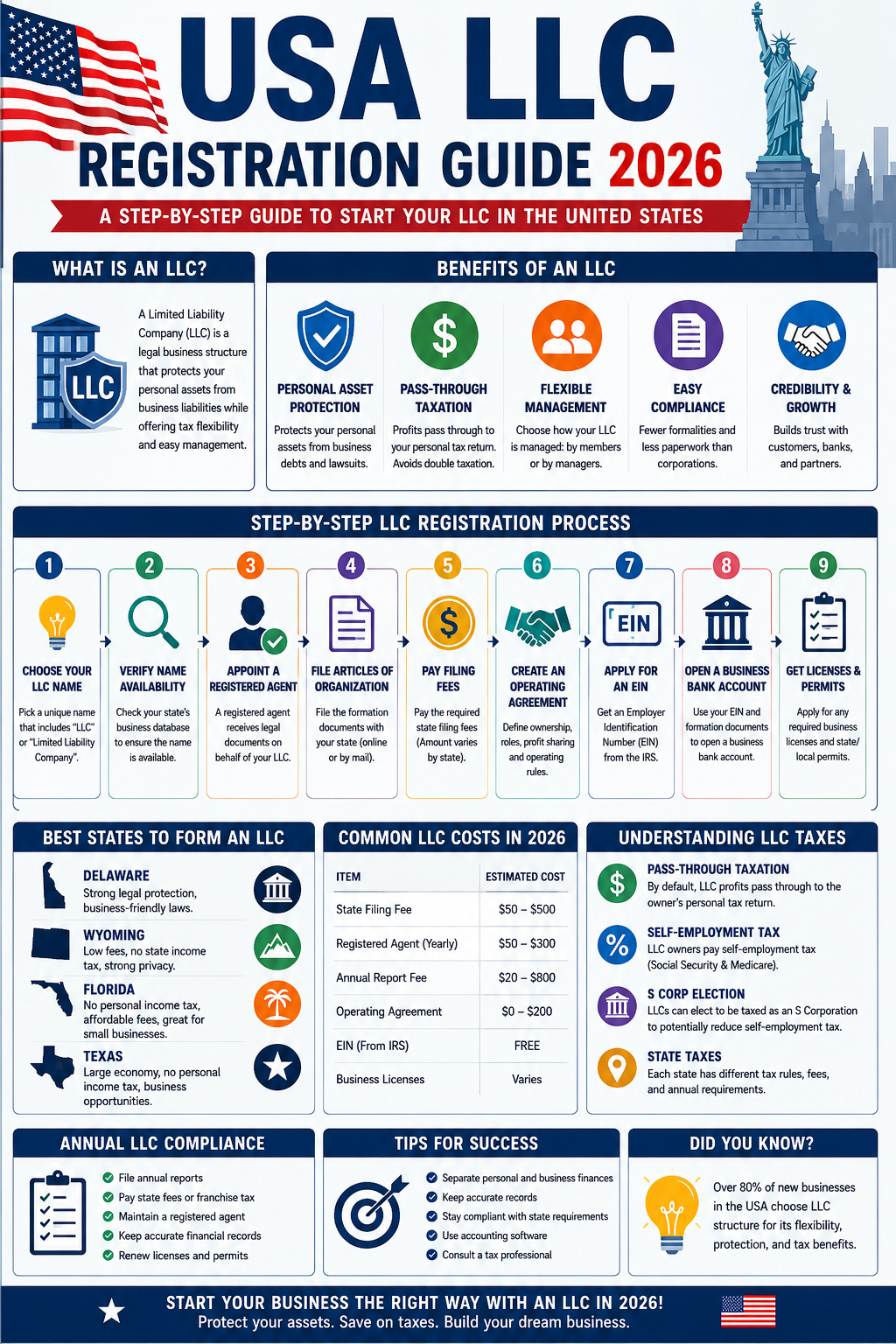
A Limited Liability Company (LLC) is a legal business structure recognized in all U.S. states. It combines features of corporations and sole proprietorships or partnerships.
When you form an LLC, your business becomes a separate legal entity from you personally. This legal separation is extremely important because it helps protect your personal assets from business debts, lawsuits, and liabilities.
For example, if your business faces financial problems or legal action, your personal savings, house, and vehicles are generally protected. Without an LLC, business owners operating as sole proprietors may risk losing personal assets if the business gets sued or cannot pay debts.
Another reason LLCs are extremely popular is tax flexibility. Most LLCs use pass-through taxation, meaning business profits pass directly to the owners rather than being taxed separately at the company level.
Why LLCs Are So Popular in 2026
Modern entrepreneurship continues growing rapidly in 2026. Millions of people are starting online businesses, freelancing, creating digital products, launching eCommerce stores, and building remote companies.
Because of this shift toward independent business ownership, LLCs remain highly attractive due to their simplicity and flexibility.
Small business owners often choose LLCs because they provide strong liability protection without the complicated structure of corporations.
Many online entrepreneurs, social media creators, Amazon sellers, consultants, coaches, and service providers use LLCs to separate personal finances from business operations.
Additionally, banks, clients, suppliers, and customers often trust registered businesses more than informal sole proprietorships.
Main Benefits of Forming an LLC
Personal Liability Protection
One of the biggest advantages of forming an LLC is liability protection.
The LLC becomes legally separate from the owner, meaning business obligations generally stay connected to the company rather than the individual owner.
If the business faces lawsuits or debt collection, personal assets are usually protected.
This protection is extremely important for businesses dealing with customers, contracts, employees, or financial risk.
Without liability protection, entrepreneurs may face serious personal financial consequences if problems arise.
Pass-Through Taxation
Most LLCs benefit from pass-through taxation.
This means profits pass directly to the owners instead of being taxed separately at the company level.
Owners simply report profits and losses on their personal tax returns.
This system helps avoid double taxation, which can occur with corporations.
Pass-through taxation is one of the main reasons small business owners prefer LLCs.
Flexible Management Structure
LLCs provide flexible management options.
Business owners can manage the LLC themselves or appoint managers to operate the company.
This flexibility makes LLCs suitable for many different industries and business models.
Solo entrepreneurs may run operations independently, while larger LLCs with multiple investors can use professional managers.
Easier Compliance Requirements
Compared to corporations, LLCs usually have fewer administrative requirements.
Corporations often require:
- Annual shareholder meetings
- Corporate minutes
- Boards of directors
- Formal resolutions
LLCs generally avoid many of these formalities, making them easier for small business owners to maintain.
Stronger Business Credibility
Customers and clients often trust businesses with official legal structures more than informal operations.
Adding “LLC” to a business name can improve professionalism and credibility.
Banks, payment processors, suppliers, and vendors may also prefer working with registered businesses.
Flexible Ownership Rules
LLCs allow flexible ownership arrangements.
An LLC may have:
- One owner
- Multiple owners
- Individual members
- Corporate members
This flexibility makes LLCs ideal for startups, partnerships, and family businesses.
Types of LLCs in the United States
Different LLC structures exist depending on ownership and business goals.
Single Member LLC
A single member LLC has only one owner.
This structure is very popular among:
- Freelancers
- Bloggers
- Online sellers
- Consultants
- Small business owners
- Social media creators
Single member LLCs provide liability protection while maintaining simple management.
Multi Member LLC
A multi member LLC has two or more owners.
This structure works well for:
- Partnerships
- Family businesses
- Investment groups
- Agencies
- Startups
Ownership percentages, voting rights, and profit distribution are usually explained through an Operating Agreement.
Professional LLC (PLLC)
Some states require licensed professionals to form PLLCs instead of regular LLCs.
This may apply to:
- Doctors
- Lawyers
- Dentists
- Architects
- Accountants
PLLC rules vary depending on state regulations.
Series LLC
A Series LLC allows separate divisions under one parent LLC.
Each series may have separate assets and liabilities.
Series LLCs are often used by real estate investors holding multiple properties.
However, not every state recognizes this structure.
Domestic LLC
A domestic LLC operates in the same state where it was formed.
For example, a Texas LLC operating in Texas is considered domestic.
Foreign LLC
A foreign LLC is an LLC operating outside its formation state.
For example, a Florida LLC doing business in California may need foreign LLC registration in California.
LLC Registration Process USA 2026
Choose Your LLC Name
Choosing the right business name is one of the most important parts of LLC formation.
Your business name represents your brand identity, professionalism, and online presence.
Most states require the LLC name to:
- Be unique
- Include “LLC” or “Limited Liability Company”
- Avoid misleading terms
- Avoid restricted government words
LLC Name Examples
- Horizon Digital Marketing LLC
- Elite Home Solutions LLC
- Prime Vision Consulting LLC
Verify Business Name Availability
After selecting a name, you must verify it is available in your state.
Most Secretary of State websites provide online business entity search tools.
You should also search:
- Social media platforms
- Trademark databases
- Domain registration websites
This helps prevent branding conflicts and legal problems later.
Appoint a Registered Agent
Every LLC must have a registered agent.
A registered agent receives legal notices and official government documents for the business.
Registered Agent Requirements
The registered agent must:
- Have a physical address in the state
- Be available during business hours
- Accept legal documents
Who Can Be a Registered Agent?
- The LLC owner
- A family member
- An attorney
- A professional registered agent service
Many entrepreneurs use professional services for privacy and convenience.
File Articles of Organization
The Articles of Organization officially create the LLC.
This document is filed with the state government.
Information Commonly Required
- LLC name
- Business address
- Registered agent details
- Member information
- Management structure
- Business purpose
Most states allow online filing, which is usually faster than mail filing.
After approval, the state issues formation documents confirming the LLC legally exists.
Pay LLC Filing Fees
Every state charges LLC formation fees.
The cost depends on the state where the LLC is formed.
Average LLC Filing Fees in 2026
| State | Estimated Filing Fee |
|---|---|
| California | $70 |
| Texas | $300 |
| Florida | $125 |
| Delaware | $90 |
| Wyoming | $100 |
Some states also charge annual franchise taxes and renewal fees.
Create an Operating Agreement
An Operating Agreement explains how the LLC will operate internally.
Even if your state does not legally require one, having an Operating Agreement is strongly recommended.
What an Operating Agreement Includes
Ownership Percentages
Defines how much of the company each member owns.
Profit Distribution
Explains how profits and losses are divided.
Voting Rights
Outlines decision-making authority.
Member Responsibilities
Defines each owner’s role in the company.
Exit Procedures
Explains what happens if a member leaves the business.
Operating Agreements help prevent disputes and improve organization.
Apply for an EIN
An EIN (Employer Identification Number) is issued by the IRS.
It works like a Social Security Number for the business.
Why LLCs Need an EIN
- Open business bank accounts
- Hire employees
- File taxes
- Process payroll
- Apply for permits
The IRS provides EINs for free.
Open a Business Bank Account
Separating business and personal finances is critical.
Using a dedicated business bank account helps maintain liability protection and improves financial organization.
Documents Usually Required
- EIN
- Articles of Organization
- Operating Agreement
- Government-issued ID
Business banking also improves bookkeeping and professionalism.
Apply for Business Licenses and Permits
Many businesses need licenses or permits before operating legally.
Requirements vary depending on:
- State
- County
- City
- Industry
Common Business Licenses
- General business licenses
- Sales tax permits
- Professional licenses
- Health permits
- Zoning permits
Online businesses may also need tax registrations depending on state laws.
Understanding LLC Taxes
Taxes are one of the most important aspects of operating an LLC.
Federal Income Taxes
By default, LLCs use pass-through taxation.
Single-member LLCs are generally taxed as sole proprietorships.
Multi-member LLCs are usually taxed as partnerships.
Self-Employment Taxes
LLC owners often pay self-employment taxes covering:
- Social Security
- Medicare
Business owners should prepare for quarterly estimated taxes.
S Corporation Tax Election
Some LLCs elect S Corporation taxation to reduce self-employment taxes.
This strategy may benefit businesses generating higher profits.
However, S Corporation rules are more complex and may require payroll management.
State Taxes
State tax rules vary significantly.
Some states charge:
- Franchise taxes
- Annual report fees
- Income taxes
- Gross receipts taxes
Entrepreneurs should understand both short-term and long-term tax obligations.
Best States for LLC Formation in 2026
Delaware LLC
Delaware is famous for strong business laws and legal protections.
Many large corporations register there.
However, local small businesses often benefit more from forming LLCs in their home states.
Wyoming LLC
Wyoming is popular because of:
- Low fees
- No state income tax
- Privacy protection
- Asset protection benefits
Many online entrepreneurs prefer Wyoming LLCs.
Florida LLC
Florida is attractive because of:
- No personal state income tax
- Affordable filing costs
- Strong business growth
Remote entrepreneurs and small businesses commonly choose Florida.
Texas LLC
Texas offers a large economy and strong business opportunities.
Although filing fees are higher, many entrepreneurs prefer Texas due to its market size.
Common LLC Mistakes to Avoid
Mixing Personal and Business Finances
Using personal accounts for business transactions can weaken liability protection.
Always separate finances.
Ignoring Annual Compliance
Many states require annual reports and renewal fees.
Missing deadlines can lead to penalties or LLC dissolution.
No Operating Agreement
Even single-member LLCs benefit from having written operating agreements.
Choosing the Wrong State
Some entrepreneurs unnecessarily form LLCs in business-friendly states while operating locally elsewhere.
Poor Financial Recordkeeping
Accurate bookkeeping is essential for taxes, compliance, and business growth.
Annual LLC Compliance Requirements
After formation, LLCs must maintain compliance every year.
Common Compliance Tasks
- File annual reports
- Pay franchise taxes
- Maintain registered agents
- Renew licenses
- Keep financial records
Failing to maintain compliance may result in penalties or loss of good standing.
How Much Does It Cost to Start an LLC in 2026?
Common LLC Startup Costs
| Expense | Estimated Cost |
|---|---|
| State Filing Fee | $50–$500 |
| Registered Agent Service | $50–$300/year |
| Annual Reports | $20–$800 |
| EIN | Free |
| Business Licenses | Varies |
Can Non U.S. Residents Form LLCs?
Yes. Non-U.S. residents can legally form LLCs in many U.S. states.
Requirements for Foreign Entrepreneurs
- Registered agent
- EIN
- Formation documents
- U.S. mailing address
Wyoming and Delaware remain popular choices for international entrepreneurs.
LLC Insurance Protection
Although LLCs provide liability protection, insurance remains extremely important.
Common Business Insurance Types
- General liability insurance
- Professional liability insurance
- Commercial auto insurance
- Cyber liability insurance
- Workers’ compensation
Insurance provides additional financial protection beyond the LLC structure.
Future Trends for LLCs in 2026
Business formation trends continue evolving rapidly.
Major Business Trends
- Remote businesses
- Online entrepreneurship
- AI-powered startups
- eCommerce growth
- Freelancing
- Digital agencies
Because of these trends, LLC formation continues growing across the United States.
FAQs About LLC Registration USA 2026
What does LLC stand for?
LLC stands for Limited Liability Company.
Can one person own an LLC?
Yes. Single-member LLCs can have only one owner.
Do LLCs pay taxes?
Yes. Most LLC profits pass through to owners’ personal tax returns.
Is an LLC better than a sole proprietorship?
LLCs usually provide stronger liability protection and greater business credibility.
Can foreigners form LLCs in the USA?
Yes. Many non-U.S. residents legally form LLCs in the United States.
How long does LLC registration take?
Online filings may take a few days, while mail filings can take several weeks.
Do I need an Operating Agreement?
Yes. It is highly recommended even if your state does not legally require it.
Can I run an online business with an LLC?
Yes. Many eCommerce stores and digital businesses operate as LLCs.
What is the cheapest state to form an LLC?
Wyoming and New Mexico are often considered affordable states for LLC formation.
Do I need a lawyer to start an LLC?
No. Many entrepreneurs form LLCs themselves online.
Reference Links
Disclaimer
Program Clarity is an independent informational website and is not affiliated with any government agency. This article is for educational purposes only. Program rules and availability may change. Always verify details with official authorities.