

Buying a home is a major financial milestone, but for many people, qualifying for a traditional mortgage can feel overwhelming. Rising home prices, strict credit score requirements, and large down payment expectations often make homeownership seem out of reach. This is especially true for first-time buyers, young families, borrowers recovering from financial hardship, and individuals with limited savings.
That is where FHA loans become extremely important. Backed by the Federal Housing Administration, FHA loans are designed to make homeownership more accessible for people who may not qualify for conventional financing. These loans offer lower down payment requirements, flexible credit standards, and competitive interest rates, making them one of the most popular mortgage options in the United States.
Over the years, FHA mortgages have helped millions of Americans purchase homes, refinance existing loans, and rebuild financial stability. Whether you are buying your first property, improving your credit after past financial issues, or simply looking for a mortgage program with more flexible requirements, understanding FHA loans can help you make better financial decisions.
Table of Contents
ToggleHow FHA Loans Work
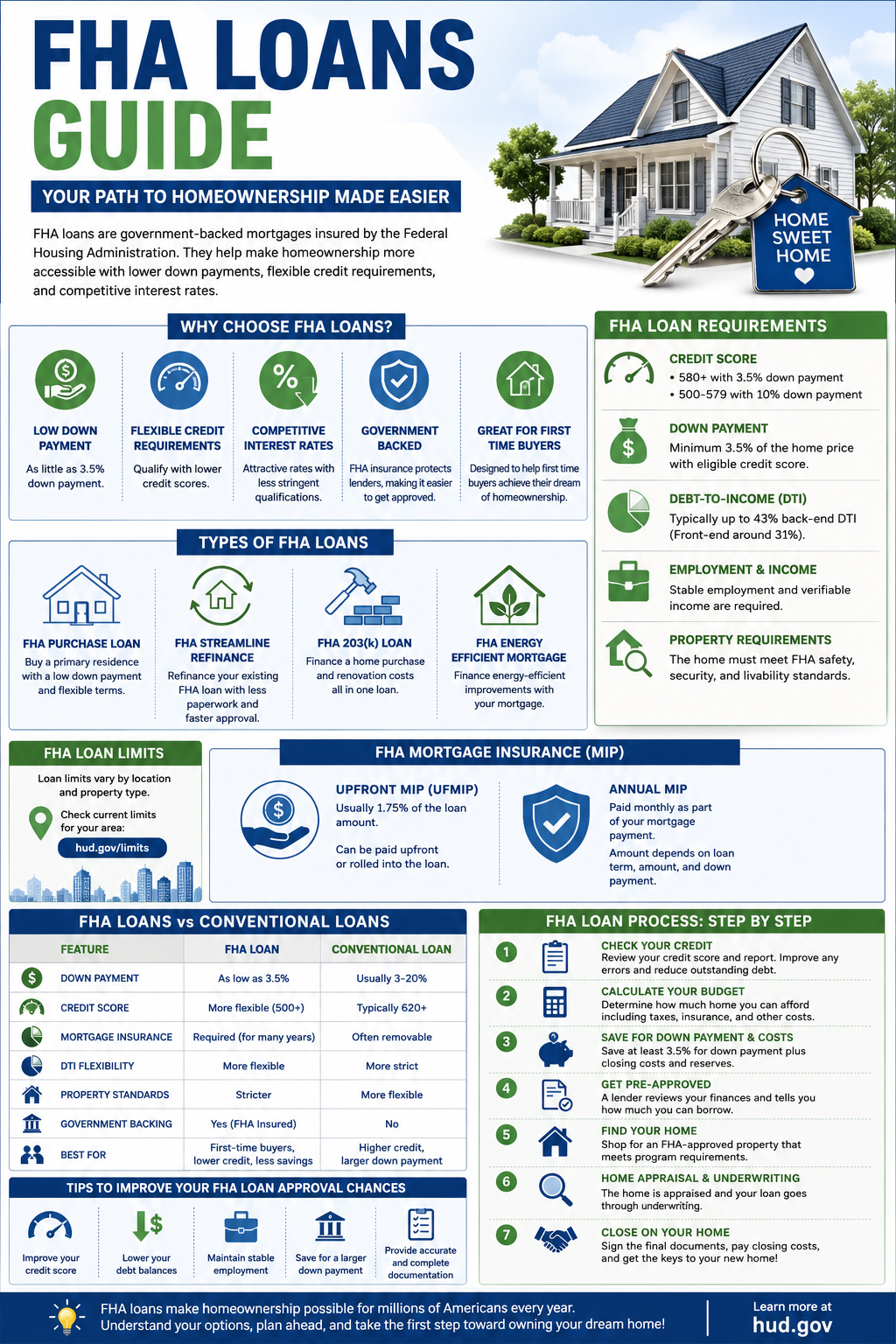
FHA loans work differently from conventional mortgages because the federal government provides insurance protection to lenders. If a borrower defaults on the mortgage, the FHA helps cover part of the lender’s losses. This insurance system gives lenders more confidence when approving borrowers who may not meet strict conventional loan standards.
Because FHA loans are insured, lenders are usually willing to accept lower credit scores, smaller down payments, higher debt-to-income ratios, and limited credit history.
However, borrowers must pay mortgage insurance premiums in exchange for these benefits. Mortgage insurance is one of the most important parts of FHA financing because it protects the lender if the borrower cannot repay the loan.
FHA mortgages are available through FHA-approved lenders, including banks, mortgage companies, and credit unions. These loans can be used for single-family homes, multi-unit properties with up to four units, FHA-approved condominiums, manufactured homes, and certain renovation and rehabilitation projects.
The property must usually serve as the borrower’s primary residence.
Why FHA Loans Are So Popular
FHA loans continue to attract millions of borrowers because they solve several common home-buying challenges. Many people struggle to save large down payments or maintain perfect credit. FHA financing gives these borrowers an opportunity to purchase homes without waiting years to meet stricter conventional loan standards.
For many families, FHA loans represent the fastest path toward homeownership. Another reason FHA loans remain popular is that they often work well with down payment assistance programs. State and local governments frequently offer grants and assistance programs that can help FHA borrowers cover upfront costs.
FHA Loan Benefits
Lower Down Payment Requirements
One of the biggest advantages of FHA loans is the low minimum down payment requirement. Qualified borrowers may purchase a home with as little as 3.5% down. Compared to conventional loans that sometimes require much larger upfront investments, this can make homeownership far more affordable.
For example, if someone buys a $300,000 home using FHA financing, a 3.5% down payment would equal only $10,500. A conventional loan requiring 10% or 20% down could require tens of thousands of dollars more upfront.
This lower down payment helps buyers preserve savings for emergency expenses, moving costs, furniture and appliances, home repairs, and future financial goals. Because of this flexibility, many first-time buyers choose FHA loans instead of delaying homeownership for several years while trying to save larger amounts.
Flexible Credit Score Requirements
Another major benefit is FHA’s flexible approach to credit scores. Conventional lenders often require strong credit histories and higher scores. FHA loans are more forgiving.
| Credit Score | Down Payment Requirement |
|---|---|
| 580 or higher | 3.5% |
| 500–579 | 10% |
Although the FHA allows lower scores, individual lenders may still apply stricter standards called lender overlays.
Even so, FHA financing remains one of the best options for borrowers who have limited credit history, experienced financial hardship in the past, missed payments years ago, or carry moderate debt balances. For many people, FHA loans provide a second chance at homeownership.
Competitive Interest Rates
Interest rates significantly affect long-term housing costs. FHA loans often offer competitive mortgage rates because lenders face lower risk due to government insurance.
Borrowers with average credit scores may qualify for better rates through FHA programs than they would receive with conventional financing. Even a slightly lower interest rate can save homeowners thousands of dollars over the life of a mortgage.
Lower rates can reduce monthly mortgage payments, total interest paid, and long-term financial stress. Because of this, many borrowers compare FHA rates carefully before choosing a mortgage program.
Higher Debt-to-Income Ratio Flexibility
Many home buyers carry existing debts such as student loans, auto loans, credit card balances, and personal loans. Conventional mortgage programs sometimes reject borrowers with higher debt obligations. FHA loans tend to offer more flexibility.
Debt-to-income ratio measures how much of a borrower’s monthly income goes toward debt payments. FHA guidelines commonly allow front-end DTI around 31% and back-end DTI around 43%.
In some situations, automated underwriting systems may approve even higher ratios when borrowers have strong compensating factors such as savings reserves or stable income.
This flexibility helps borrowers qualify sooner without waiting years to eliminate every debt balance.
FHA Loan Requirements
Although FHA loans are more flexible than conventional financing, borrowers still must meet several important requirements.
Employment and Income Verification
Lenders need proof that borrowers can afford mortgage payments consistently. Applicants generally must provide W-2 forms, pay stubs, tax returns, bank statements, and employment history documentation.
Most lenders prefer at least two years of stable employment or consistent income history. Self-employed borrowers may need additional documentation, including business tax returns and profit-and-loss statements.
Stable income improves approval chances because lenders want confidence that borrowers can maintain long-term mortgage payments.
FHA Property Standards
The home itself must also qualify for FHA financing. An FHA-approved appraiser evaluates whether the property meets safety and habitability standards.
FHA appraisals are stricter than many conventional appraisals because the government wants to ensure homes are safe for occupants.
The appraiser checks issues such as structural stability, roofing condition, heating systems, plumbing functionality, electrical safety, water damage, and health hazards.
If major problems exist, repairs may be required before closing. These rules protect buyers from purchasing severely damaged or unsafe homes.
Occupancy Requirement
FHA loans are generally intended for primary residences. Borrowers usually cannot use FHA financing for vacation homes, second homes, or pure investment properties.
However, buyers may purchase multi-unit properties with up to four units if they personally live in one unit. This option allows some borrowers to generate rental income while building equity.
FHA Mortgage Insurance Explained
Mortgage insurance is one of the most important aspects of FHA financing. Unlike conventional loans where private mortgage insurance may eventually disappear, FHA mortgage insurance often remains for many years.
Borrowers pay two types of FHA mortgage insurance.
Upfront Mortgage Insurance Premium (UFMIP)
The upfront mortgage insurance premium is typically 1.75% of the loan amount.
| Loan Amount | Estimated UFMIP |
|---|---|
| $250,000 | $4,375 |
| $350,000 | $6,125 |
Most borrowers finance this cost into the mortgage instead of paying it in cash.
Annual Mortgage Insurance Premium (MIP)
Borrowers also pay annual mortgage insurance divided into monthly installments. The amount depends on loan balance, loan term, and down payment amount.
Mortgage insurance increases the monthly housing payment, which is why some borrowers eventually refinance into conventional loans after building equity.
FHA Loan Limits
FHA loan limits determine the maximum amount borrowers can finance under FHA programs. Limits vary depending on county, property type, and local housing market conditions.
Higher-cost areas generally have larger limits. Expensive housing markets often allow significantly larger FHA loan amounts than rural or lower-cost regions.
Borrowers can check current limits through the official FHA database:
FHA Mortgage Limits Lookup Tool
Understanding local loan limits is important before shopping for homes because properties exceeding FHA limits may require alternative financing.
Types of FHA Loans
FHA Purchase Loans
This is the standard FHA mortgage used for buying a primary residence. It remains the most commonly used FHA program nationwide.
FHA Streamline Refinance
The FHA Streamline Refinance program allows existing FHA borrowers to refinance with simplified documentation and reduced underwriting requirements.
Benefits may include lower interest rates, reduced monthly payments, limited paperwork, and faster processing times.
FHA 203(k) Rehabilitation Loan
The FHA 203(k) loan helps buyers purchase homes that need repairs or renovations. Instead of obtaining separate financing for renovations, borrowers combine purchase and repair costs into one mortgage.
Eligible projects may include roof replacement, plumbing repairs, flooring installation, kitchen remodeling, and structural improvements.
This program can help buyers purchase affordable fixer-upper properties in competitive housing markets.
FHA Loans vs Conventional Loans
Choosing between FHA and conventional financing depends heavily on credit, savings, and financial goals.
| Feature | FHA Loan | Conventional Loan |
|---|---|---|
| Minimum Down Payment | 3.5% | Usually 3–20% |
| Credit Flexibility | Higher | Lower |
| Mortgage Insurance | Required | Sometimes removable |
| Government Backing | Yes | No |
| Property Standards | Stricter | More flexible |
FHA loans work best for borrowers needing flexibility, while conventional financing may benefit borrowers with stronger financial profiles.
Common FHA Loan Mistakes to Avoid
Many buyers unintentionally damage their mortgage approval chances during the process.
Opening New Credit Accounts
Applying for new credit before closing can lower scores and increase debt ratios. Avoid financing cars, furniture, electronics, or appliances until after closing.
Making Large Bank Deposits Without Documentation
Lenders carefully review bank statements. Large unexplained deposits may create underwriting issues. Always maintain documentation for transferred or gifted funds.
Changing Jobs During Underwriting
Stable employment matters during mortgage approval. Switching careers or changing income structures during underwriting may delay or jeopardize approval.
Ignoring Total Homeownership Costs
Mortgage payments are only one part of owning a home. Buyers should also budget for property taxes, insurance, utilities, repairs, maintenance, and HOA fees.
Planning carefully prevents future financial stress.
How to Improve FHA Loan Approval Chances
Borrowers can take several steps to improve approval odds and secure better loan terms.
Improve Credit Before Applying
Even modest score increases may lead to better interest rates. Helpful strategies include paying bills on time, reducing credit card balances, avoiding unnecessary inquiries, and correcting credit report errors.
Free annual credit reports are available here:
Annual Credit Report Official Site
Reduce Debt Balances
Lower debt obligations improve debt-to-income ratios and make mortgage approval easier. Paying off smaller debts before applying can strengthen applications significantly.
Build Emergency Savings
Having extra savings reassures lenders and protects borrowers after closing. Unexpected home repairs can become expensive, especially for first-time homeowners.
Maintain Consistent Employment
Stable employment history demonstrates reliable income and repayment ability. Lenders prefer consistency before and during the mortgage process.
FHA Loan Alternatives
Although FHA loans are popular, other government-backed programs may offer advantages depending on the borrower’s situation.
VA Loans
Eligible military service members and veterans may qualify for VA loans, which often require no down payment.
USDA Loans
USDA loans support eligible rural and suburban home buyers and may offer zero-down financing.
Conventional Mortgages
Borrowers with excellent credit and larger down payments may qualify for strong conventional loan terms with lower long-term insurance costs.
Is an FHA Loan Right for You?
FHA loans can be an excellent solution for borrowers who need flexibility, lower upfront costs, and accessible qualification standards. For many first-time home buyers, FHA financing provides the opportunity to stop renting and begin building long-term equity.
However, FHA loans are not perfect for every situation. Mortgage insurance costs, property restrictions, and loan limits may make conventional financing more attractive for borrowers with stronger financial profiles.
The best approach is to compare multiple loan estimates carefully, evaluate total monthly costs, and consider long-term financial goals before making a final decision.
Speaking with FHA-approved lenders and housing counselors can also help borrowers understand available programs and assistance opportunities.
Frequently Asked Questions About FHA Loans
What is the minimum credit score for an FHA loan?
Most borrowers need a 580 credit score to qualify for the 3.5% down payment option. Some lenders may require higher scores.
Are FHA loans only for first-time buyers?
No. Both first-time and repeat buyers may qualify for FHA financing.
Can FHA loans be used for rental properties?
FHA loans are mainly for primary residences, but multi-unit properties may qualify if the borrower lives in one unit.
How long does FHA mortgage insurance last?
Mortgage insurance duration depends on the loan terms and down payment amount. In many cases, it remains for the life of the loan.
Can I refinance an FHA loan later?
Yes. Many borrowers refinance into conventional loans later to remove mortgage insurance or reduce monthly payments.
Do FHA loans have income limits?
Most standard FHA programs do not have strict income limits, but borrowers must show sufficient income to repay the mortgage.
Is FHA appraisal different from a home inspection?
Yes. FHA appraisals focus mainly on value and safety standards, while inspections provide more detailed evaluations of property condition.
Reference Links
- HUD FHA Loans Resource Center
- FHA Mortgage Limits Lookup Tool
- HUD Housing Counseling Services
- Annual Credit Report Official Site
- VA Home Loan Programs
- USDA Rural Housing Loans
Disclaimer
Program Clarity is an independent informational website and is not affiliated with any government agency. This article is for educational purposes only. Program rules and availability may change. Always verify details with official authorities.