For many military families in the United States, homeownership is more than just a financial milestone. It represents stability after years of service, deployments, relocations, and sacrifices made for the country. Buying a home can feel overwhelming for first-time buyers, especially with rising property prices, interest rates, and strict mortgage requirements. Fortunately, the VA loan program exists to make homeownership more affordable and accessible for eligible veterans, active-duty service members, and surviving spouses.
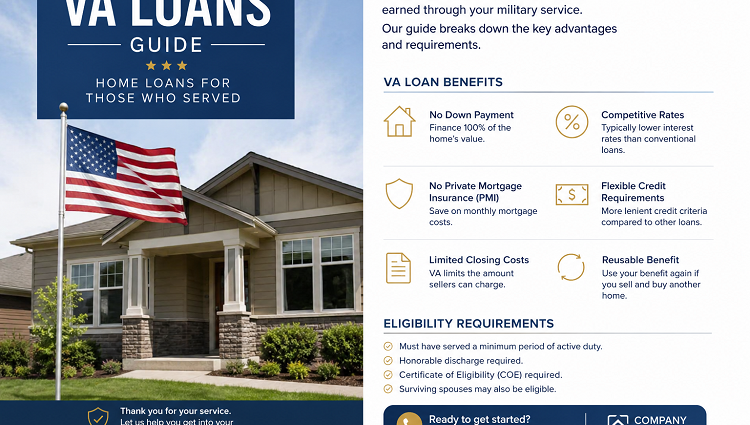
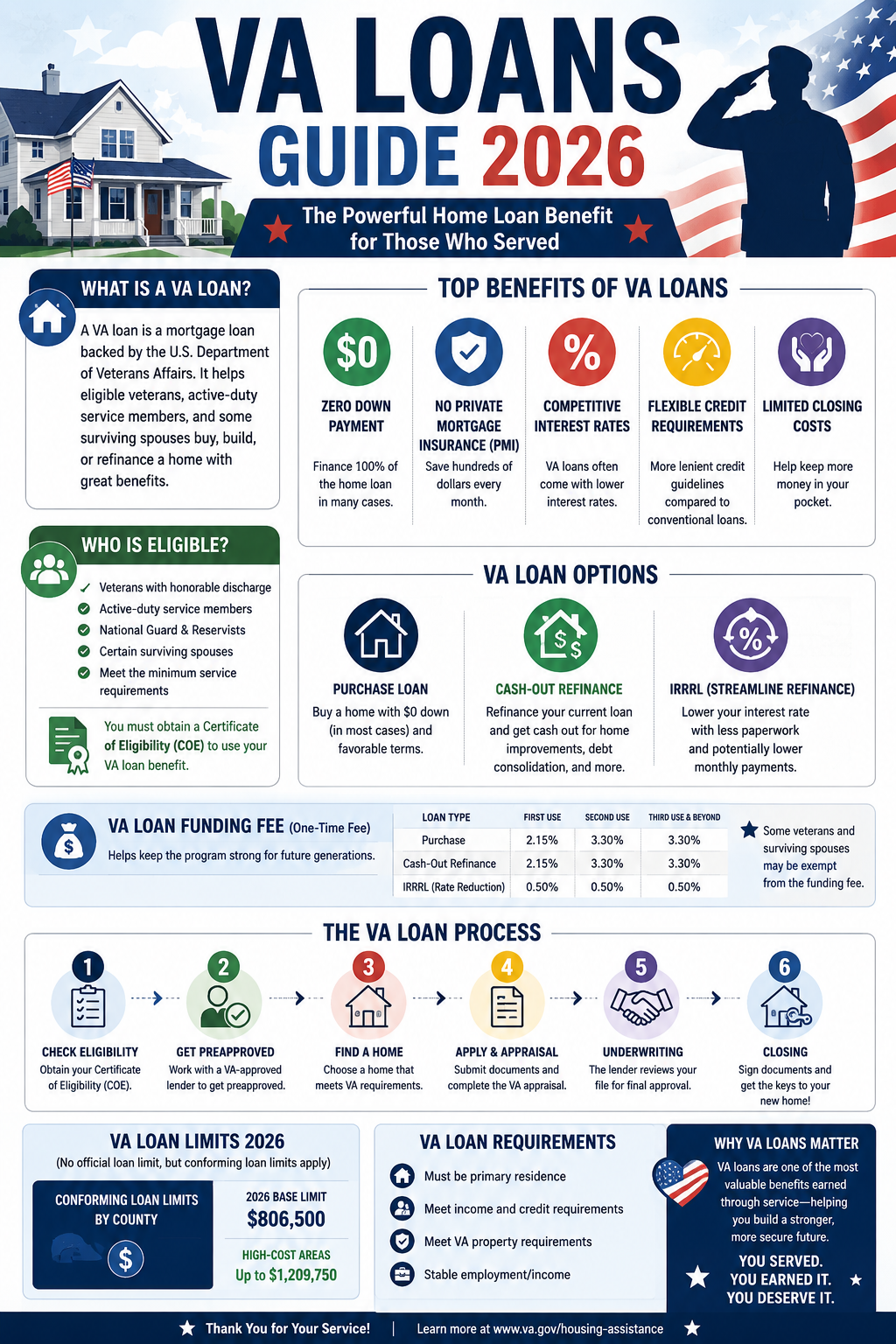
VA loans are considered one of the most powerful mortgage benefits available to military families. Backed by the U.S. Department of Veterans Affairs, these loans provide major advantages compared to conventional mortgages. Eligible borrowers may qualify for zero down payment financing, competitive interest rates, no private mortgage insurance, and more flexible credit requirements. These benefits can save borrowers thousands of dollars over the life of a loan while making it easier to qualify for financing.
The VA loan program has helped millions of Americans purchase homes since its creation through the GI Bill in 1944. Over the decades, it has evolved into a flexible and reliable mortgage solution that continues to support military families across the country. Whether someone is purchasing their first home, refinancing an existing mortgage, or accessing home equity, VA loans provide financial opportunities that many other loan programs cannot match.
Overview of VA Loans
| Feature | VA Loan Benefit |
|---|---|
| Down Payment | Often 0% required |
| Mortgage Insurance | No PMI |
| Interest Rates | Usually lower than conventional loans |
| Credit Requirements | Flexible compared to conventional loans |
| Government Backing | Guaranteed by the Department of Veterans Affairs |
| Eligible Borrowers | Veterans, active-duty military, reservists, and some surviving spouses |
| Property Use | Primary residence only |
| Refinancing Options | Streamline and cash-out refinancing available |
Major Benefits of VA Loans
VA loans offer numerous advantages that make them one of the most affordable mortgage programs available in the United States. For eligible borrowers, these benefits can create substantial long-term savings and improve access to homeownership.
Zero Down Payment Option
One of the biggest advantages of a VA loan is the ability to purchase a home without making a down payment. Conventional mortgages frequently require buyers to contribute between 5% and 20% of the purchase price upfront. Saving such a large amount can take years, especially for younger military families dealing with relocation costs or changing employment situations.
VA loans eliminate this requirement for many borrowers. Qualified applicants can often finance 100% of the property value. This allows service members and veterans to buy homes sooner rather than waiting years to save for a large down payment.
No Private Mortgage Insurance (PMI)
Private mortgage insurance is one of the most expensive hidden costs associated with conventional loans. Borrowers who put down less than 20% usually must pay PMI every month to protect the lender in case of default.
PMI can add hundreds of dollars to monthly housing expenses. Over several years, this cost becomes substantial.
VA loans remove this requirement completely. Borrowers do not need monthly mortgage insurance regardless of down payment size. This significantly lowers monthly housing payments and improves affordability.
For many families, eliminating PMI makes the difference between comfortably affording a home and struggling with monthly expenses.
Competitive Interest Rates
VA mortgage rates are often lower than rates offered on conventional loans. Since lenders receive government backing on a portion of the loan, they are generally willing to provide more favorable terms.
Even a small difference in interest rates can produce major long-term savings.
For instance, a lower rate may reduce monthly payments while also decreasing the total amount of interest paid over a 30-year mortgage. Over time, this can save tens of thousands of dollars.
Lower interest rates also improve purchasing power. Borrowers may qualify for larger homes or better neighborhoods without dramatically increasing monthly payments.
Flexible Credit Requirements
Many military families worry that past financial difficulties could prevent mortgage approval. VA loans are often more forgiving than conventional financing when it comes to credit history.
The Department of Veterans Affairs does not establish a strict minimum credit score. Instead, approved lenders create their own requirements. Many lenders approve borrowers with scores ranging between 580 and 620, though stronger scores may qualify for better rates.
This flexibility benefits borrowers who may have experienced financial hardship during deployments, relocations, or career transitions.
Lenders also consider additional factors such as:
- Stable income
- Employment history
- Debt-to-income ratio
- Residual income
- Payment history
This broader evaluation process allows more borrowers to qualify successfully.
Limited Closing Costs
VA loans include protections that limit certain lender fees and closing expenses. This prevents excessive charges and helps keep home-buying costs manageable.
In some cases, sellers may contribute toward closing costs as part of purchase negotiations. This further reduces upfront financial pressure for buyers.
Closing costs may include:
- Appraisal fees
- Title insurance
- Recording fees
- Credit report charges
- Attorney fees
- Taxes
Reducing these expenses makes homeownership more attainable for military families.
Lifetime Loan Benefit
Many people mistakenly believe VA loans can only be used once. In reality, eligible borrowers may use their VA loan benefits multiple times throughout their lives.
This flexibility is extremely valuable for military families who relocate frequently due to service obligations.
Borrowers may:
- Restore entitlement after paying off a previous VA loan
- Use remaining entitlement while owning another VA-financed home
- Purchase another primary residence after relocation
This long-term flexibility makes VA loans one of the most versatile mortgage benefits available.
Who Qualifies for a VA Loan?
Eligibility for a VA loan depends mainly on military service history and discharge status. The Department of Veterans Affairs sets specific guidelines regarding service duration and eligibility categories.
Eligible groups typically include veterans, active-duty service members, National Guard members, reservists, and some surviving spouses.
Different service periods may require different minimum service lengths. For example, wartime service requirements may differ from peacetime standards.
Generally, eligibility may include:
- At least 90 consecutive days of wartime active-duty service
- Around 181 days during peacetime
- Six years in the National Guard or Reserves
- Certain service-related conditions for surviving spouses
A discharge under dishonorable conditions usually disqualifies applicants.
The easiest way to confirm eligibility is through a Certificate of Eligibility, commonly called a COE.
Understanding the Certificate of Eligibility (COE)
The Certificate of Eligibility proves that a borrower qualifies for VA loan benefits. Lenders use this document during the mortgage approval process.
Obtaining a COE is usually simple. Borrowers may apply through:
- The Department of Veterans Affairs website
- Approved lenders
- Mail applications
In many cases, lenders can retrieve the COE electronically within minutes.
The document contains important details regarding:
- Eligibility status
- Available entitlement
- Funding fee exemptions
Without a COE, lenders cannot finalize VA mortgage approval.
Types of VA Loans
The VA loan program offers several mortgage options designed to meet different financial needs and housing goals.
VA Purchase Loans
This is the most common type of VA loan. It allows eligible borrowers to purchase a primary residence with favorable loan terms.
VA purchase loans are popular because they combine:
- No down payment
- No PMI
- Flexible qualification standards
- Competitive rates
Borrowers may use these loans for:
- Single-family homes
- Certain condominiums
- Manufactured homes
- Multi-unit properties where the borrower occupies one unit
For many veterans, this loan becomes the easiest and most affordable path to homeownership.
VA Cash-Out Refinance Loans
A VA cash-out refinance allows homeowners to replace their existing mortgage with a larger loan and receive the difference in cash.
This option helps borrowers access home equity for various financial purposes, including:
- Home renovations
- Debt consolidation
- Emergency expenses
- Education costs
- Medical bills
Some borrowers also use cash-out refinancing to convert non-VA loans into VA-backed mortgages.
While this option provides flexibility, borrowers should carefully evaluate long-term repayment costs before increasing mortgage balances.
Interest Rate Reduction Refinance Loan (IRRRL)
The IRRRL program, commonly called the VA Streamline Refinance, helps borrowers refinance existing VA loans into lower interest rates.
This refinancing option is popular because it simplifies the process significantly.
Benefits often include:
- Reduced paperwork
- Faster processing
- Lower monthly payments
- Limited income verification
- Possible appraisal waivers
Homeowners typically use IRRRL refinancing when interest rates decline and they want to reduce long-term mortgage expenses.
Native American Direct Loan (NADL)
The NADL program helps eligible Native American veterans purchase, build, or improve homes on federal trust land.
Benefits may include:
- Low interest rates
- Limited closing costs
- Potential no-down-payment financing
Although less common, this program provides important support for qualifying Native American veterans and families.
VA Funding Fee Explained
Most VA borrowers pay a funding fee when obtaining a mortgage. This one-time fee helps support the sustainability of the VA loan program and reduces costs to taxpayers.
The funding fee amount varies depending on several factors, including:
- First-time or repeat use
- Loan type
- Down payment amount
- Military category
Borrowers making larger down payments generally pay lower funding fees.
Many borrowers choose to finance the fee into the loan amount rather than paying it upfront. While this reduces immediate out-of-pocket expenses, it increases the total mortgage balance.
Some borrowers are exempt from the funding fee entirely, including veterans receiving disability compensation and certain surviving spouses.
Understanding funding fees is important because they affect overall borrowing costs.
Credit Score and Financial Requirements
Although VA loans are more flexible than many mortgage programs, lenders still evaluate financial stability carefully.
Credit scores remain an important part of approval decisions. Higher scores typically result in:
- Better interest rates
- Easier approvals
- Lower overall loan costs
Debt-to-income ratio is another major factor. Lenders compare monthly debt obligations to gross monthly income.
A DTI ratio below 41% is commonly preferred, though exceptions may exist for borrowers with strong financial profiles.
VA loans also use residual income calculations. This measures how much money remains after major monthly obligations are paid. Residual income standards help ensure borrowers can comfortably manage housing expenses and everyday living costs.
This additional affordability check is one reason VA loans historically maintain relatively low default rates.
Property Requirements for VA Loans
The Department of Veterans Affairs requires homes financed with VA loans to meet minimum property standards.
These standards focus on safety, sanitation, and structural integrity.
The property must generally provide:
- Safe living conditions
- Reliable utilities
- Sound roofing
- Adequate heating
- Clean water access
- Functional electrical systems
If the appraisal identifies serious issues, repairs may be required before approval.
VA loans are intended for primary residences. Vacation homes and purely investment-focused properties usually do not qualify.
However, borrowers may purchase multi-family properties if they occupy one of the units as their primary residence.
The VA Loan Application Process
The VA loan application process includes checking eligibility, getting preapproved, submitting financial documents, completing a VA appraisal, and finalizing the mortgage through closing. Working with a VA-approved lender can help make the process faster and smoother for eligible borrowers.
VA Loans vs Conventional Mortgages
Many borrowers compare VA loans with conventional financing before choosing a mortgage.
VA loans often provide lower upfront costs and more flexible qualification standards. Conventional loans may require substantial down payments and monthly PMI, especially for borrowers with lower credit scores.
Conventional loans can sometimes offer advantages for borrowers purchasing second homes or investment properties, since VA loans are limited to primary residences.
However, for eligible military borrowers, VA loans are frequently the more affordable option overall.
Common Myths About VA Loans
Several misconceptions continue discouraging eligible borrowers from using their VA loan benefits.
Some people believe VA loans take too long to close. In reality, many VA transactions close within similar timelines as conventional mortgages.
Others assume sellers dislike VA buyers. While misunderstandings still exist, experienced real estate agents can help explain the strength and reliability of VA financing.
Another common myth is that VA appraisals are excessively strict. In truth, appraisals mainly ensure homes are safe and livable rather than requiring perfection.
Some borrowers also incorrectly believe they can only use VA benefits once. Entitlement restoration allows many borrowers to reuse benefits multiple times throughout their lives.
Tips for Getting Approved for a VA Loan
Preparing financially before applying can improve approval chances and help borrowers secure better loan terms.
Paying bills on time consistently helps build stronger credit scores. Reducing credit card balances and avoiding unnecessary debt may also improve debt-to-income ratios.
Borrowers should save funds for closing costs and emergency expenses even if no down payment is required.
Comparing multiple lenders is equally important because rates, fees, and approval standards vary widely.
Working with professionals experienced in VA lending often simplifies the process and reduces confusion.
FAQs About VA Loans
What is the minimum credit score for a VA loan?
The VA itself does not set a minimum credit score, but many lenders prefer scores between 580 and 620.
Can I buy a home with no down payment?
Yes, many eligible borrowers qualify for zero-down-payment financing through VA loans.
Do VA loans require mortgage insurance?
No, VA loans do not require private mortgage insurance.
Can VA loans be used more than once?
Yes, eligible borrowers may reuse their VA loan benefits multiple times.
Can I refinance a non-VA loan into a VA loan?
Yes, the VA Cash-Out Refinance program allows eligible borrowers to refinance conventional mortgages into VA-backed loans.
How long does VA loan approval take?
Many VA loans close within 30 to 45 days, though timelines vary by lender and market conditions.
Are surviving spouses eligible for VA loans?
Certain surviving spouses may qualify depending on service-related circumstances and eligibility rules.
Are VA loans only for first-time buyers?
No, both first-time and repeat home buyers may use VA loan benefits.
Can VA loans be used for vacation homes?
Generally no, because VA loans are intended for primary residences.
Is the funding fee always required?
Most borrowers pay the funding fee, but some veterans and surviving spouses qualify for exemptions.
Reference Links
- U.S. Department of Veterans Affairs Home Loans
- Consumer Financial Protection Bureau Mortgage Resources
- U.S. Department of Housing and Urban Development
- Fannie Mae Home Buying Education
Disclaimer
Program Clarity is an independent informational website and is not affiliated with any government agency. This article is for educational purposes only. Program rules and availability may change. Always verify details with official authorities.