

Immigration Status After Job Loss
Losing a job can be stressful for anyone, but it often creates additional concerns for immigrants working in the United States. Besides the financial impact, many foreign workers worry about whether they can legally remain in the country, how long they have before leaving, and what options are available to maintain lawful immigration status.
The answer depends on several factors, including the type of visa you hold, your employment authorization, whether you are waiting for a green card, and how quickly you can secure a new job or change your immigration status. Some visa holders are granted a grace period after employment ends, while others may need to take immediate action to avoid violating immigration rules.
Understanding your rights and responsibilities is essential because maintaining lawful status can affect future visa applications, employment opportunities, permanent residency, and even eligibility for U.S. citizenship. Missing important deadlines or failing to notify the appropriate authorities can lead to serious immigration consequences.
This guide explains what generally happens after job loss, the rules for common employment-based visas, available options for remaining in the United States, and practical steps you should take to protect your immigration status.
Why Job Loss Affects Immigration Status
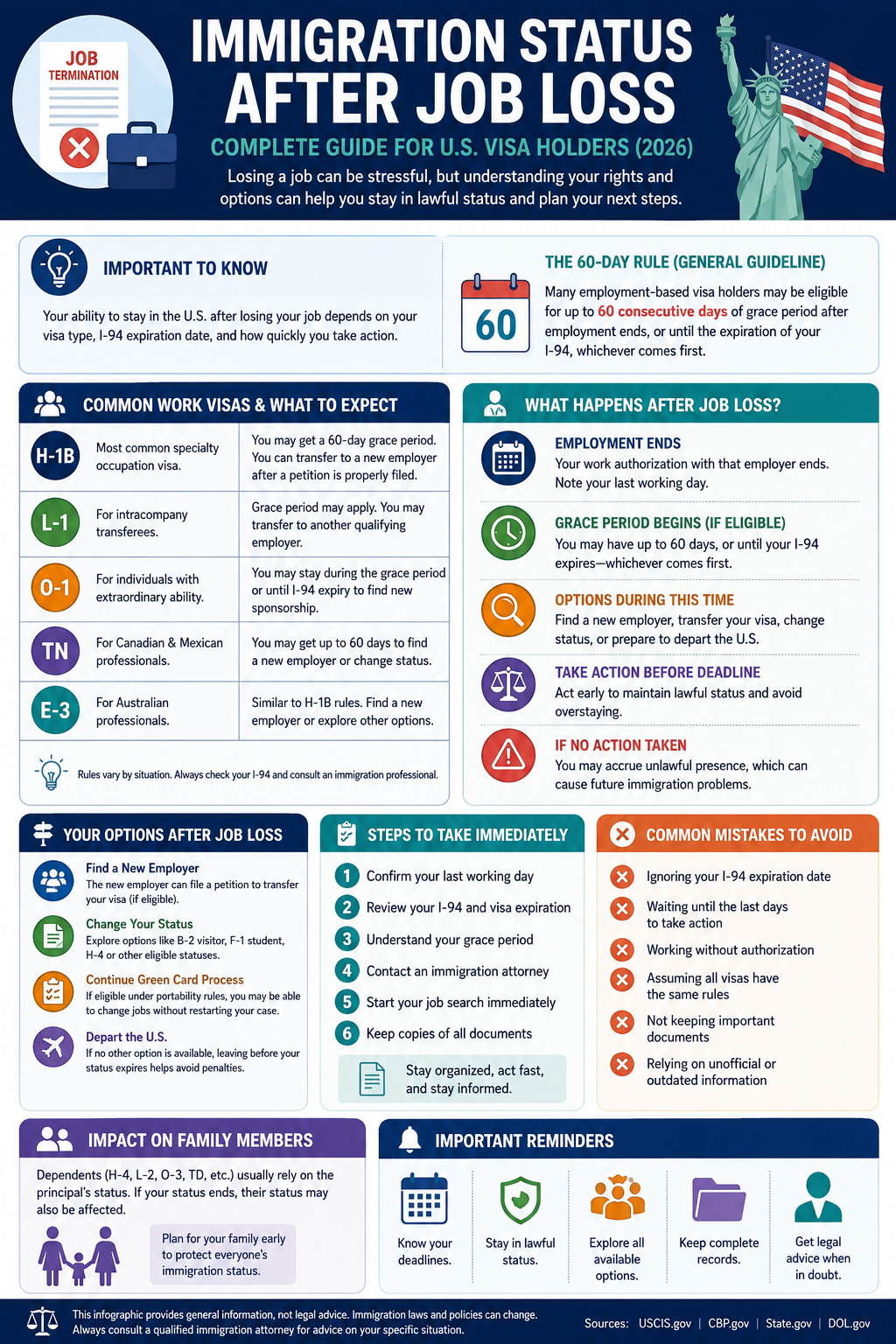
Many temporary work visas in the United States are employer-sponsored. This means your legal authorization to work—and in some cases your permission to remain in the country—is tied to the employer that petitioned for your visa.
When employment ends, the immigration benefit connected to that employer may also be affected. However, this does not always mean you must leave the United States immediately. U.S. immigration law provides different protections depending on your visa category and personal circumstances.
Important factors include:
- Your current visa classification
- Whether you were laid off or resigned
- Your I-94 expiration date
- Eligibility for a grace period
- Whether another employer is willing to sponsor you
- Whether you qualify for a different immigration category
Understanding these factors helps you make informed decisions instead of acting out of panic.
Common Reasons Employment Ends
Job loss can occur for many reasons that are unrelated to immigration.
Some of the most common situations include:
- Company layoffs
- Business closure
- Budget reductions
- Position elimination
- Contract expiration
- Performance-related termination
- Voluntary resignation
- Corporate restructuring
- Mergers and acquisitions
From an immigration perspective, the reason for employment ending is often less important than how quickly you take appropriate action afterward.
Does Losing Your Job Mean You Must Leave Immediately?
Not necessarily.
Many employment-based visa holders do not have to leave the United States the same day their employment ends.
For many nonimmigrant workers, U.S. immigration regulations allow a discretionary grace period of up to 60 consecutive days, or until the expiration date on the I-94 record, whichever comes first. During this period, eligible individuals may:
- Find a new employer
- Transfer their work visa
- Apply for another visa category
- Prepare to depart the United States while maintaining compliance
The grace period is not automatic in every circumstance, so individuals should review their situation carefully and seek qualified legal advice if needed.
Immigration Status vs. Employment Authorization
Many people mistakenly believe immigration status and work authorization are exactly the same. They are related but different.
| Immigration Status | Employment Authorization |
|---|---|
| Allows you to remain legally in the U.S. | Allows you to work legally |
| Based on your visa classification | Often depends on employer sponsorship |
| Managed through immigration laws | Managed through visa conditions and employment rules |
| Can sometimes continue after job loss | May end when employment ends |
Knowing the difference helps you understand what options remain available after losing employment.
Understanding the 60-Day Grace Period
One of the most important protections for many employment-based visa holders is the grace period established under U.S. immigration regulations.
Eligible workers may receive up to 60 consecutive days after employment ends to remain in the United States while taking steps to maintain lawful status.
During this time, individuals may:
- Search for another employer
- File a change of status application
- Transfer to another qualifying employer
- Apply for dependent status if eligible
- Prepare to leave the country
The grace period generally ends on whichever occurs first:
- 60 days after employment ends, or
- The expiration date listed on the I-94 arrival/departure record.
Waiting until the final days of the grace period is risky because preparing immigration filings often requires gathering documents and obtaining employer support.
Immigration Status for H-1B Workers After Job Loss
The H-1B visa is one of the most common employment-based visas in the United States.
Because the visa is employer-sponsored, employment termination affects your ability to continue working for that employer.
After job loss, eligible H-1B workers generally have several options:
Find Another Employer
Another employer may file an H-1B petition on your behalf. In many cases, eligible workers may begin employment with the new employer once the transfer petition is properly filed, subject to applicable rules.
Change Immigration Status
Some workers change to:
- B-2 visitor status
- F-1 student status
- Dependent status (such as H-4)
- Other qualifying nonimmigrant categories
Leave the United States
If no suitable option is available before lawful status ends, departing the country may help avoid accruing unlawful presence.
What Happens to L-1 Visa Holders?
The L-1 visa allows multinational companies to transfer executives, managers, and specialized knowledge employees.
Because the visa is tied to the sponsoring employer, losing employment generally affects continued eligibility.
Possible options include:
- Finding another qualifying employer if eligible
- Changing to another immigration category
- Applying for a different work-authorized visa
- Leaving the United States before losing lawful status
Workers employed by multinational organizations should review transfer possibilities within related corporate entities.
O-1 Visa Holders After Employment Ends
The O-1 visa is designed for individuals with extraordinary ability in fields such as:
- Science
- Education
- Athletics
- Arts
- Business
- Entertainment
If employment ends, options depend on the original petition and future employment opportunities.
Many O-1 professionals continue qualifying work by obtaining new sponsorship or filing amended petitions when appropriate.
TN Visa Holders
Citizens of Canada and Mexico working under the TN classification should also understand that employment authorization is linked to the sponsoring employer.
Following job loss, workers often:
- Obtain a new qualifying employer
- Apply for a new TN admission or petition
- Explore another immigration category
- Leave the United States if necessary
Timing is important because employment cannot simply continue without appropriate authorization.
E-3 Visa Holders
Australian professionals working under E-3 status face similar challenges after employment ends.
A new employer typically needs to complete the required immigration process before employment can resume legally.
Affected workers should avoid unauthorized employment while arranging new sponsorship.
What If You Already Filed for a Green Card?
Many immigrants lose employment while waiting for permanent residency.
Whether this creates a problem depends on:
- The stage of the green card process
- The immigration category
- Whether portability rules apply
- The employer’s continued sponsorship
Some employment-based applicants may benefit from portability provisions if their adjustment application has been pending long enough and the new job is in the same or a similar occupational classification.
However, every green card case is unique and should be evaluated carefully before changing employers.
PERM Labor Certification and Job Loss
If job loss occurs before certain stages of the employment-based green card process are completed, the immigration case may be affected.
Examples include:
- PERM labor certification
- Form I-140 immigrant petition
- Adjustment of status
Some cases require starting portions of the process again with a new employer.
Because employment-based permanent residence involves multiple steps, timing can significantly influence available options.
Can You Receive Unemployment Benefits?
Eligibility for unemployment compensation depends on both federal and state laws.
Receiving unemployment benefits does not automatically affect immigration status. However, applicants must continue complying with all visa conditions and employment authorization requirements.
Can You Change to Another Visa After Losing Your Job?
For many immigrants, changing to another visa category is one of the best ways to remain in lawful status after employment ends. The appropriate option depends on your qualifications, family situation, future plans, and the amount of time you have remaining in the United States.
Common visa categories that may be available include:
B-2 Visitor Status
Some workers apply to change to B-2 visitor status while they search for a new employer or prepare to leave the United States. A visitor visa does not authorize employment, but it may provide additional time if approved.
F-1 Student Status
If you plan to pursue higher education, changing to F-1 student status may allow you to remain in the United States while attending an approved educational institution.
H-4 Dependent Status
If your spouse holds H-1B status, you may qualify to change to H-4 dependent status.
L-2, E-2, TD, or Other Dependent Visas
Individuals whose spouses hold other qualifying employment visas may be eligible for dependent classifications that allow them to remain legally in the country.
Changing status should generally be filed before your authorized stay expires.
Can You Start Working for a New Employer Immediately?
The answer depends on your visa category.
For example, eligible H-1B workers may benefit from portability provisions that can allow them to begin working for a new employer after a qualifying petition is properly filed, rather than waiting for final approval. Other visa classifications may require approval before employment can legally begin.
Never assume that accepting a job offer automatically authorizes you to work. Unauthorized employment can have serious immigration consequences.
What Happens If You Overstay?
Remaining in the United States after your authorized stay expires can create significant immigration problems.
Potential consequences include:
- Accruing unlawful presence
- Future visa denials
- Difficulty obtaining permanent residence
- Bars on re-entering the United States in certain circumstances
- Removal (deportation) proceedings
Taking action before your lawful stay expires is usually much easier than resolving an overstay later.
What Documents Should You Keep After Job Loss?
Maintaining organized records can help if you apply for another visa, seek new employment, or respond to immigration requests.
Important documents include:
- Passport
- Visa stamp
- Form I-94
- Employment contract
- Offer letter
- Recent pay stubs
- W-2 or tax documents
- Employment termination or layoff notice
- Form I-797 approval notices
- Immigration filings
- Green card application records (if applicable)
Having these documents readily available can make future immigration filings smoother and faster.
Steps to Take Immediately After Losing Your Job
Instead of panicking, follow a structured plan.
1. Confirm Your Employment End Date
Ask your employer for written confirmation of your last working day. This date may affect immigration deadlines.
2. Review Your Immigration Documents
Check:
- Passport validity
- Visa category
- Form I-94 expiration date
- Employment authorization documents
- Pending immigration applications
3. Contact an Immigration Attorney
Professional legal advice is especially valuable if:
- You have a pending green card case
- You are close to the end of your grace period
- You have dependents
- You have multiple immigration filings
- Your case involves unusual circumstances
4. Begin Your Job Search Immediately
Do not wait until the end of the grace period. Employers often require time to prepare immigration paperwork.
5. Keep Copies of Everything
Maintain electronic and printed copies of all employment and immigration records.
How Job Loss Affects Family Members
Many spouses and children hold dependent immigration status based on the principal worker’s visa.
Examples include:
- H-4
- L-2
- TD
- O-3
If the principal worker loses lawful status and no alternative immigration solution is found, dependent family members may also lose their lawful status.
Families should consider immigration planning together rather than focusing only on the principal worker.
Does Severance Pay Affect Immigration Status?
Receiving severance pay does not automatically extend your immigration status.
Although severance may provide financial support after employment ends, immigration authorities generally focus on the actual employment relationship and your authorized period of stay, not simply whether payments continue.
Always confirm how your employer reports your final employment date.
Remote Work and Freelancing After Job Loss
Many immigrants consider freelancing or remote work while searching for another employer.
However, most employer-sponsored visas do not permit self-employment or freelance work unless specifically authorized under the terms of that immigration category.
Working without authorization—even for an overseas company while physically present in the United States—may have immigration implications depending on the facts of the situation. Before accepting freelance projects or consulting work, ensure your immigration status permits it.
Green Card Applicants and Job Portability
Employment-based green card applicants may, in some situations, change employers without restarting the entire immigration process.
Eligibility depends on factors such as:
- The stage of the green card application.
- Whether Form I-485 has been pending long enough for portability rules to apply.
- Whether the new position is in the same or a similar occupational classification.
Because portability rules are technical, applicants should evaluate their case carefully before changing employers.
How Employers Can Help
Some employers assist former employees during transitions by:
- Providing detailed termination documentation.
- Offering severance packages.
- Cooperating with immigration paperwork.
- Confirming employment history.
- Supporting visa transfer documentation where appropriate.
Maintaining a professional relationship with your former employer can be beneficial during future immigration filings.
Common Mistakes to Avoid
After losing a job, avoid these common errors:
- Ignoring immigration deadlines.
- Assuming every visa has the same grace period.
- Working without authorization.
- Waiting too long to search for a new employer.
- Failing to keep copies of immigration documents.
- Not checking the expiration date on Form I-94.
- Relying on social media or unofficial advice instead of authoritative sources.
- Missing important correspondence from immigration authorities.
Avoiding these mistakes can help protect your ability to remain in lawful status and pursue future immigration benefits.
Frequently Asked Questions (FAQs)
Can I stay in the U.S. after losing my job?
It depends on your immigration status. Many employment-based visa holders may receive a grace period or may be able to change status, transfer to another employer, or depart the country before their authorized stay ends.
How long can I stay after being laid off?
Some eligible nonimmigrant workers may receive a grace period of up to 60 consecutive days or until the expiration of their Form I-94, whichever comes first. Eligibility depends on your specific visa category and circumstances.
Can I apply for another job while unemployed?
Yes. You can generally search for employment while maintaining lawful status. However, you must not begin working until you are legally authorized to do so under your immigration classification.
Can I freelance during my grace period?
In most cases, no. Many employer-sponsored visas do not allow freelance or self-employed work unless specifically authorized.
Will unemployment benefits cancel my visa?
Receiving unemployment benefits does not automatically cancel your visa. Eligibility and the effect on your immigration situation depend on federal and state rules as well as your individual circumstances.
Can I switch to a visitor visa?
Some individuals apply to change to B-2 visitor status. Approval is discretionary and depends on meeting the legal requirements.
Does losing my job cancel my green card application?
Not necessarily. The impact depends on the stage of your employment-based green card process and whether portability rules or other provisions apply.
Should I leave the U.S. immediately?
Not always. Review your visa conditions, your Form I-94, and any available grace period before making a decision. Seek legal advice if you are uncertain.
References
- U.S. Citizenship and Immigration Services (USCIS). Employment-Based Immigration. https://www.uscis.gov/working-in-the-united-states
- USCIS. Options for Nonimmigrant Workers Following Termination of Employment. https://www.uscis.gov
- U.S. Department of Labor (DOL). Employment and Training Administration. https://www.dol.gov
- USCIS Policy Manual. https://www.uscis.gov/policy-manual
- U.S. Customs and Border Protection (CBP). Form I-94 Information. https://i94.cbp.dhs.gov
- U.S. Department of State. Visas. https://travel.state.gov/content/travel/en/us-visas.html
Disclaimer
Program Clarity is an independent informational website and is not affiliated with any government agency. This article is for educational purposes only. Program rules and availability may change. Always verify details with official authorities.