
For millions of college students across the United States, the Pell Grant is one of the most important forms of financial assistance available. It provides essential funding that helps cover tuition, books, supplies, housing, transportation, and other educational expenses. Unlike student loans, the Pell Grant does not need to be repaid in most situations, which makes it especially valuable for students from low-income families. However, one of the most common questions students ask every year is: When will my Pell Grant be paid?
Understanding the Pell Grant payment schedule is extremely important for financial planning. Many students rely on these funds to buy textbooks at the beginning of the semester, pay rent, purchase a laptop, or cover transportation costs. If the timing of disbursement is misunderstood, unexpected financial stress can occur. The Pell Grant does not typically arrive as a single lump sum directly from the federal government to the student. Instead, it follows a structured system that involves the school’s financial aid office.
What Is the Pell Grant?
The Pell Grant is a federal need-based financial aid program administered by:
The official program is known as the Federal Pell Grant Program. It is designed to assist undergraduate students who demonstrate significant financial need through the FAFSA (Free Application for Federal Student Aid).
Unlike federal student loans, Pell Grants generally do not need to be repaid, unless specific conditions occur, such as withdrawing from school early or receiving funds improperly. The maximum Pell Grant award amount is determined each year by Congress and may change annually.
How Pell Grant Payments Actually Work
Many students assume the federal government sends Pell Grant money directly into their bank accounts. In reality, the process works differently.
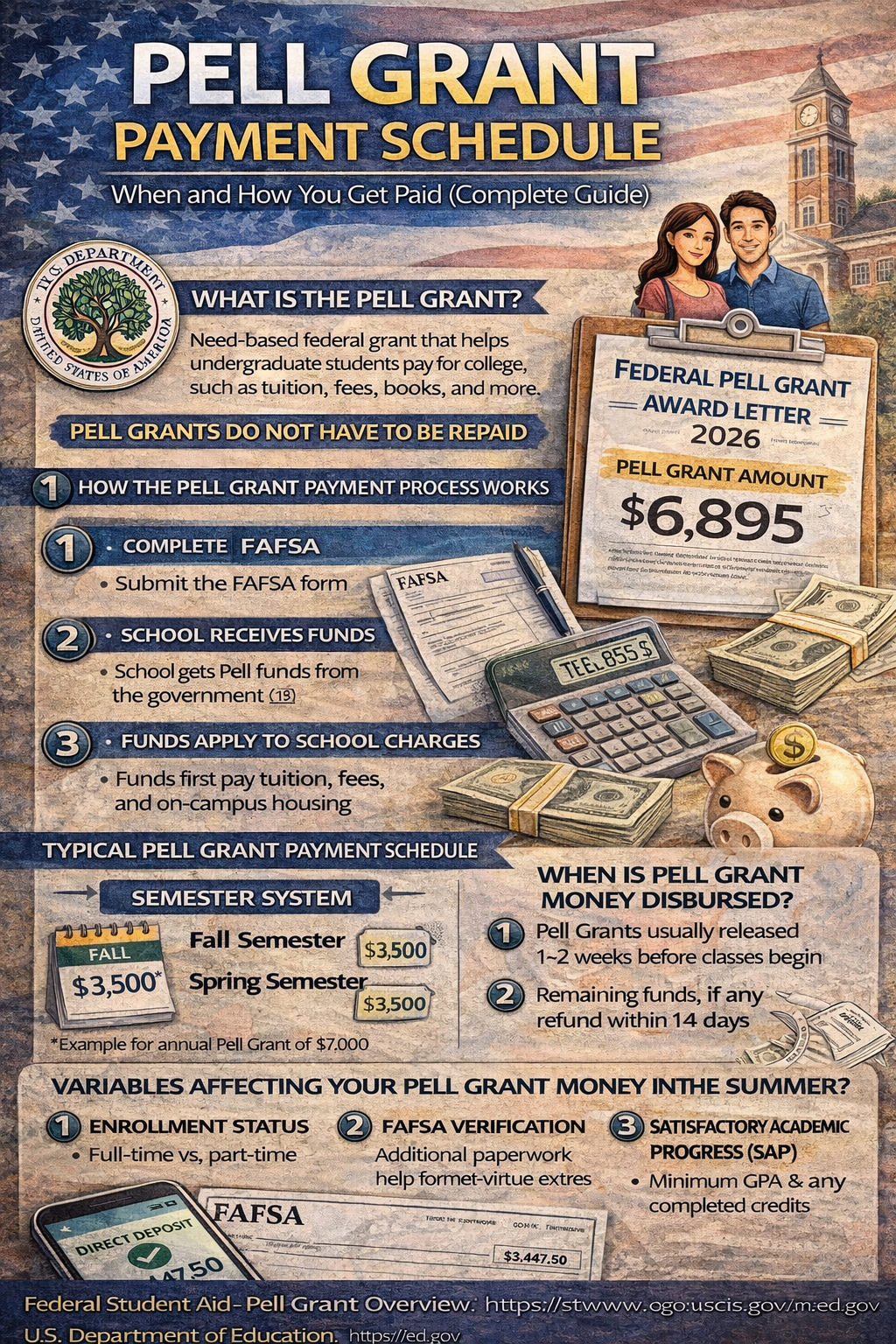
The typical flow of Pell Grant funds follows this structure:
You complete and submit the FAFSA.
Your eligibility is calculated based on financial information.
Your school receives confirmation of your Pell eligibility.
The federal government sends Pell funds to your school.
The school applies the funds to tuition and mandatory fees.
Any remaining balance is refunded to you.
The school’s financial aid office plays a central role in managing and scheduling disbursements. Therefore, payment dates vary by institution.
Standard Pell Grant Payment Schedule
Most colleges operate on a semester system with Fall and Spring terms. In these cases, your annual Pell Grant award is typically divided into two equal payments.
Example:
If your annual Pell award is $7,400:
Fall Semester: $3,700
Spring Semester: $3,700
The funds are usually disbursed at the beginning of each semester. However, “beginning” does not necessarily mean the first day of class. Some schools disburse funds 7–14 days before classes begin, while others release funds during the first week of the semester.
Quarter System and Trimester Schools
If your school operates on a quarter or trimester system, your Pell award is typically divided into three payments instead of two.
For example:
Fall Quarter
Winter Quarter
Spring Quarter
Each disbursement represents a portion of your total annual award.
Because academic calendars vary widely, students must always check directly with their school’s financial aid office for exact payment dates.
When Are Pell Grant Funds Applied to Your Account?
In most cases, Pell Grant funds are first applied to:
Tuition
Mandatory fees
On-campus housing (if applicable)
If your Pell award exceeds your school charges, the remaining amount is considered a refund and is sent to you.
What Is a Pell Grant Refund?
A Pell Grant refund occurs when your financial aid exceeds your school charges. For example:
Pell disbursement: $3,700
Tuition and fees: $2,500
Remaining balance: $1,200
That $1,200 is refunded to you.
Refunds may be issued through:
Direct deposit (fastest method)
Paper check
Campus debit card system
Direct deposit is strongly recommended for faster access to funds.
Why Is the Pell Grant Split Into Multiple Payments?
Federal law requires Pell Grants to be disbursed in at least two payments per academic year. This ensures:
Students remain enrolled
Academic progress is monitored
Funds are distributed responsibly
This structure also protects students from receiving the full award upfront and later becoming ineligible.
Factors That Affect Your Pell Grant Payment Schedule
Several factors can change the timing or amount of your Pell Grant disbursement.
Enrollment Status
Your Pell award is directly linked to how many credit hours you take.
Full-time (12+ credits) = 100% award
Three-quarter time = Reduced award
Half-time = Reduced award
Less than half-time = Significantly reduced
If you drop classes before your school’s census date, your Pell amount may be adjusted downward.
FAFSA Verification
Some students are selected for verification. This means the school must confirm certain financial details before disbursing aid. Required documents may include:
Tax transcripts
W-2 forms
Verification worksheets
Until verification is completed, Pell payments may be delayed.
Satisfactory Academic Progress (SAP)
Students must maintain:
Minimum GPA
Completion rate of attempted credits
Progress toward degree completion
Failure to meet SAP standards can result in delayed or canceled Pell payments.
Late Registration
If you register for classes close to the start of the term, disbursement may be delayed until enrollment is confirmed.
Pell Grant Payment Example
Let’s assume:
Annual Pell Award: $7,395
Semester award: $3,697.50
Tuition and fees: $2,200
Step 1: Pell is applied to tuition.
Step 2: $1,497.50 remains.
Step 3: Refund is issued within 14 days.
That refund can be used for books, rent, transportation, groceries, or other education-related costs.
Summer Pell Grant Payments
Some students qualify for additional summer Pell funding. This depends on:
Remaining Lifetime Eligibility Used (LEU)
Enrollment status (usually half-time minimum)
School participation in year-round Pell
Summer Pell is often treated as a third payment in the academic year.
Lifetime Pell Grant Limit
Students can receive Pell Grants for up to 600% of Lifetime Eligibility Used (LEU), which equals approximately 12 full-time semesters.
If you attend part-time, eligibility may stretch longer because usage is prorated.
You can check your lifetime usage through your Federal Student Aid account.
Frequently Asked Questions (FAQs)
Exactly when will my Pell refund arrive?
Most schools issue refunds within 14 days after funds are applied. Exact timing depends on your institution.
Can Pell payments be delayed?
Yes. Common reasons include verification, incomplete FAFSA, enrollment changes, or academic progress issues.
Do I receive the full Pell award at once?
No. It is typically split across academic terms.
Can I use Pell for living expenses?
Yes. After tuition and fees are covered, remaining funds can be used for rent, food, transportation, or supplies.
What happens if I drop classes?
Your Pell award may be reduced if enrollment decreases before the census date.
What if I withdraw completely?
You may be required to repay part of the Pell under Return of Title IV rules.
Is Pell taxable?
Pell Grants are generally not taxable if used for qualified education expenses.
Can graduate students receive Pell?
No. Pell Grants are typically for undergraduate students only.
How do I check my award amount?
Log into your school’s financial aid portal or Federal Student Aid account.
Can my Pell amount change mid-year?
Yes. Changes in enrollment or financial circumstances can adjust award amounts.
Reference Links
Federal Student Aid – Pell Grant Overview https://studentaid.gov/understand-aid/types/grants/pell
U.S. Department of Education https://www.ed.gov
FAFSA Application https://studentaid.gov/h/apply-for-aid/fafsa
Disclaimer
Program Clarity is an independent informational website and is not affiliated with any government agency. This article is for educational purposes only. Program rules and availability may change. Always verify details with official U.S. Department of Education authorities.