
When families face serious financial hardship, even basic daily needs such as rent, food, utilities, clothing, and transportation can become overwhelming. Job loss, reduced work hours, illness, unexpected emergencies, or family changes can quickly create a crisis. During these challenging periods, government assistance programs are designed to provide temporary support while families work toward stability. One of the most important cash assistance programs in the United States is known as TANF.
TANF stands for Temporary Assistance for Needy Families. It is a federally funded but state-administered program that provides financial assistance and supportive services to eligible low-income families with children. However, TANF is more than just a monthly payment. It is structured around work participation, personal responsibility, and time-limited assistance. The goal is not long-term dependency, but rather short-term help combined with support for employment and self-sufficiency.
What Does TANF Stand For?
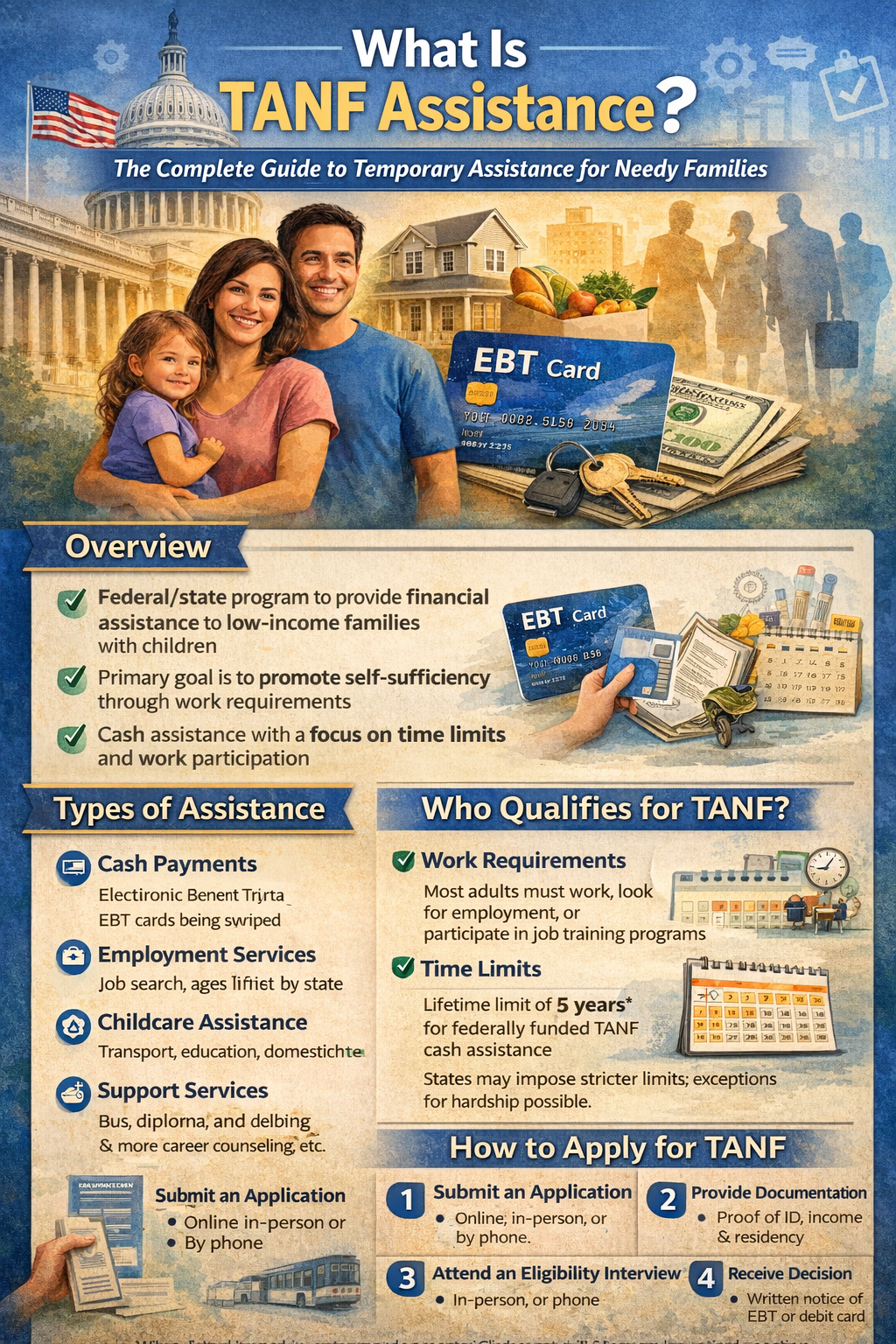
TANF stands for Temporary Assistance for Needy Families.
The program is overseen at the federal level by: U.S. Department of Health and Human Services
Within this department, TANF is managed through the Administration for Children and Families (ACF). However, an important detail must be emphasized: although TANF is federally funded, it is administered by individual states. This means that each state designs its own TANF program within federal guidelines.
What Type of Assistance Does TANF Provide?
Temporary Assistance for Needy Families (TANF) primarily provides direct cash assistance to eligible low-income families with children. Unlike programs that restrict benefits to specific categories such as food or medical care, TANF payments offer flexibility. Families can use the funds to cover essential living expenses based on their most urgent needs. The program is funded federally and overseen by the U.S. Department of Health and Human Services, but each state designs and administers its own TANF system. Because of this, benefit amounts and additional services vary by state.
The core component of TANF is a monthly cash payment. These payments are typically distributed through an Electronic Benefit Transfer (EBT) card, direct deposit, or a state-issued debit card. The money can be used for housing costs such as rent or mortgage payments, utility bills like electricity and water, clothing for children, transportation expenses, personal hygiene items, and other household necessities. Since it is cash assistance, families have discretion in how funds are spent, provided they are used legally and responsibly.
In addition to cash payments, many state TANF programs offer employment and support services designed to promote long-term self-sufficiency. These services often include job search assistance, job training programs, resume development support, vocational education, and work placement programs. The goal is to help recipients transition from public assistance to stable employment.
TANF may also provide childcare assistance for parents who are participating in work or approved job training programs. Access to affordable childcare is often critical for parents trying to maintain employment. Some states also offer transportation assistance, educational support, parenting classes, substance abuse counseling, and domestic violence support services.
Who Qualifies for TANF?
Eligibility for Temporary Assistance for Needy Families (TANF) is based on a combination of federal guidelines and state-specific rules. Although the program is funded at the federal level through the U.S. Department of Health and Human Services, each state administers its own TANF program. This means income limits, asset limits, and specific requirements may vary depending on where you live. However, there are general criteria that apply nationwide.
First, TANF is primarily designed for families with dependent children. In most cases, the household must include a child under the age of 18, or under 19 if the child is still attending high school full-time. Pregnant women in their third trimester may also qualify in some states, even if the child has not yet been born.
Second, applicants must meet low-income requirements. States set maximum income limits based on family size and household earnings. Both earned income (such as wages) and unearned income (such as child support or unemployment benefits) are considered when determining eligibility. Many states also apply asset limits, meaning families cannot have resources above a certain threshold, such as large savings accounts or valuable property beyond a primary vehicle.
Third, applicants must meet citizenship or qualified immigration status requirements. Generally, U.S. citizens and certain lawful permanent residents or other qualified non-citizens may be eligible. Immigration rules can be complex, and some non-citizens may face waiting periods before qualifying.
Fourth, individuals must be residents of the state where they apply. Proof of residency is typically required during the application process.
Finally, most adult applicants must comply with work participation requirements. TANF is structured as a work-oriented program, meaning adults are generally expected to participate in approved work activities such as employment, job search, or training programs unless they qualify for an exemption due to disability, caregiving responsibilities, or other special circumstances.
How Much Does TANF Pay?
The amount of money a family receives through Temporary Assistance for Needy Families (TANF) varies significantly depending on the state, family size, household income, and specific state policies. Although TANF is funded federally under the oversight of the U.S. Department of Health and Human Services, each state sets its own benefit levels. As a result, there is no single national payment amount.
TANF payments are typically modest and are intended to provide temporary financial support rather than fully cover all living expenses. For example, in some states, a family of three might receive around $300 to $400 per month, while in other states the same family could receive $500 to $700 per month. States with higher costs of living sometimes offer slightly higher benefit levels, but overall TANF payments remain relatively low compared to average household expenses.
The exact payment amount is determined by several factors. First, family size plays a major role. Larger households may receive higher total benefits than smaller households, although the increase per additional family member is usually limited. Second, household income affects the benefit calculation. If a family has some earned income from employment, the TANF payment may be reduced based on state income disregard rules. Third, some states consider assets, such as savings accounts or additional vehicles, when calculating eligibility and payment levels.
Payments are generally issued monthly and are distributed through an Electronic Benefit Transfer (EBT) card, direct deposit, or a state-issued debit card. The funds can be used to cover essential living costs such as rent, utilities, clothing, transportation, and other household necessities.
Work Requirements Under TANF
Work requirements are a central part of the Temporary Assistance for Needy Families (TANF) program. When TANF replaced earlier welfare programs in 1996, the focus shifted toward encouraging employment and reducing long-term dependency on public assistance. Although TANF is funded federally under the oversight of the U.S. Department of Health and Human Services, each state designs and enforces its own specific work rules within federal guidelines.
In general, most adult recipients of TANF must participate in approved work-related activities for a set number of hours each week. Federal law establishes minimum participation rates that states must meet, and states translate those requirements into individual obligations for recipients. For single-parent households, the required work hours are typically around 20 to 30 hours per week, depending on the age of the children. Two-parent households often face higher combined hour requirements.
Approved work activities may include regular employment (full-time or part-time), job search activities, vocational training, on-the-job training, community service, or participation in work experience programs. In some cases, limited educational activities such as high school completion or basic education programs may count toward work participation. However, states often limit how long education alone can satisfy the requirement.
Recipients are usually required to report their work hours and comply with case management meetings. States closely monitor participation. If a recipient fails to meet work requirements without a valid reason, penalties may apply. These penalties can include reduced monthly benefits or, in some cases, termination of assistance for a period of time.
Certain individuals may qualify for exemptions from work requirements. Common exemptions include individuals with documented disabilities, caregivers of very young children, elderly caregivers, or victims of domestic violence. Even in these situations, documentation is typically required.
Time Limits for TANF Assistance
Time limits are one of the most defining features of the Temporary Assistance for Needy Families (TANF) program. When TANF was created in 1996, it replaced earlier welfare programs that allowed ongoing assistance without strict federal time restrictions. The reform introduced a clear principle: cash assistance would be temporary and tied to efforts toward employment and self-sufficiency. Although TANF is federally funded under the oversight of the U.S. Department of Health and Human Services, states administer their own programs and may set stricter limits within federal guidelines.
Federal law establishes a lifetime limit of 60 months (five years) for receiving TANF-funded cash assistance. This 60-month limit does not need to be consecutive. It represents a cumulative total across a person’s lifetime. For example, if a parent receives TANF for 12 months, stops for several years, and later reapplies, those initial 12 months still count toward the 60-month lifetime cap.
Importantly, states are allowed to impose shorter time limits than the federal maximum. Some states limit benefits to fewer than five years, while others structure benefits in stages, gradually reducing assistance as families approach the lifetime limit. Because of this flexibility, the exact duration of eligibility can vary significantly depending on where a family lives.
There are also limited exceptions. Federal rules allow states to grant hardship extensions to a small percentage of recipients who face serious barriers such as disability, domestic violence, or extreme economic hardship. However, these extensions are not automatic and must meet strict state criteria.
How to Apply for TANF
Applying for Temporary Assistance for Needy Families (TANF) involves several steps, and the exact process depends on the state where you live. Although the program is funded federally under the oversight of the U.S. Department of Health and Human Services, each state manages its own TANF system through a department of human services or social services agency. Because of this state-level control, application methods and required documents may vary slightly, but the overall process is generally similar nationwide.
The first step is to submit an application. Most states allow applications to be completed online through the state’s benefits portal. Applicants may also apply in person at a local social services office, and some states provide options to apply by phone or mail. During the application, you will be asked to provide detailed information about your household, including the names and ages of all family members, income sources, housing situation, and employment status.
After submitting the application, you will typically need to provide supporting documentation. Common required documents include proof of identity (such as a driver’s license or state ID), Social Security numbers for household members, proof of income (pay stubs or employer statements), proof of residency (lease agreement or utility bill), and birth certificates for children. If you have little or no income, you may need to provide a written explanation of how your household is currently being supported.
Most states require applicants to attend an eligibility interview, either in person or by phone. During this interview, a caseworker reviews your information, verifies documents, and explains work participation requirements. Applicants are often required to sign agreements outlining their responsibilities, including participation in work or job training programs if approved.
How TANF Differs From Other Assistance Programs
Temporary Assistance for Needy Families (TANF) differs from other public assistance programs in several important ways. While many government benefit programs provide targeted support such as food, healthcare, or housing subsidies, TANF is primarily a cash assistance program with strict work requirements and lifetime time limits. It operates under federal oversight through the U.S. Department of Health and Human Services, but states have significant flexibility in designing their individual programs.
One of the main differences is that TANF provides direct cash payments, giving recipients flexibility in how funds are used. Families may use TANF benefits to cover rent, utilities, clothing, transportation, and other essential expenses. In contrast, programs like SNAP (Supplemental Nutrition Assistance Program) provide benefits that can only be used for food purchases, and Medicaid provides health coverage rather than cash. This flexibility makes TANF distinct because it allows families to prioritize their most urgent financial needs.
Another key difference is the presence of mandatory work participation requirements. Most adult TANF recipients must participate in approved work-related activities such as employment, job training, or job search programs. Failure to meet these requirements can result in reduced or terminated benefits. By comparison, programs like SNAP and Medicaid generally do not impose the same level of work obligations for all recipients, especially families with children.
TANF also has a lifetime time limit, typically capped at 60 months of federally funded assistance. Many other assistance programs do not have strict lifetime limits. For example, Medicaid and SNAP eligibility is usually based on income and household size rather than cumulative lifetime usage.
Frequently Asked Questions (FAQs)
Is TANF the same as welfare?
Yes, TANF is commonly referred to as welfare, but it is structured with strict work requirements and time limits.
How long can I receive TANF?
Federal law limits benefits to 60 months over a lifetime, though some states impose shorter limits.
Can single parents receive TANF?
Yes. Single-parent households are a primary group served by TANF.
Can two-parent households qualify?
Yes, if income requirements are met.
Do I have to work while receiving TANF?
Most adults must participate in work-related activities unless exempt.
Is TANF taxable?
Generally, TANF cash benefits are not considered taxable income.
Can I receive TANF and SNAP at the same time?
Yes. Many families receive both programs simultaneously.
What happens if my income increases?
Benefits may be reduced or discontinued if income exceeds limits.
Can immigrants receive TANF?
Eligibility depends on immigration status and state rules.
Can I reapply after time limit ends?
Some states allow hardship extensions, but rules vary.
Reference Links
U.S. Department of Health and Human Services – TANF https://www.acf.hhs.gov/ofa/programs/tanf
Benefits.gov TANF Overview https://www.benefits.gov/benefit/613
USA.gov Public Assistance Programs https://www.usa.gov/benefits
Disclaimer
Program Clarity is an independent informational website and is not affiliated with any government agency. This article is for educational purposes only. Program rules and availability may change. Always verify details with official authorities.