International students from around the world choose the United States for higher education because American universities provide excellent academic programs, advanced research opportunities, modern facilities, and strong career prospects. However, studying in the United States as an international student comes with important immigration responsibilities. Receiving an F-1 visa is only the first step. Students must continuously maintain lawful F-1 status during their entire academic journey.
Many international students accidentally violate their status because they misunderstand immigration rules about full-time enrollment, work authorization, online classes, or travel regulations. Even a small mistake can create serious immigration problems that affect future opportunities such as Optional Practical Training (OPT), H-1B work visas, graduate school admission, or permanent residency applications.
Maintaining F-1 visa status requires careful attention to immigration regulations, academic progress, and document management. Fortunately, most problems can be avoided if students understand the rules and communicate regularly with their Designated School Official (DSO).
What Is F-1 Visa Status?
The F-1 visa is a nonimmigrant student visa issued to international students who want to study full-time at approved educational institutions in the United States. Many students think the visa stamp in the passport automatically allows them to stay in America for the entire duration of their studies, but immigration status works differently.
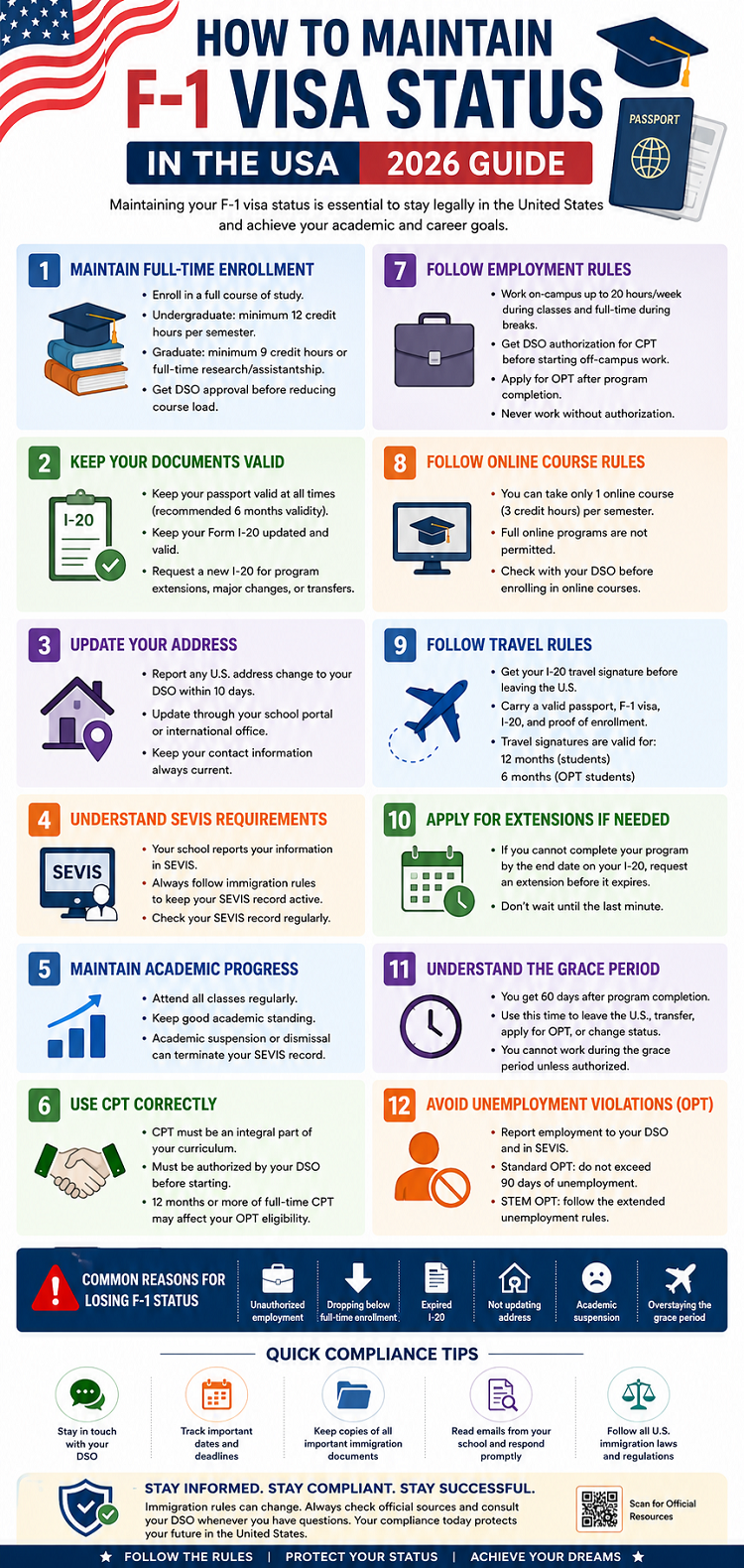
The visa stamp is mainly used for entering the United States through an airport or border checkpoint. Immigration status refers to the legal condition that allows a student to remain inside the country while following all F-1 visa rules.
Students maintain lawful F-1 status by:
- Staying enrolled full-time
- Maintaining academic progress
- Keeping immigration documents valid
- Following employment rules
- Updating personal information
- Obeying SEVIS regulations
Even if a visa stamp expires while a student is inside the United States, the student may still remain legally if all F-1 requirements continue to be followed properly.
Understanding this difference is extremely important because many students panic when their visa expires, even though visa expiration does not automatically mean loss of legal status.
Importance of SEVIS for International Students
The Student and Exchange Visitor Information System (SEVIS) is a government database used by the Department of Homeland Security to monitor international students in the United States.
Every F-1 student receives a unique SEVIS number printed on the Form I-20. Schools approved to host international students must regularly update student records in SEVIS.
The system tracks:
- Enrollment status
- Program dates
- Address information
- Employment authorization
- Transfers
- Academic status
- Graduation information
The Designated School Official (DSO) at each school is responsible for managing SEVIS records.
SEVIS compliance is one of the most important parts of maintaining F-1 status. If students violate immigration rules, schools may terminate their SEVIS records. A terminated SEVIS record can create severe immigration consequences including:
- Loss of lawful status
- Ineligibility for OPT
- Visa cancellation
- Future immigration problems
- Difficulty re-entering the United States
Students should always communicate with their DSO before making important academic or employment decisions.
Full Time Enrollment Requirements
Maintaining full-time enrollment is one of the most important F-1 visa requirements.
The U.S. government expects F-1 students to come to the country primarily for education. Students who fail to remain enrolled full-time may violate their immigration status.
Undergraduate Student Requirements
Most undergraduate students must enroll in:
- At least 12 credit hours per semester
Some universities may require additional coursework depending on institutional policies.
Graduate Student Requirements
Graduate student requirements vary by institution, but most graduate students must maintain:
- 9 credit hours
- Full-time research status
- Thesis enrollment
Students should verify full-time enrollment rules directly with their school.
Reduced Course Load Authorization
In some situations, students may legally enroll below full-time status with official approval from the DSO.
This is called a Reduced Course Load (RCL).
Students should never reduce their course load without authorization because unauthorized withdrawal may immediately violate F-1 status.
Academic Difficulties
Students experiencing temporary academic adjustment problems may qualify for reduced enrollment.
Examples include:
- English language difficulties
- Unfamiliar teaching methods
- Improper course placement
- Initial adjustment challenges
Academic difficulty authorization is limited and usually available only once per educational level.
Medical Conditions
Students with documented medical conditions may receive permission for reduced enrollment or temporary leave.
Medical authorization usually requires:
- Documentation from licensed medical professionals
- DSO approval
- Proper SEVIS reporting
Final Semester
Students nearing graduation may study below full-time enrollment if fewer credits are needed to complete degree requirements.
Approval from the DSO is still required.
Maintaining a Valid Passport and Form I-20
International students must always maintain valid immigration documents while studying in the United States.
The two most important documents are:
- Passport
- Form I-20
Passport Requirements
Most immigration regulations require passports to remain valid for at least six months into the future.
Expired passports can create problems involving:
- Travel
- Employment authorization
- Visa applications
- Immigration processing
Students should renew passports early through their embassy or consulate.
Understanding the Form I-20
The Form I-20 is an official immigration document issued by the school.
It includes important information such as:
- SEVIS number
- Program information
- Degree level
- School details
- Estimated completion date
Students should keep all old I-20 forms permanently because they may be needed for future immigration applications.
Reporting Address Changes
F-1 students are legally required to report address changes within ten days of moving.
Address updates are usually submitted through:
- Student portals
- International offices
- DSOs
Failing to update address information may violate immigration regulations even if the mistake appears minor.
Students should also keep emergency contact information updated.
Employment Rules for F-1 Students
Employment regulations are one of the most misunderstood areas of F-1 status compliance.
Unauthorized employment is considered a serious immigration violation.
Students should never begin any type of work without understanding whether authorization is required.
Even some unpaid internships, freelance work, or online business activities may require immigration approval.
On Campus Employment Rules
Most F-1 students may work on-campus without separate authorization from USCIS.
Students may generally work:
- Up to 20 hours weekly during academic sessions
- Full-time during official school breaks
Common on-campus jobs include:
- Library assistant positions
- Research assistant jobs
- Dining hall work
- Administrative office support
- Campus bookstore jobs
Employment must generally be connected to the institution.
Working beyond authorized hours may violate immigration status.
CPT Rules for International Students
Curricular Practical Training (CPT) allows students to participate in off-campus work directly related to their degree program.
CPT is commonly used for:
- Internships
- Cooperative education programs
- Clinical training
- Practicum experiences
Students must receive CPT authorization before beginning work.
The authorization appears directly on the Form I-20.
Important CPT Restrictions
CPT employment must:
- Relate to the student’s field of study
- Be approved by the DSO
- Be connected to the curriculum
Students should also understand that excessive full-time CPT can affect OPT eligibility.
Generally:
- 12 months or more of full-time CPT removes eligibility for OPT
Part-time CPT usually does not affect OPT eligibility.
Optional Practical Training (OPT)
Optional Practical Training allows F-1 students to gain temporary work experience related to their degree field.
Most students receive:
- 12 months of standard OPT
Eligible STEM students may qualify for:
- 24-month STEM OPT extension
OPT is extremely valuable because it allows international students to gain professional experience in the United States after graduation.
Maintaining Status During OPT
Many students believe immigration compliance becomes easier after graduation, but OPT introduces additional responsibilities.
Students on OPT must:
- Work in positions related to their degree
- Report employment updates
- Report address changes
- Track unemployment carefully
Unemployment Limits
Students on standard OPT cannot exceed:
- 90 days of unemployment
STEM OPT students receive additional unemployment allowances but still must maintain compliance.
Excessive unemployment can terminate F-1 status.
Online Class Restrictions
International students must follow specific rules regarding online education.
F-1 students usually cannot count fully online coursework toward full-time enrollment requirements.
Most regulations allow:
- Only one online class counting toward full-time enrollment each semester
Programs offered entirely online generally do not qualify for F-1 status.
Students should confirm online learning rules with their school before registering for remote classes.
Travel Rules for F-1 Students
International students often travel during vacations or emergencies. However, traveling outside the United States requires proper preparation.
Before traveling internationally, students should carry:
- Valid passport
- Valid F-1 visa
- Signed Form I-20
- Enrollment verification
- Employment authorization documents if applicable
Failure to carry proper documents may create problems when returning to the United States.
Travel Signature Requirements
The travel signature on the Form I-20 confirms that the student remains in good standing.
Travel signatures are usually valid for:
- 12 months for enrolled students
- 6 months for OPT students
Traveling with an outdated signature may cause re-entry delays or denial.
Students should request updated travel signatures before leaving the country.
Program Extensions
Some students need additional time to complete their academic program.
Common reasons include:
- Thesis delays
- Research problems
- Medical issues
- Academic difficulties
- Major changes
Students must request an I-20 extension before the current I-20 expires.
Late extension requests may create serious immigration violations.
Changing Schools or Majors
International students may transfer schools or change majors while maintaining F-1 status.
However, these changes must be updated correctly in SEVIS.
The transfer process usually includes:
- Acceptance into the new school
- Coordination between DSOs
- New Form I-20 issuance
- SEVIS transfer procedures
Improper transfers can accidentally terminate lawful status.
Students should plan transfers carefully and communicate with both schools.
Understanding the F-1 Grace Period
After completing studies, most F-1 students receive a grace period allowing time to prepare for departure or future immigration steps.
Most students receive:
- 60 days after program completion
During the grace period students may:
- Leave the United States
- Transfer schools
- Apply for OPT
- Change immigration status
Employment is generally not allowed during the grace period unless separately authorized.
Students who violate immigration status may lose eligibility for the grace period.
Common Reasons Students Lose F-1 Status
Many international students lose status because of avoidable mistakes or misunderstanding immigration rules.
Unauthorized Employment
Working without authorization is one of the most serious violations.
Dropping Below Full-Time Enrollment
Students sometimes withdraw from courses without DSO approval.
Expired I-20
Failure to request program extensions before expiration creates immigration problems.
Excessive Unemployment During OPT
OPT students must carefully monitor unemployment days.
Failure to Report Address Changes
Even administrative mistakes can become immigration violations.
Academic Suspension
Suspension or dismissal may terminate SEVIS records.
Unauthorized Leave of Absence
Leaving studies without approval may violate status.
Consequences of Violating F-1 Status
Violating immigration regulations can create serious long-term consequences.
Possible outcomes include:
- SEVIS termination
- Visa cancellation
- Deportation proceedings
- Loss of OPT eligibility
- Future visa denials
- Problems obtaining green cards
- Difficulty re-entering the United States
Immigration officers carefully review past compliance history during future applications.
Maintaining clean immigration records is extremely important for long-term opportunities.
Tips to Maintain F-1 Visa Status Successfully
Maintaining lawful status becomes easier when students develop organized habits and remain proactive.
Stay in Contact With Your DSO
Always ask questions before making academic, employment, or travel decisions.
Track Important Deadlines
Monitor:
- Passport expiration
- I-20 expiration
- OPT deadlines
- Travel signature validity
Keep Immigration Documents Safe
Store copies of:
- Passport
- Visa
- Form I-20
- I-94 record
- Employment documents
Never Work Without Authorization
Always confirm employment eligibility before starting any work activity.
Maintain Academic Progress
Attend classes regularly and avoid academic probation.
Plan International Travel Carefully
Check documents before traveling to avoid re entry problems.
FAQs
Can I stay in the USA with an expired F-1 visa?
Yes. Students may remain legally in the United States if they maintain valid F-1 status and possess a valid Form I-20.
Can I work off-campus without CPT or OPT?
No. Unauthorized off-campus employment violates immigration rules.
How many online classes can F-1 students take?
Usually only one online course may count toward full-time enrollment requirements.
What happens if my I-20 expires?
Students may lose lawful status unless they receive an approved extension before expiration.
How long is the F-1 grace period?
Most students receive a 60-day grace period after completing their program.
Can poor grades affect immigration status?
Yes. Academic suspension or dismissal may result in SEVIS termination.
Do students need to report address changes?
Yes. F-1 students must report address changes within ten days.
Reference Links
- U.S. Citizenship and Immigration Services (USCIS)
- Study in the States
- Student and Exchange Visitor Program (SEVP)
- U.S. Department of State Student Visa Information
- OPT Information for F-1 Students
Disclaimer
Program Clarity is an independent informational website and is not affiliated with any government agency. This article is for educational purposes only. Program rules and availability may change. Always verify details with official authorities.