
Moving to the United States or visiting the country for education, tourism, employment, or family reasons usually begins with one important requirement: obtaining the correct visa. However, many people become confused when they hear the terms immigrant visa and nonimmigrant visa because both involve entering the United States, yet they are designed for completely different purposes.
In simple terms, an immigrant visa is intended for people who want to live permanently in the United States, while a nonimmigrant visa is for temporary visits such as tourism, study, work assignments, or business travel. Understanding this distinction is extremely important because choosing the wrong visa category can lead to delays, denials, or future immigration problems.
In 2026, U.S. immigration rules continue to evolve due to global travel demand, labor shortages, international student mobility, and changing border policies. Millions of people apply for visas every year, but many applications are rejected because applicants fail to understand the legal purpose of the visa they choose. Immigration officers carefully review whether a person’s intentions match the visa category they are applying for, and even a small misunderstanding can affect approval chances.
Overview of Immigrant vs Nonimmigrant Visas
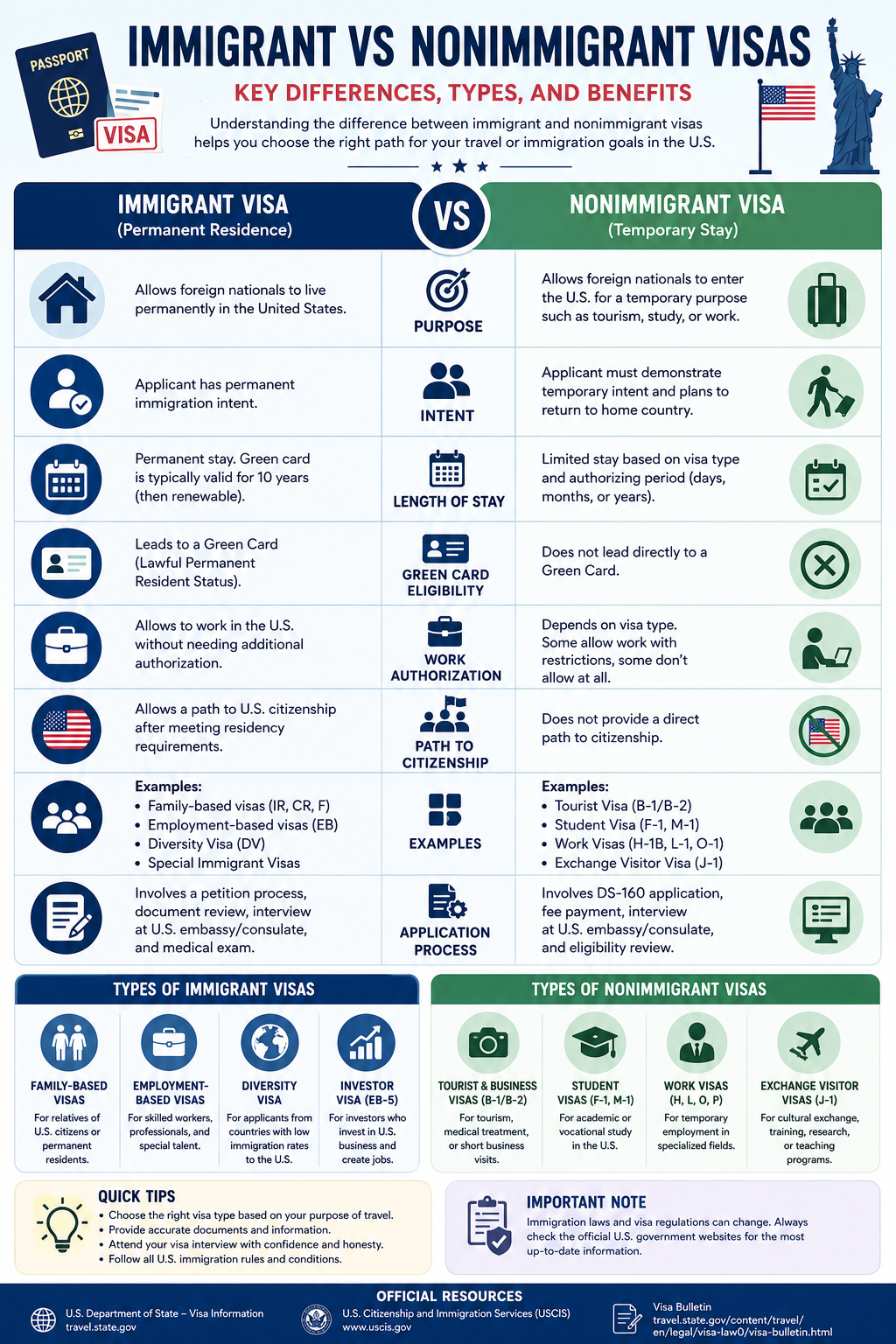
| Feature | Immigrant Visa | Nonimmigrant Visa |
|---|---|---|
| Main Purpose | Permanent residence | Temporary stay |
| Green Card Eligibility | Yes | Usually no |
| Immigration Intent | Allowed | Must usually show temporary intent |
| Length of Stay | Permanent | Limited duration |
| Citizenship Path | Possible | Indirect or unavailable |
| Work Authorization | Broad work rights | Depends on visa type |
| Renewal Requirements | Green card renewal every several years | Frequent renewals may be required |
| Examples | Family-based and employment-based green cards | Tourist, student, and temporary work visas |
What Is an Immigrant Visa?
An immigrant visa is a visa category issued to foreign nationals who plan to permanently relocate to the United States. Individuals entering the country with immigrant visas are usually granted lawful permanent resident status, commonly known as obtaining a green card.
This visa category is specifically designed for people who intend to build their lives in the United States over the long term. Unlike temporary visitors, immigrant visa holders are not expected to return to their home countries after a short stay. Instead, they are legally authorized to reside in the United States permanently, work freely, and eventually apply for citizenship if they meet the eligibility requirements.
Immigrant visas are commonly used by family members of U.S. citizens, highly skilled professionals, foreign investors, and individuals selected through special immigration programs. Many people spend years waiting for immigrant visa approval because certain categories are subject to annual quotas and country-specific limitations.
Main Benefits of an Immigrant Visa
Immigrant visas provide numerous advantages for individuals and families seeking stability and long-term opportunities in the United States. One major benefit is the ability to permanently live and work in the country without repeatedly renewing temporary status.
Permanent residents can generally accept employment from most employers without needing separate sponsorship approvals. This flexibility allows immigrants to pursue career growth, education, entrepreneurship, and financial stability more easily than many temporary visa holders.
Immigrant visa holders may also sponsor certain relatives for immigration in the future, helping families reunite legally in the United States. In many cases, permanent residents can eventually become U.S. citizens, gaining additional rights such as voting and obtaining U.S. passports.
What Is a Nonimmigrant Visa?
A nonimmigrant visa is a temporary visa issued to foreign nationals who plan to enter the United States for a limited purpose and limited duration. Unlike immigrant visas, nonimmigrant visas do not generally grant permanent residence.
These visas are designed for short-term activities such as tourism, studying, temporary employment, medical treatment, business meetings, cultural exchanges, or visiting family members. Immigration officers expect nonimmigrant visa holders to leave the United States after their authorized stay ends.
One of the most important requirements for many nonimmigrant visa categories is proving temporary intent. Applicants must convince consular officers that they have strong reasons to return to their home countries after completing their travel purpose. Strong ties may include employment, business ownership, family responsibilities, property ownership, or educational commitments.
Why Nonimmigrant Visas Are Important
Nonimmigrant visas play a critical role in international education, tourism, global business, and workforce mobility. Millions of visitors enter the United States every year using temporary visas, contributing to the economy, universities, research institutions, and labor markets.
International students use nonimmigrant visas to pursue academic degrees and vocational training. Skilled professionals use temporary work visas to support American industries experiencing labor shortages. Tourists and business visitors contribute billions of dollars to the U.S. travel and hospitality sectors annually.
Temporary visas also strengthen diplomatic and cultural relationships between countries by encouraging educational exchanges, international cooperation, and tourism.
Major Differences
Although both visa categories allow foreign nationals to enter the United States, their legal purposes are entirely different. Understanding these differences is essential before applying for any visa.
Immigration Intent
Immigration intent is one of the most significant distinctions between immigrant and nonimmigrant visas.
Applicants for immigrant visas are expected to have permanent immigration intentions. In fact, the entire purpose of the immigrant visa system is to allow eligible foreign nationals to permanently relocate to the United States.
In contrast, most nonimmigrant visa applicants must prove that they intend to stay temporarily and return home afterward. If a consular officer believes a tourist or student visa applicant secretly plans to immigrate permanently, the application may be denied.
For example, a person applying for a tourist visa must usually demonstrate strong social, financial, or professional ties to their home country. Immigration officers want evidence that the individual has compelling reasons to leave the United States after the visit ends.
This difference in intent often determines whether an applicant qualifies for a visa category at all.
Length of Stay
Immigrant visas grant permanent residence, meaning individuals can live indefinitely in the United States as long as they maintain lawful status.
Nonimmigrant visas, however, only authorize temporary stays. The permitted stay depends on the specific visa category and the applicant’s purpose.
Tourist visas may allow stays of several months, while temporary work visas might allow several years of employment. Student visas generally remain valid for the duration of the educational program, provided the student continues meeting enrollment requirements.
Even when nonimmigrant visas have long validity periods, they still remain temporary under immigration law.
Employment Authorization
Permanent residents generally enjoy broad employment rights. They may work for most employers in the United States without needing additional authorization documents or employer sponsorship.
Nonimmigrant visa holders face more restrictions. Some temporary visas completely prohibit employment, while others allow work only under specific conditions.
For instance, tourist visa holders cannot legally work in the United States. International students may work under limited conditions related to their studies. H-1B visa holders may only work for approved sponsoring employers.
These restrictions make employment authorization one of the most important differences between visa categories.
Common Types of Immigrant Visas
The United States offers several immigrant visa categories based on family relationships, employment qualifications, humanitarian protections, and investment programs.
Family-Based Immigrant Visas
Family reunification remains one of the largest components of U.S. immigration policy. U.S. citizens and lawful permanent residents may sponsor eligible relatives for permanent residence.
Immediate relatives of U.S. citizens often receive priority treatment because these categories are not subject to annual numerical caps in the same way as some preference categories.
Common family-based immigrant visas include visas for spouses, children, parents, and siblings.
Family sponsorship usually requires financial support documentation because sponsors must prove they can financially assist incoming immigrants if necessary.
Employment-Based Immigrant Visas
Employment-based immigration allows U.S. employers to sponsor qualified foreign workers for permanent residence.
These visas are generally divided into preference categories based on education, skills, experience, and professional achievements.
Highly skilled professionals, multinational executives, scientists, researchers, healthcare workers, and investors commonly use employment-based immigrant visas.
Processing times may vary significantly depending on visa category and country of origin because annual limits affect availability.
Diversity Visa Lottery
The Diversity Visa Program provides immigration opportunities to applicants from countries with historically low immigration rates to the United States.
Each year, thousands of applicants are randomly selected through the visa lottery system. Winners must still meet eligibility requirements and complete background checks before receiving immigrant visas.
The Diversity Visa Program remains highly competitive because millions of people apply annually.
Common Types of Nonimmigrant Visas
The nonimmigrant visa system contains many categories tailored to specific temporary activities.
Tourist and Visitor Visas
Tourist visas are among the most widely recognized nonimmigrant visas. They allow foreign nationals to visit the United States for tourism, sightseeing, family visits, or medical treatment.
Business visitor visas allow participation in meetings, conferences, negotiations, and professional events without entering long-term employment.
Student Visas
International students attending academic institutions typically require F-1 visas. Vocational students often use M-1 visas.
Student visa holders must maintain full-time enrollment and comply with immigration regulations throughout their studies.
Many international students later pursue temporary work opportunities or employer sponsorship after graduation.
Temporary Work Visas
Temporary work visas allow foreign professionals and laborers to work legally in the United States for specific employers and time periods.
Examples include:
- H-1B visas for specialized occupations
- L-1 visas for intracompany transfers
- O-1 visas for individuals with extraordinary ability
- H-2A visas for agricultural workers
- H-2B visas for seasonal non-agricultural workers
These visas are especially important for industries experiencing labor shortages or requiring highly specialized talent.
Dual Intent Visas Explained
Some temporary visa categories permit dual intent, meaning applicants may legally hold temporary status while also pursuing permanent residency.
This concept is extremely important because many temporary visa holders eventually wish to immigrate permanently.
For example, H-1B visa holders can legally seek employment-based green cards without automatically violating their temporary visa conditions.
Dual intent visas provide greater flexibility and reduce the risk of visa denials related to future immigration plans.
Immigrant Visa Application Process
The immigrant visa process often involves multiple government agencies and extensive documentation.
Applicants usually begin by having a sponsor file an immigration petition with U.S. Citizenship and Immigration Services. Family sponsors commonly submit Form I-130, while employers often file Form I-140.
After petition approval, the case generally moves to the National Visa Center, where applicants submit civil documents, financial records, and processing fees.
Applicants then complete medical examinations and attend interviews at U.S. embassies or consulates abroad. Immigration officers review eligibility, background information, and supporting evidence before making final decisions.
Because immigrant visas involve permanent residence, background investigations and documentation requirements are often more extensive than temporary visa applications.
Nonimmigrant Visa Application Process
Temporary visa applications are generally shorter but still require careful preparation.
Applicants usually complete the DS-160 online application form, pay visa fees, and schedule interviews at U.S. embassies or consulates.
During interviews, officers evaluate the applicant’s purpose of travel, financial capability, immigration history, and ties to the home country.
The interview is especially important for temporary visa categories because officers must determine whether the applicant genuinely intends to return home after the authorized stay ends.
Even minor inconsistencies during interviews can lead to delays or denials.
Common Reasons for Visa Denials
Visa denials occur for many reasons, and understanding these risks helps applicants prepare stronger cases.
One common reason for denial is insufficient documentation. Missing financial records, incomplete forms, or inconsistent information can negatively affect credibility.
Temporary visa applicants are frequently denied when they fail to demonstrate strong home-country ties. Immigration officers may suspect unauthorized immigration intentions if the applicant lacks employment, family responsibilities, or financial stability.
Criminal history, previous immigration violations, visa overstays, and fraudulent information can also create serious eligibility problems.
Financial concerns are another common issue because applicants may need to prove they can support themselves during their stay.
Can Nonimmigrant Visas Lead to Permanent Residency?
Although temporary visas are not designed primarily for immigration, some visa holders later transition to permanent resident status through lawful immigration pathways.
International students often obtain employer sponsorship after graduation. Temporary workers may qualify for employment-based green cards. Marriage to a U.S. citizen is another common adjustment pathway.
However, not every nonimmigrant visa category allows easy transition to permanent residence, so applicants should carefully understand their long-term options before applying.
Challenges Facing Visa Applicants in 2026
Immigration systems worldwide continue facing increased demand and administrative pressure in 2026.
Family-based immigrant visa backlogs remain significant for many countries. Employment-based categories also experience delays because annual quotas limit availability.
Temporary visa applicants face stricter interview scrutiny as immigration authorities continue emphasizing fraud prevention and compliance monitoring.
At the same time, digital processing systems, online scheduling improvements, and electronic document management continue modernizing portions of the immigration process.
Applicants must stay informed because immigration regulations, processing times, and interview procedures can change frequently.
Official Immigration Resources
Applicants should always verify immigration requirements through official government sources rather than relying entirely on unofficial advice or social media discussions.
Important official resources include:
FAQs About Immigrant vs Nonimmigrant Visas
What is the main difference between immigrant and nonimmigrant visas?
The main difference is that immigrant visas are for permanent residence, while nonimmigrant visas are for temporary stays in the United States.
Can a nonimmigrant visa holder become a permanent resident?
Yes, some temporary visa holders later qualify for permanent residency through employment sponsorship, marriage, family petitions, or investment programs.
Does an immigrant visa automatically provide a green card?
After entering the United States with an immigrant visa, individuals generally receive lawful permanent resident status and a green card.
Can tourist visa holders work in the United States?
No, tourist visa holders are generally prohibited from working in the United States.
What are dual intent visas?
Dual intent visas allow temporary visa holders to pursue permanent residency without violating visa conditions.
Which visas are considered nonimmigrant visas?
Tourist visas, student visas, exchange visitor visas, and many temporary work visas are classified as nonimmigrant visas.
How long does immigrant visa processing take?
Processing times vary greatly depending on visa category, country of origin, and government workload. Some cases take months, while others may take years.
Why are nonimmigrant visas denied?
Common reasons include insufficient documentation, weak home-country ties, financial concerns, and suspected immigration intent.
Can students apply for green cards later?
Yes, many international students later qualify for employment-based or family-sponsored permanent residency.
Disclaimer
Program Clarity is an independent informational website and is not affiliated with any government agency. This article is for educational purposes only. Program rules and availability may change. Always verify details with official authorities.