
Online education has transformed the way students pursue higher education in the United States. Instead of attending classes on campus every day, students can now earn degrees, certificates, and professional credentials from the comfort of their homes. Advances in digital learning platforms have made online education more interactive, flexible, and accessible than ever before. Today, millions of students—including recent high school graduates, working professionals, parents, military personnel, and career changers—choose online programs because they offer the freedom to study at their own pace while balancing work and family responsibilities.
Although online learning is often more affordable than traditional classroom education, it is not free. Tuition fees, digital textbooks, software subscriptions, laptops, internet service, and other educational expenses can create financial challenges for many students. Fortunately, the United States offers a wide variety of online education assistance programs designed to make higher education more accessible. These programs include federal financial aid, grants, scholarships, employer tuition assistance, military education benefits, state-funded aid, and nonprofit scholarships. By taking advantage of these opportunities, students can significantly reduce the overall cost of earning an online degree.
Many students mistakenly believe that financial aid is available only to those attending classes on campus. However, students enrolled in accredited online colleges are often eligible for the same federal and state financial aid programs as traditional students. Whether you plan to earn an associate degree, bachelor’s degree, master’s degree, or professional certification, understanding how online education assistance works can help you make informed financial decisions and reduce educational expenses.
What Are Online Education Assistance Programs?
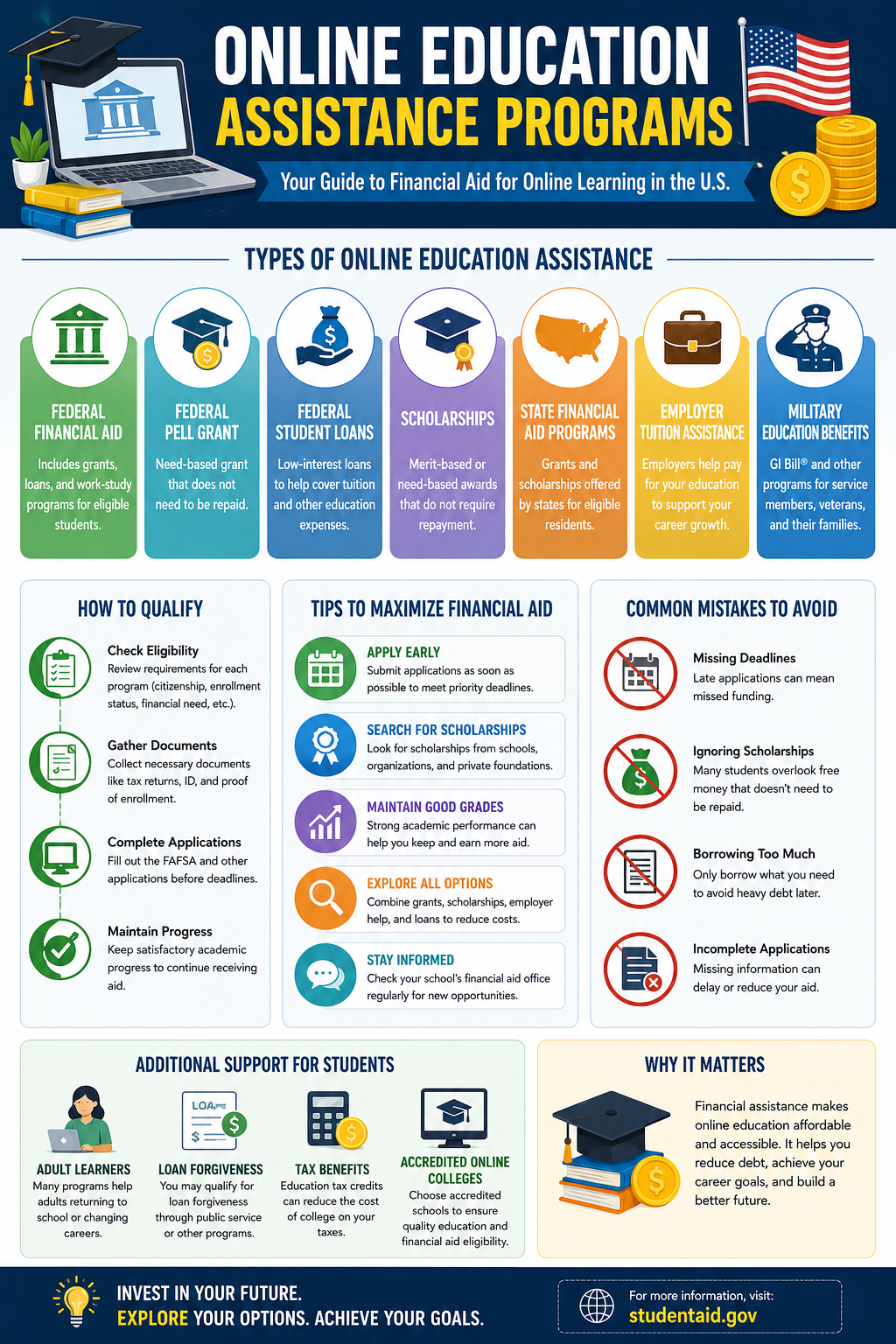
Online education assistance programs are financial support initiatives that help students pay for accredited online education. These programs are offered by federal and state governments, colleges and universities, employers, nonprofit organizations, and private foundations. Their primary purpose is to remove financial barriers that prevent students from pursuing higher education and career development.
Financial assistance can cover much more than tuition alone. Depending on the specific program, students may receive support for textbooks, online course materials, internet access, technology purchases, certification examinations, and other education-related expenses. Some forms of assistance, such as grants and scholarships, do not require repayment, while others, such as student loans, provide affordable financing with flexible repayment options.
As online education continues to grow in popularity, educational institutions are expanding their financial aid opportunities for distance learners. Many universities now offer scholarships specifically for online students, while employers and nonprofit organizations increasingly invest in educational programs that help individuals improve their professional skills. These developments have made online education more accessible than ever before for students from diverse financial backgrounds.
Why Financial Assistance Matters for Online Students
Many people assume that studying online automatically eliminates the financial challenges associated with higher education. While online programs can reduce transportation, housing, and meal expenses, students still face numerous education-related costs. Tuition remains the largest expense for most online learners, but technology requirements such as laptops, webcams, software subscriptions, and reliable internet service also contribute significantly to the overall cost of earning a degree.
Financial assistance allows students to focus on learning instead of worrying about paying educational expenses. Grants and scholarships reduce the amount students must pay from their own income, while employer tuition assistance and military education benefits provide valuable support for eligible individuals. Even federal student loans, when used responsibly, make higher education accessible for students who may not otherwise be able to afford college.
The benefits of financial aid extend beyond reducing tuition costs. Students who receive adequate financial support are more likely to remain enrolled, complete their degree programs on time, and graduate with lower levels of debt. This financial stability enables graduates to begin their careers with greater confidence and fewer financial obligations, ultimately contributing to long-term professional success.
Types of Online Education Assistance Programs
Students pursuing online education in the United States have access to several different forms of financial assistance. Each program serves a unique purpose, and many students combine multiple funding sources to create a comprehensive financial aid package. Understanding these options helps students identify the resources that best fit their educational and financial needs.
The most common forms of online education assistance include federal financial aid, scholarships, state grants, employer tuition assistance, military education benefits, and nonprofit funding programs. While some forms of aid are based on financial need, others reward academic excellence, leadership, community involvement, or career aspirations. Exploring multiple funding opportunities can significantly reduce educational expenses and minimize the need for student loans.
Federal Financial Aid
Federal financial aid is the largest source of educational funding for students in the United States. Administered by the U.S. Department of Education, these programs help millions of students pay for higher education each year. Students enrolled in eligible online degree programs at accredited institutions can often receive the same federal financial aid available to students attending classes on campus.
Federal financial aid includes grants, student loans, and other educational assistance programs designed to make college more affordable. Eligibility is generally determined by completing the Free Application for Federal Student Aid (FAFSA), which evaluates a student’s financial situation and determines the types of aid they may receive. Because many federal aid programs have annual funding limits, submitting the FAFSA early can improve the chances of receiving the maximum available assistance.
For many students, federal financial aid serves as the foundation of their education funding strategy. Grants reduce out-of-pocket costs, while federal loans provide affordable financing with borrower protections that are generally unavailable through private lenders.
Federal Pell Grant
The Federal Pell Grant is one of the most valuable forms of financial assistance available to undergraduate students with demonstrated financial need. Unlike student loans, Pell Grants typically do not need to be repaid, making them an attractive funding source for students seeking affordable online education. Award amounts vary depending on financial need, enrollment status, and the cost of attendance at the student’s chosen institution.
Many accredited online colleges participate in the Pell Grant program, allowing eligible students to use these funds toward tuition, fees, and other educational expenses. Because Pell Grants reduce the need for borrowing, they play a critical role in helping students graduate with less debt. Students should complete the FAFSA every academic year to determine whether they continue to qualify for Pell Grant funding.
Receiving a Pell Grant may also increase eligibility for additional financial aid programs. Many colleges consider Pell Grant recipients for institutional grants and scholarships, further reducing educational expenses and making higher education more accessible.
Federal Student Loans
Federal student loans provide another important source of financial assistance for students whose grants and scholarships do not fully cover educational expenses. These loans generally offer lower interest rates, flexible repayment options, and borrower protections that make them more favorable than many private student loans. When used responsibly, federal loans help students complete their education while maintaining manageable repayment obligations after graduation.
There are several types of federal student loans available. Direct Subsidized Loans are awarded based on financial need, and the federal government pays the interest while eligible students remain enrolled. Direct Unsubsidized Loans are available regardless of financial need, although interest begins accumulating immediately after disbursement. Graduate students and parents of dependent undergraduate students may also qualify for PLUS Loans to help cover remaining educational expenses.
Although borrowing should always be approached carefully, federal student loans provide an important safety net for students who need additional financial assistance after exhausting grants and scholarship opportunities.
Scholarships for Online Students
Scholarships remain one of the most effective ways to reduce the cost of higher education because they generally do not require repayment. Thousands of scholarship opportunities are available each year for students pursuing online education, and many are specifically created for distance learners, adult students, military families, first-generation college students, and individuals entering high-demand career fields.
Scholarships may be awarded based on academic achievement, financial need, leadership experience, community service, extracurricular activities, career goals, or other personal accomplishments. Some colleges automatically consider students for institutional scholarships during the admissions process, while others require separate scholarship applications. In addition, nonprofit organizations, corporations, community foundations, and professional associations offer private scholarships that can significantly reduce tuition expenses.
Students should begin searching for scholarships well before enrolling in an online program and continue applying throughout their education. Consistently applying for multiple scholarships can substantially decrease educational costs and reduce dependence on student loans.
State Financial Aid Programs
In addition to federal assistance, many U.S. states operate financial aid programs that help residents pay for higher education. These programs may include need-based grants, merit scholarships, workforce development funding, and tuition assistance for students enrolled in eligible online colleges. State financial aid plays an important role in making education affordable while supporting local workforce needs.
Each state establishes its own eligibility requirements, application procedures, and funding priorities. Some programs focus on students pursuing careers in education, healthcare, technology, or other high-demand industries, while others assist low-income families or adult learners returning to school. Because funding is often limited, students should research their state’s education agency and apply as early as possible to maximize their chances of receiving assistance.
Employer Tuition Assistance Programs
Many employers recognize that investing in employee education leads to a more knowledgeable, skilled, and productive workforce. As a result, thousands of companies across the United States offer tuition assistance or tuition reimbursement programs that help employees pay for college courses, online degree programs, and professional certifications. These benefits encourage lifelong learning while helping businesses retain talented employees and prepare them for leadership positions.
Employer tuition assistance programs vary depending on the organization. Some companies pay educational expenses directly to the college or university, while others reimburse employees after they successfully complete their courses. Many employers require employees to maintain a minimum grade, remain with the company for a specific period, or enroll in a program related to their current position or future career path. Large corporations, healthcare organizations, technology companies, financial institutions, and government agencies are among the employers that frequently provide education benefits.
For working professionals, employer-sponsored education can significantly reduce the cost of earning an online degree. Instead of relying entirely on student loans or personal savings, employees can use workplace education benefits to build new skills while continuing to earn a full-time income. Students should always contact their Human Resources department to determine whether tuition assistance is available and understand the eligibility requirements before enrolling in a program.
Military Education Benefits
Military service members, veterans, and eligible family members have access to some of the most valuable education assistance programs in the United States. These benefits are designed to recognize military service while supporting career development and higher education. Because many accredited colleges offer online degree programs, military personnel can continue their education regardless of where they are stationed or living.
One of the most well-known education benefits is the GI Bill, which helps eligible veterans and service members pay for tuition, books, supplies, and other education-related expenses. Active-duty personnel may also qualify for Military Tuition Assistance (TA), which helps cover tuition costs while they continue serving in the Armed Forces. Additional programs, such as the Yellow Ribbon Program and Veteran Readiness and Employment (VR&E), provide enhanced educational support for qualifying students.
Military spouses and dependents may also qualify for education assistance through transferable GI Bill benefits, military scholarships, and specialized family education programs. These opportunities make higher education more affordable for military families while helping them prepare for successful civilian careers.
How to Qualify for Online Education Assistance Programs
Eligibility requirements vary depending on the financial aid program, but many assistance opportunities share several common requirements. For federal financial aid, students generally must enroll in an accredited institution that participates in federal student aid programs and maintain satisfactory academic progress throughout their studies. Financial need is an important factor for many grants, while certain scholarships focus on academic achievement, leadership experience, or community involvement.
Some education assistance programs are designed for specific groups of students. Adult learners returning to school, military personnel, first-generation college students, and individuals pursuing careers in high-demand industries may qualify for specialized grants or scholarships. Employer tuition assistance usually requires applicants to be current employees, while military education benefits require qualifying service records or family eligibility.
Students should carefully review the eligibility requirements for every financial aid opportunity they plan to pursue. Applying for multiple forms of assistance increases the chances of receiving enough funding to significantly reduce educational expenses.
Basic Eligibility Requirements
Although requirements differ between programs, most education assistance opportunities consider factors such as enrollment status, academic performance, financial circumstances, residency, and participation in an eligible degree or certificate program. Maintaining good academic standing is especially important because many scholarships and grants require students to meet minimum GPA standards to continue receiving funding.
Choosing an Accredited Online College
Selecting an accredited online college is one of the most important decisions students make before applying for financial aid. Accreditation confirms that an institution meets recognized standards for educational quality and that its programs are evaluated regularly by approved accrediting organizations. Most federal financial aid programs are available only to students attending accredited institutions, making accreditation essential for accessing many forms of educational funding.
Students should also compare tuition costs, graduation rates, student support services, faculty qualifications, technology resources, and career placement services before choosing an online college. Researching these factors helps students select programs that provide strong educational value while supporting long-term career goals. Reading student reviews and speaking with admissions representatives can also provide valuable insight into the quality of an institution’s online learning environment.
Why Accreditation Matters
Graduating from an accredited institution increases the credibility of your degree, improves opportunities for transferring credits, and ensures employers recognize your educational qualifications. Choosing an accredited college protects your investment and improves future career prospects.
Common Mistakes Students Should Avoid
Many students unintentionally reduce their financial aid opportunities by making avoidable mistakes during the application process. One of the most common errors is waiting until the last minute to apply for grants or scholarships. Because many programs have limited funding, students who submit applications early often receive greater financial support than those who miss priority deadlines.
Another mistake is applying for only one type of financial aid. Some students rely solely on federal assistance while overlooking institutional scholarships, employer tuition reimbursement, private foundations, and community-based scholarships. Combining several funding sources often creates a stronger financial aid package and reduces dependence on student loans.
Students should also review every application carefully before submission. Incorrect personal information, missing documents, or incomplete forms can delay processing or result in denied applications. Staying organized, monitoring deadlines, and keeping copies of important financial documents can help students avoid unnecessary complications.
Borrow Only What You Need
Although federal student loans provide valuable financial support, students should avoid borrowing more money than necessary. Creating a realistic education budget and maximizing grants and scholarships before accepting loans can reduce long-term financial obligations after graduation.
Tips to Maximize Financial Aid
Maximizing financial aid requires planning, organization, and continuous research. Students who begin searching for funding opportunities several months before enrolling generally have access to more scholarships and grant programs than those who wait until classes begin. Starting early also provides more time to prepare strong scholarship applications and gather any required documentation.
Maintaining excellent academic performance can further increase financial aid opportunities. Many merit-based scholarships require students to maintain a minimum GPA throughout their studies. Participating in volunteer work, leadership activities, or community organizations may also strengthen scholarship applications by demonstrating commitment beyond academic achievement.
Students should continue searching for financial assistance throughout their educational journey. New scholarships become available every year, and colleges frequently introduce additional institutional funding opportunities. Regular communication with the financial aid office ensures students remain informed about new grants, emergency assistance, and scholarship programs.
Continue Applying Every Year
Financial aid is not always automatically renewed. Students should update required applications each academic year and continue exploring new scholarship opportunities to maximize available funding.
Online Education Assistance for Adult Learners
Adult learners are one of the fastest-growing populations in online education. Many individuals return to school after several years in the workforce to improve their qualifications, change careers, or pursue promotions. Because adult learners often balance employment and family responsibilities, flexible online education provides an ideal solution for continuing their education.
Several financial assistance programs specifically support adult learners. Workforce development grants, employer tuition reimbursement, returning student scholarships, and nonprofit education funds help reduce the financial burden of earning a degree later in life. Some colleges also offer discounted tuition rates, flexible payment plans, or scholarships designed specifically for nontraditional students.
By taking advantage of these resources, adult learners can gain valuable skills, increase earning potential, and remain competitive in today’s rapidly changing job market without placing excessive strain on their personal finances.
Student Loan Forgiveness and Tax Benefits
Federal student loan borrowers may qualify for loan forgiveness programs if they meet specific employment and repayment requirements. The Public Service Loan Forgiveness (PSLF) program, for example, provides loan forgiveness for eligible borrowers who work full-time in qualifying public service positions while making the required loan payments. Certain teachers and other public service professionals may also qualify for additional federal forgiveness initiatives.
Education-related tax benefits can further reduce the overall cost of earning an online degree. Programs such as the American Opportunity Tax Credit (AOTC) and the Lifetime Learning Credit (LLC) help eligible students reduce their federal income taxes. Borrowers may also qualify for deductions related to eligible student loan interest payments, creating additional long-term financial savings.
Frequently Asked Questions (FAQs)
1. Can online students receive federal financial aid?
Yes. Students enrolled in eligible online programs at accredited colleges and universities can qualify for federal grants, loans, and other financial aid by completing the FAFSA.
2. Do online students qualify for scholarships?
Yes. Many colleges, nonprofit organizations, private companies, and community foundations offer scholarships specifically for online learners.
3. Is financial aid available for part-time online students?
Yes. Many financial aid programs are available for part-time students, although award amounts may differ from those offered to full-time students.
4. Do grants have to be repaid?
No. Most grants do not require repayment as long as students continue meeting the program’s eligibility requirements.
5. Can working professionals receive tuition assistance?
Yes. Many employers provide tuition reimbursement or education assistance programs that help employees earn degrees and professional certifications.
6. Why is accreditation important?
Accreditation ensures educational quality and allows students to qualify for many federal and state financial aid programs.
7. Can adult learners qualify for financial aid?
Absolutely. Adult learners can receive federal aid, scholarships, workforce development grants, employer assistance, and nonprofit funding opportunities.
8. Can multiple financial aid programs be combined?
Yes. Many students combine grants, scholarships, employer tuition assistance, and federal aid to reduce the total cost of their education.
References
- https://studentaid.gov/
- https://www.ed.gov/
- https://studentaid.gov/h/apply-for-aid/fafsa
- https://www.va.gov/education/
- https://collegescorecard.ed.gov/
- https://www.irs.gov/credits-deductions/individuals/education-credits
- https://www.careeronestop.org/
- https://www.scholarships.com/
Disclaimer
Program Clarity is an independent informational website and is not affiliated with any government agency. This article is for educational purposes only. Program rules and availability may change. Always verify details with official authorities.