
For many undocumented immigrants who arrived in the United States as children, Deferred Action for Childhood Arrivals (DACA) has provided a path toward stability, education, employment, and opportunity. Since the program was introduced in 2012, thousands of young immigrants have used DACA to legally work, attend college, obtain driver’s licenses, and pursue careers that once felt impossible to reach.
However, applying for DACA is not always simple. Immigration paperwork can feel stressful, especially for first-time applicants who may not fully understand the process or current legal situation surrounding the program. From gathering residency evidence to completing USCIS forms correctly, every step requires careful attention.
One missing document, incorrect date, or incomplete answer can slow down the application process or create additional complications. That is why understanding the full procedure before filing is extremely important.
This detailed guide explains everything applicants need to know about how to apply for DACA in 2026. You will learn who qualifies, what forms are required, how much the process costs, which documents to prepare, how long processing takes, renewal information, common mistakes to avoid, and answers to frequently asked questions.
Whether you are applying for the first time or helping a family member prepare their paperwork, this article will help you understand the DACA application process step by step.
Why DACA Is Important
For many young immigrants, DACA represents much more than an immigration benefit. It can create access to education, employment, financial stability, and independence.
Before DACA existed, many undocumented immigrants struggled to find legal employment opportunities. Even highly educated students often faced serious barriers after graduating from high school or college because they lacked work authorization.
DACA changed that reality for many people.
With legal work authorization, recipients may pursue careers in healthcare, technology, education, business, engineering, construction, and many other industries. They may also gain access to internships, professional licenses, and better-paying jobs that require employment verification.
In addition to career benefits, DACA recipients may also feel greater peace of mind because of temporary protection from deportation. Although the program does not guarantee permanent legal status, it can provide stability while recipients explore future immigration options.
Quick Overview of the DACA Application Process
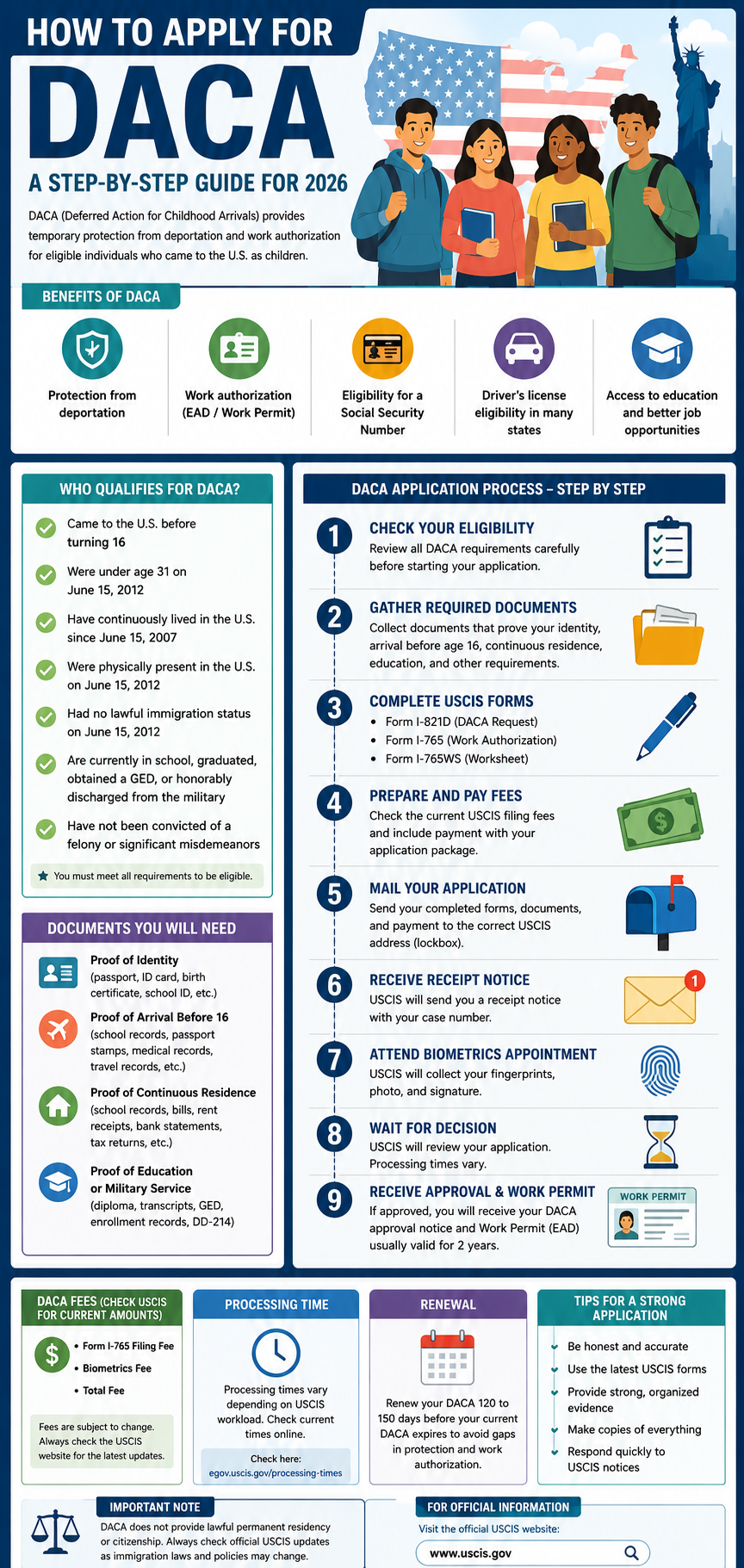
Before diving into the full details, it helps to understand the basic structure of the application process.
| Step | What Happens |
|---|---|
| 1 | Check DACA eligibility |
| 2 | Gather identity and residency documents |
| 3 | Complete USCIS forms |
| 4 | Prepare filing fees |
| 5 | Mail application package |
| 6 | Attend biometrics appointment |
| 7 | Wait for USCIS review |
| 8 | Receive approval and work permit |
Every step matters. USCIS carefully reviews applications and supporting evidence before making decisions.
Who Qualifies for DACA?
Not everyone can apply for DACA. USCIS has strict eligibility requirements that applicants must satisfy before receiving approval.
Understanding these rules is one of the most important parts of the application process.
Age Requirement
Applicants must have arrived in the United States before turning 16 years old.
This requirement is extremely important because DACA specifically focuses on individuals who entered the country as children.
Applicants must also have been under age 31 on June 15, 2012.
Continuous Residence Requirement
One of the biggest parts of DACA eligibility involves proving continuous residence in the United States.
Applicants generally must show that they have continuously lived in the U.S. since June 15, 2007.
USCIS often requests documents from different years to confirm that the applicant remained physically present in the country.
Large gaps in evidence may cause delays or requests for additional documentation.
Education Requirement
Applicants must also meet certain education-related requirements.
Eligible individuals may qualify if they are:
- Currently enrolled in school
- Graduated from high school
- Earned a GED certificate
- Honorably discharged veterans of the U.S. military
Education records are commonly used to support both school eligibility and continuous residence requirements.
Criminal Background Restrictions
USCIS carefully reviews criminal history before approving DACA requests.
Applicants may be denied if they have:
- Felony convictions
- Significant misdemeanor convictions
- Multiple misdemeanor offenses
- Security-related concerns
Individuals with criminal history should strongly consider speaking with an immigration attorney before filing.
Current Legal Status of DACA in 2026
The legal status of DACA has changed multiple times because of federal court cases and government policy changes.
In recent years, courts have issued rulings that affected new applications and renewals. Because of this, the immigration situation surrounding DACA can sometimes feel uncertain.
As of 2026:
- Current DACA recipients are generally still able to renew
- USCIS may continue accepting applications
- Approval of first-time requests may depend on ongoing court decisions
Applicants should always review official USCIS announcements before filing paperwork.
Official USCIS DACA page:
Documents Needed to Apply for DACA
One of the most time-consuming parts of applying for DACA is collecting supporting documents.
USCIS requires applicants to prove:
- Identity
- Age
- U.S. residence
- Education status
- Immigration history
Strong documentation can improve application quality and reduce delays.
Proof of Identity Documents
Applicants must prove who they are using official records.
Common identity documents include:
- Passport
- Birth certificate with photo ID
- National identification card
- School identification card
- Military identification document
Documents should clearly display the applicant’s full legal name and date of birth.
Proof of Arrival Before Age 16
Applicants must show they entered the United States before turning 16.
Helpful evidence may include:
- School enrollment records
- Medical records
- Travel documents
- Passport stamps
- Immigration records
- Church or religious records
Even older documents can be useful if they help establish presence in the United States.
Proof of Continuous Residence
Continuous residence is one of the most important parts of the DACA application process.
Applicants should try to provide documents covering multiple years without large gaps.
Examples include:
- School transcripts
- Report cards
- Rent receipts
- Lease agreements
- Utility bills
- Employment records
- Tax returns
- Bank statements
- Medical records
The more organized and complete the evidence is, the easier it becomes for USCIS to review the case.
Education and Military Records
Applicants must also prove they satisfy educational or military service requirements.
Acceptable documents may include:
- High school diploma
- GED certificate
- School transcripts
- Enrollment verification letters
- Military discharge records
Students currently enrolled in school should request updated enrollment records before applying.
Required USCIS Forms for DACA
Several immigration forms must be completed correctly during the application process.
Using outdated forms or incomplete answers can create serious delays.
Form I-821D
Form I-821D is the primary DACA request form.
It collects important information about:
- Identity
- Immigration history
- Residence
- Education background
Official form:
Form I-765
Form I-765 is used to request employment authorization.
Without this form, applicants cannot receive a work permit.
The Employment Authorization Document (EAD) allows approved recipients to legally work in the United States.
Official form:
Form I-765WS
This worksheet explains why the applicant needs employment authorization.
Applicants generally describe their financial situation and economic need for employment.
Official worksheet:
Step by Step Guide to Applying for DACA
Understanding the complete process step by step can make the application less stressful.
Confirm Your Eligibility
Before spending money on filing fees or preparing documents, applicants should carefully confirm they satisfy every DACA requirement.
This includes reviewing:
- Age eligibility
- Arrival date
- Education status
- Criminal history
- Continuous residence evidence
Applicants with complicated immigration histories should seek legal advice before filing.
Organize Your Documents
Many applicants underestimate how important organization is during immigration filings.
Create separate folders for:
- Identity records
- School records
- Residence evidence
- Immigration papers
- Financial documents
Sorting records by year can make the application easier to prepare and review.
Fill Out USCIS Forms Carefully
Accuracy matters greatly during immigration applications.
Always:
- Use current USCIS forms
- Write clearly
- Double-check all dates
- Use consistent names
- Review every answer before signing
Mistakes may result in delays, requests for additional evidence, or denials.
Prepare Filing Fees
DACA applications require filing fees that may change over time.
Applicants should verify current fee amounts directly on the USCIS website before mailing paperwork.
Official filing fee page:
Some nonprofit organizations may offer financial assistance or low-cost legal support for eligible applicants.
Submit Your Application Package
Once forms and documents are complete, applicants must mail the package to the correct USCIS lockbox address.
The package usually includes:
- Completed forms
- Supporting documents
- Filing fees
- Passport photos if required
USCIS mailing addresses:
Using tracked mailing services is highly recommended.
Receive USCIS Receipt Notices
After USCIS receives the application, the agency sends official receipt notices.
These notices contain:
- Receipt numbers
- Case tracking information
- Filing confirmation
Applicants should keep these notices in a safe location.
Attend the Biometrics Appointment
Most applicants must attend a biometrics appointment.
During this appointment, USCIS collects:
- Fingerprints
- Photograph
- Signature
Biometrics help USCIS perform background checks.
Applicants should bring:
- Appointment notice
- Government-issued photo identification
Missing the appointment without proper rescheduling may negatively affect the application.
Wait for USCIS Processing
After biometrics are completed, USCIS continues reviewing the case.
Processing times vary depending on:
- Application volume
- Background check completion
- Missing evidence
- Legal developments
Applicants can track case status online.
Case tracking page:
What Happens After DACA Approval?
If USCIS approves the request, applicants generally receive:
- DACA approval notice
- Employment Authorization Document (work permit)
The work permit usually arrives by mail.
Recipients should review all information carefully to ensure there are no errors.
Benefits of DACA
DACA offers several important advantages that may improve quality of life and future opportunities.
Legal Employment Authorization
One of the biggest benefits is the ability to legally work in the United States.
This can help recipients:
- Build careers
- Earn stable income
- Gain professional experience
- Access better jobs
Legal employment may also improve long-term financial stability.
Social Security Number
Approved recipients may qualify for a Social Security Number.
A Social Security Number can help with:
- Employment
- Taxes
- Banking
- Credit building
- Financial applications
Driver’s License Access
Many states allow DACA recipients to apply for driver’s licenses.
State laws differ, so applicants should check local DMV rules.
Education Opportunities
DACA can improve educational opportunities for students and young professionals.
Some recipients may qualify for:
- Scholarships
- Tuition assistance
- Professional licensing
- Career training programs
Common Mistakes to Avoid During the DACA Process
Even strong applications can face delays because of avoidable errors.
Submitting Incomplete Forms
Missing answers or signatures can cause rejection or delays.
Review forms multiple times before mailing them.
Using Incorrect Information
Dates, names, and addresses should match official records exactly.
Inconsistencies can create confusion during review.
Weak Residence Documentation
Continuous residence is one of the most heavily reviewed DACA requirements.
Applicants should avoid leaving long unexplained gaps in evidence.
Missing USCIS Deadlines
If USCIS sends a Request for Evidence (RFE), applicants must respond before the deadline.
Ignoring USCIS notices can result in denial.
Filing Without Legal Advice in Complex Cases
Individuals with criminal history, deportation orders, or previous immigration violations should strongly consider consulting an immigration lawyer.
DACA Renewal Process
DACA protection is temporary and requires renewal.
USCIS generally recommends filing renewal applications about 120 to 150 days before expiration.
Renewal applicants usually submit:
- Form I-821D
- Form I-765
- Form I-765WS
- Updated supporting documents
- Filing fees
Renewal guidance:
Can DACA Lead to Permanent Residency?
DACA alone does not provide a direct path to citizenship or a green card.
However, some recipients later qualify for permanent residency through:
- Marriage to a U.S. citizen
- Family sponsorship
- Employment-based petitions
- Humanitarian immigration programs
Every immigration case is different, so legal guidance may help identify possible options.
Travel Rules for DACA Recipients
Travel outside the United States can be risky for DACA recipients without proper authorization.
Some individuals may qualify for Advance Parole for:
- Educational purposes
- Employment opportunities
- Humanitarian situations
Advance Parole information:
USCIS Advance Parole Information
Travel without approval may create serious immigration consequences.
How Long Does DACA Processing Take?
Processing times vary depending on:
- USCIS workload
- Background checks
- Application accuracy
- Legal changes
Some cases move quickly, while others may take several months.
Current processing estimates:
Should You Hire an Immigration Attorney?
Although many people complete DACA applications successfully on their own, professional legal guidance may help in complicated situations.
An attorney may be especially useful if the applicant has:
- Criminal history
- Immigration court history
- Prior deportation orders
- Missing documentation
- Prior immigration denials
Nonprofit immigration organizations may also provide affordable legal services.
Tips for a Strong DACA Application
Stay Organized Throughout the Process
Create copies of every document and store them safely.
Good organization reduces stress and helps applicants respond quickly if USCIS requests more evidence.
Use Reliable Information Sources
Immigration misinformation is extremely common online.
Always rely on official USCIS resources or qualified legal professionals.
Keep Copies of Everything
Applicants should save copies of:
- Forms
- Receipts
- Mailing confirmations
- Supporting evidence
- USCIS notices
These records may be important later.
Respond Quickly to USCIS Requests
If USCIS requests additional documents, respond as quickly as possible.
Delays may affect processing times or case outcomes.
Frequently Asked Questions (FAQs)
Can first-time applicants apply for DACA in 2026?
Court rulings may affect approval of new applications, so applicants should check official USCIS updates before filing.
How long does DACA protection last?
DACA approval generally lasts for two years before renewal is required.
Does DACA provide citizenship?
No. DACA does not directly provide permanent residency or citizenship.
Can DACA recipients legally work in the United States?
Yes. Approved recipients receive work authorization through an Employment Authorization Document.
What happens if DACA expires?
Recipients may lose work authorization and deportation protection if they fail to renew on time.
Can DACA recipients travel internationally?
Only with approved Advance Parole authorization in eligible situations.
Is an immigration lawyer required?
No, but legal help may be beneficial for applicants with complicated cases.
How can I check my DACA case status?
Applicants can track their cases online through USCIS.