

Running a business involves much more than serving customers and generating revenue. Every company, whether it is a sole proprietorship, partnership, limited liability company (LLC), or corporation, must meet various legal and regulatory obligations throughout the year. Among the most important of these responsibilities are business renewal deadlines.
Missing a renewal deadline may seem like a minor administrative mistake, but it can quickly lead to late fees, financial penalties, suspended licenses, loss of good standing, or even forced business closure in severe cases. Staying ahead of renewal dates ensures your business remains compliant, maintains its legal protections, and continues operating without interruption.
This comprehensive guide explains everything business owners need to know about renewal deadlines, the types of renewals required, common mistakes to avoid, and practical strategies for maintaining compliance.
Business Renewal Deadlines Overview
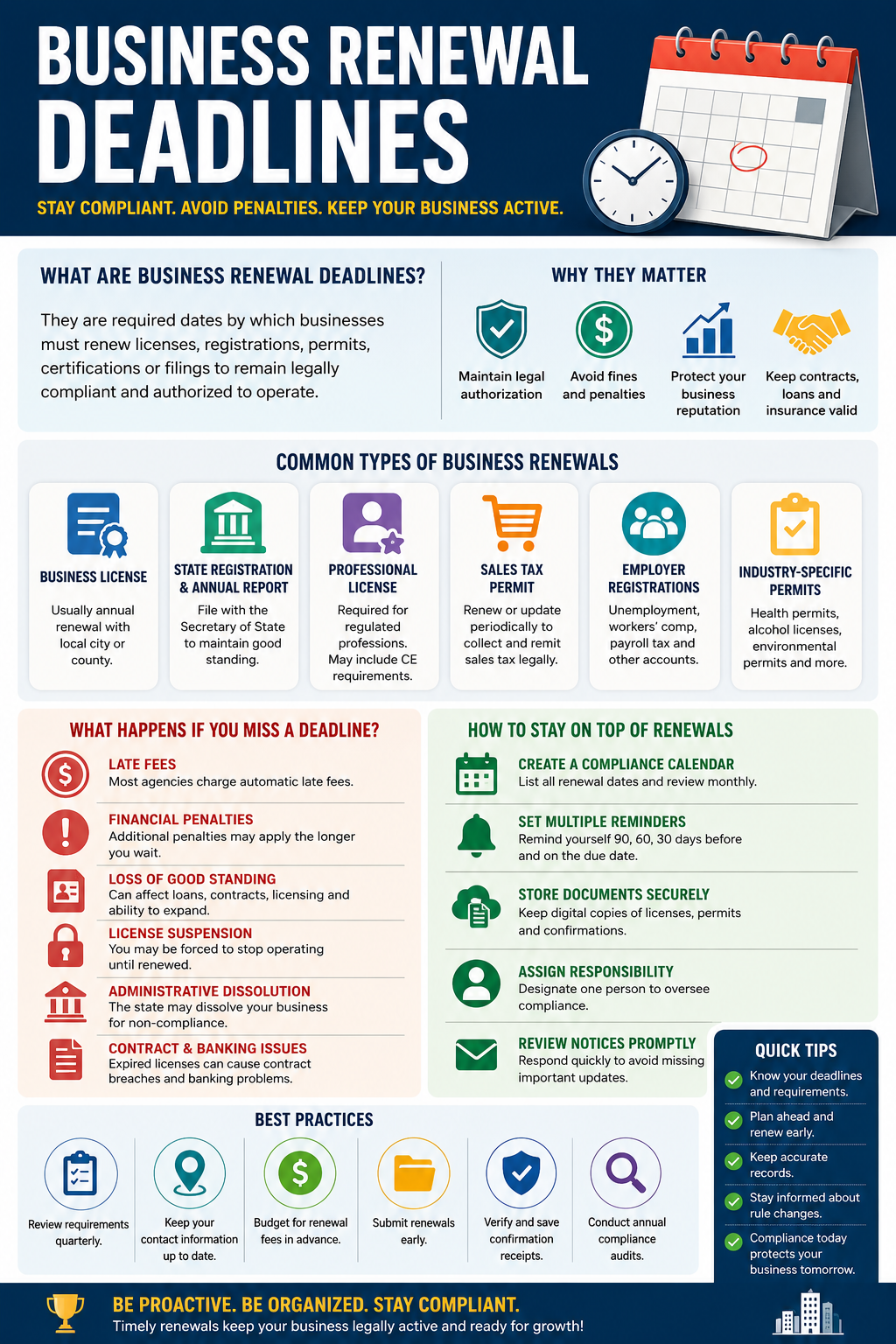
| Renewal Type | Typical Frequency | Possible Consequences if Missed |
|---|---|---|
| Business License | Annual or Biennial | Fines, suspension |
| State Registration | Annual | Loss of good standing |
| Annual Report | Annual | Administrative dissolution |
| Professional License | Annual or Multi-year | Inability to legally operate |
| Sales Tax Permit | Periodic updates | Tax penalties |
| Employer Registrations | Varies | Payroll compliance issues |
| Local Permits | Annual | Local enforcement actions |
| Industry Certifications | Varies | Contract or licensing problems |
What Are Business Renewal Deadlines?
Business renewal deadlines are legally required dates by which a business must renew licenses, registrations, permits, certifications, or government filings.
These deadlines differ depending on:
- Business structure
- Industry
- State laws
- Local regulations
- Federal requirements
- Professional licensing boards
Some renewals occur every year, while others happen every two, three, or five years. Certain filings are based on your business formation date, while others follow the calendar year.
Understanding these differences is essential because no single renewal schedule applies to every business.
Why Business Renewal Deadlines Matter
Many entrepreneurs focus primarily on sales, marketing, and growth. However, regulatory compliance is equally important because it protects your company’s legal status.
Meeting renewal deadlines helps businesses:
- Maintain legal authorization to operate
- Avoid unnecessary fines
- Preserve liability protection
- Maintain business reputation
- Qualify for government contracts
- Keep insurance policies valid
- Protect banking relationships
- Continue receiving business financing
Companies with strong compliance practices also experience fewer operational disruptions and spend less time resolving legal issues.
Types of Business Renewals Every Owner Should Know
Businesses often have multiple renewal obligations rather than a single annual requirement.
Business License Renewal
A general business license allows a company to legally operate within a city, county, or municipality.
Many local governments require annual renewal along with payment of renewal fees.
Typical information requested includes:
- Business name
- Business address
- Ownership details
- Number of employees
- Business activities
- Updated contact information
Failure to renew may result in license suspension or closure notices.
State Business Registration Renewal
Most states require LLCs, corporations, and certain partnerships to remain registered with the Secretary of State or equivalent agency.
Renewal usually involves:
- Annual reports
- Updated ownership information
- Registered agent verification
- Filing fees
Missing this filing may cause the business to lose “good standing.”
Annual Report Filing
Many states require businesses to submit annual reports.
Despite the name, these reports are usually simple compliance documents rather than detailed financial reports.
They often include:
- Principal office address
- Registered agent
- Company officers
- Directors
- Members or managers
- Contact information
Timely filing keeps your business officially active.
Professional License Renewal
Businesses operating in regulated industries often require professional licenses.
Examples include:
- Healthcare providers
- Contractors
- Architects
- Engineers
- Accountants
- Insurance agencies
- Real estate professionals
Many licensing boards also require continuing education before renewal.
Sales Tax Permit Renewal
Some jurisdictions require businesses to periodically renew their sales tax permits.
Retailers should ensure permits remain active to continue collecting and remitting sales taxes legally.
Employer Registration Renewals
Businesses with employees may need to maintain:
- State unemployment accounts
- Workers’ compensation coverage
- Payroll tax registrations
- Employer identification records
Renewal requirements vary by jurisdiction.
Industry-Specific Permits
Certain industries require additional renewals, including:
- Food service permits
- Alcohol licenses
- Environmental permits
- Transportation permits
- Childcare licenses
- Manufacturing certifications
These often have strict inspection requirements before renewal approval.
Who Must Meet Business Renewal Deadlines?
Nearly every business entity has compliance obligations.
Examples include:
- Sole proprietors
- Partnerships
- LLCs
- S corporations
- C corporations
- Nonprofit organizations
- Professional corporations
- Foreign entities registered in another state
Even home-based businesses frequently require permit renewals.
Common Business Renewal Deadlines
Although requirements differ by jurisdiction, many businesses encounter recurring deadlines such as:
- Annual report filing
- Business license renewal
- Registered agent confirmation
- State franchise tax payment
- Professional license renewal
- Sales tax registration updates
- Employer account verification
- Industry permit renewal
Creating a compliance calendar helps organize these recurring obligations.
What Happens If You Miss a Business Renewal Deadline?
Missing a deadline can trigger several consequences.
Late Fees
Most government agencies charge automatic late fees.
These fees increase the longer a renewal remains overdue.
Financial Penalties
Some agencies impose additional administrative penalties beyond late filing fees.
Repeated violations may result in substantial financial costs.
Loss of Good Standing
Businesses that fail to renew state registrations may lose their good standing.
This status affects:
- Business loans
- Vendor contracts
- Government bidding
- Expansion into other states
License Suspension
A suspended business license may prevent legal operation until renewal requirements are satisfied.
This interruption can affect customer confidence and revenue.
Administrative Dissolution
States may administratively dissolve corporations or LLCs that repeatedly ignore renewal requirements.
Reinstatement often involves:
- Additional paperwork
- Higher fees
- Penalty payments
- Backdated filings
Contract Problems
Many commercial contracts require businesses to remain properly licensed.
Expired licenses may violate contractual obligations.
Banking Complications
Banks occasionally verify business registration before approving loans or maintaining commercial accounts.
An inactive business registration can delay financial transactions.
Why Businesses Miss Renewal Deadlines
Several common factors contribute to missed deadlines.
Poor Record Keeping
Many businesses fail to maintain organized compliance records.
Documents become scattered across emails, filing cabinets, and multiple software systems.
Ownership Changes
New owners sometimes inherit businesses without understanding existing compliance obligations.
Address Changes
Government notices sent to outdated addresses often go unnoticed.
Updating contact information promptly is essential.
Staff Turnover
Employees responsible for compliance may leave without properly transferring renewal responsibilities.
Multiple Jurisdictions
Businesses operating in several cities or states often have dozens of separate renewal dates.
Tracking each deadline manually becomes increasingly difficult.
How to Keep Track of Business Renewal Deadlines
Successful businesses use organized systems instead of relying on memory.
Maintain a Compliance Calendar
Create a master calendar listing:
- Filing dates
- Renewal dates
- Payment deadlines
- Inspection dates
- Tax deadlines
Review it monthly.
Set Multiple Reminders
Use digital calendars with alerts scheduled:
- 90 days before
- 60 days before
- 30 days before
- One week before
- One day before
Multiple reminders reduce the likelihood of oversight.
Store Documents Securely
Maintain electronic copies of:
- Licenses
- Permits
- Certificates
- Tax registrations
- Annual reports
- Renewal confirmations
Cloud storage makes documents accessible whenever needed.
Assign Responsibility
Designate one person to oversee compliance.
Whether it’s the owner, office manager, or legal department, accountability helps prevent missed filings.
Review Government Notices Promptly
Never ignore letters or emails from regulatory agencies.
Many renewal reminders include updated instructions or fee changes.
Digital Tools That Help Track Renewals
Technology simplifies compliance management.
Popular tools include:
- Calendar applications
- Compliance software
- Accounting platforms
- Project management systems
- Cloud document storage
- Automated reminder services
Businesses with multiple locations often benefit from specialized compliance management software.
Best Practices for Business Compliance
Developing consistent habits significantly reduces compliance risks.
Recommended practices include:
- Review compliance obligations quarterly.
- Update ownership records immediately after changes.
- Maintain current mailing addresses.
- Pay renewal fees early.
- Keep digital backups.
- Verify confirmation receipts.
- Schedule annual compliance audits.
- Monitor regulatory updates.
These habits strengthen long-term business operations.
Renewal Deadlines for Growing Businesses
As businesses expand, compliance requirements become more complex.
Expansion into new states may require:
- Foreign registration
- Additional licenses
- State tax registrations
- Local permits
- Industry certifications
Each new location introduces additional renewal schedules.
Businesses should incorporate compliance planning into every expansion strategy.
Industry Examples
Restaurants
Restaurants commonly renew:
- Food establishment permits
- Health inspections
- Alcohol licenses (where applicable)
- Business licenses
- Fire inspections
Missing one renewal can temporarily halt operations.
Construction Companies
Construction businesses may need:
- Contractor licenses
- Specialty trade licenses
- Workers’ compensation coverage
- Surety bonds
- Vehicle registrations
Many licenses require continuing education.
Retail Businesses
Retail stores often maintain:
- Sales tax permits
- Business licenses
- Sign permits
- Fire inspections
- Local occupancy permits
Renewal schedules frequently differ by agency.
Healthcare Practices
Healthcare providers generally renew:
- Professional licenses
- DEA registrations (where applicable)
- Facility permits
- Business registrations
- Insurance credentials
Compliance requirements are among the strictest in regulated industries.
The Importance of Keeping Business Information Current
Renewal filings also provide an opportunity to update important business information.
Businesses should review:
- Mailing address
- Physical address
- Phone number
- Email address
- Registered agent
- Ownership structure
- Officer information
- Business activities
Accurate records help government agencies communicate important compliance updates.
Preparing for Renewal Season
Rather than waiting until deadlines approach, businesses should prepare several months in advance.
Preparation checklist:
- Review all licenses.
- Confirm expiration dates.
- Verify filing requirements.
- Update company records.
- Budget for renewal fees.
- Gather required documents.
- Schedule inspections if necessary.
- Submit filings early.
Early preparation reduces stress and avoids last-minute complications.
Common Mistakes to Avoid
Business owners frequently make avoidable compliance errors.
Some of the most common include:
- Assuming all renewals happen annually
- Ignoring local permit requirements
- Forgetting professional license renewals
- Missing annual reports
- Using outdated contact information
- Waiting until the final day
- Losing renewal confirmations
- Failing to update ownership records
- Assuming an accountant handles every filing
- Overlooking multi-state compliance obligations
Avoiding these mistakes can save significant time and money.
Building a Long-Term Compliance Strategy
Business renewal deadlines should become part of an overall governance strategy rather than isolated administrative tasks.
A long-term compliance plan includes:
- Annual compliance reviews
- Internal audits
- Employee training
- Document management
- Risk assessments
- Regulatory monitoring
- Professional legal and accounting support when needed
This proactive approach allows businesses to focus on growth while remaining legally compliant.
Frequently Asked Questions (FAQs)
What are business renewal deadlines?
Business renewal deadlines are the required dates by which companies must renew licenses, permits, registrations, annual reports, or certifications to remain legally compliant.
How often do businesses need to renew licenses?
It depends on the jurisdiction and license type. Many require annual renewal, while others may renew every two, three, or five years.
What happens if I miss a renewal deadline?
You may face late fees, penalties, license suspension, loss of good standing, or administrative dissolution, depending on the applicable laws.
Do sole proprietors have renewal requirements?
Yes. Many sole proprietors must renew local business licenses, permits, or professional licenses depending on their industry and location.
Can I renew my business license online?
In many jurisdictions, yes. State and local government agencies increasingly offer secure online renewal systems.
Why is good standing important?
A business in good standing can obtain financing, enter contracts, register in additional states, and maintain legal protections.
Should I hire someone to manage compliance?
Larger businesses often assign compliance responsibilities to internal staff or work with attorneys, accountants, or compliance service providers. Small businesses may successfully manage renewals using calendars and digital reminders.
How early should I renew?
Whenever permitted, submit renewals several weeks before the deadline to allow time for processing and to resolve any unexpected issues.
References
- Internal Revenue Service (IRS). Business Tax Information: https://www.irs.gov/businesses
- U.S. Small Business Administration (SBA). Manage Your Business: https://www.sba.gov/business-guide/manage-your-business
- U.S. Securities and Exchange Commission (SEC): https://www.sec.gov
- National Association of Secretaries of State (NASS): https://www.nass.org
- USA.gov Business Resources: https://www.usa.gov/business
Disclaimer
Program Clarity is an independent informational website and is not affiliated with any government agency. This article is for educational purposes only. Program rules and availability may change. Always verify details with official authorities.