
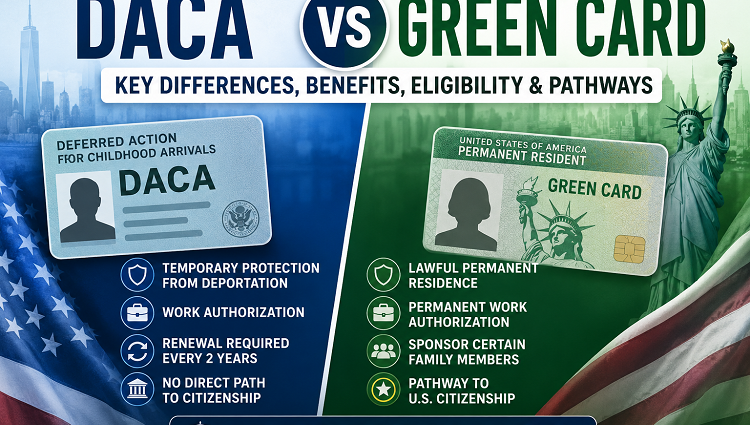
For many immigrants in the United States, understanding the difference between DACA and a Green Card is essential. While both can provide opportunities to live and work in the U.S., they are completely different immigration benefits with different legal protections, eligibility requirements, and long-term outcomes.
Many people mistakenly believe DACA automatically leads to a Green Card. In reality, DACA is only a temporary protection from deportation, while a Green Card grants lawful permanent resident status. Understanding these differences can help immigrants and families make informed decisions about their future.
Overview of DACA vs Green Card
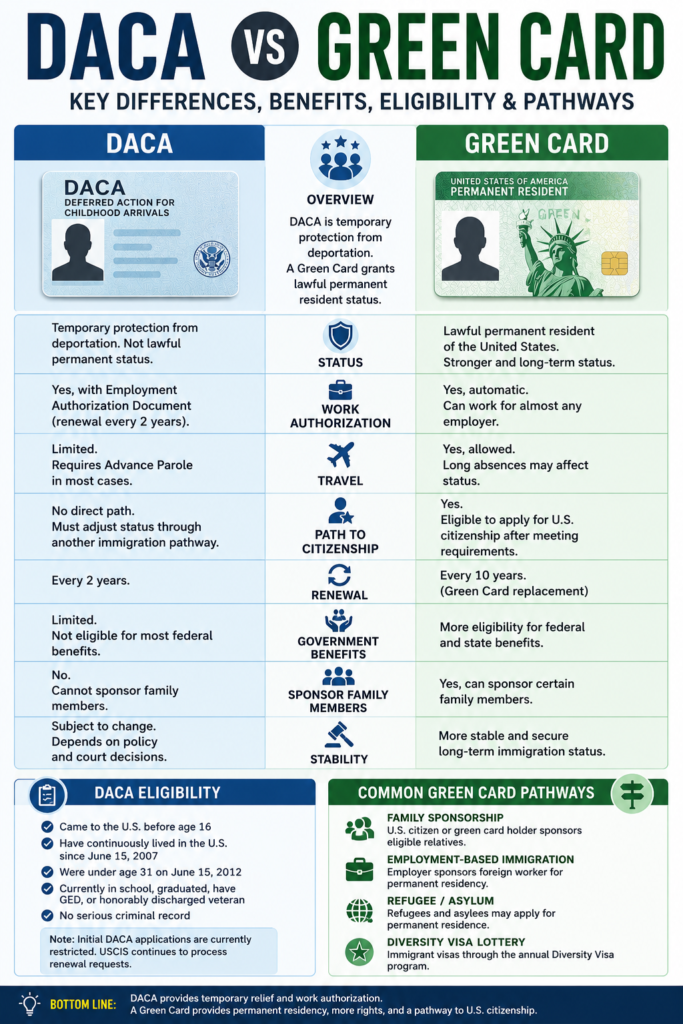
| Feature | DACA | Green Card |
|---|---|---|
| Full Name | Deferred Action for Childhood Arrivals | Permanent Resident Card |
| Immigration Status | Temporary protection | Lawful permanent residence |
| Work Authorization | Yes | Yes |
| Protection From Deportation | Temporary | Stronger permanent protection |
| Path to Citizenship | No direct path | Yes |
| Travel Outside U.S. | Limited with approval | Allowed |
| Renewal Requirement | Every 2 years | Every 10 years |
| Government Benefits | Limited | More eligibility |
| Voting Rights | No | No federal voting rights |
| Sponsor Family Members | No | Limited sponsorship rights |
| Stability | Temporary and court-dependent | Long-term immigration status |
What Is DACA?
Deferred Action for Childhood Arrivals, commonly called DACA, is a U.S. immigration policy created in 2012. It protects certain undocumented immigrants who came to the United States as children from deportation and allows them to work legally for renewable periods.
DACA does not provide lawful permanent residency or citizenship. Instead, it offers temporary protection and work authorization.
The program was introduced under the Department of Homeland Security and remains subject to ongoing court challenges. USCIS currently continues processing DACA renewals, but initial applications are still restricted due to federal court rulings.
Main Benefits of DACA
- Protection from deportation
- Eligibility for work permits
- Social Security number access
- Ability to obtain a driver’s license in many states
- Opportunity to attend school and work legally
Main Limitations of DACA
- No direct pathway to citizenship
- Temporary status only
- Renewal required every two years
- Limited federal benefits
- Vulnerable to legal and political changes
What Is a Green Card?
A Green Card is an official document proving lawful permanent resident status in the United States. A person with a Green Card can permanently live and work in the U.S.
Green Card holders have stronger immigration protection than DACA recipients and can eventually apply for U.S. citizenship if they meet eligibility requirements.
Permanent residency is one of the most important immigration statuses because it provides long-term stability and broader rights under U.S. immigration law.
Main Difference Between DACA and Green Card
The biggest difference is that DACA is temporary protection, while a Green Card is permanent legal residency.
A DACA recipient remains undocumented in many legal contexts, even though they may receive temporary protection from deportation. In contrast, a Green Card holder is legally recognized as a permanent resident of the United States.
This distinction affects employment opportunities, travel rights, access to benefits, sponsorship options, and the ability to become a U.S. citizen.
DACA Eligibility Requirements
To qualify for DACA, applicants generally must meet several requirements established by USCIS.
Basic DACA Requirements
Applicants must:
- Have arrived in the U.S. before age 16
- Have continuously lived in the U.S. since June 15, 2007
- Have been under age 31 on June 15, 2012
- Be enrolled in school, graduated, earned a GED, or served in the military
- Have no serious criminal record
USCIS continues accepting DACA renewal requests, but initial applications are not currently being processed due to court orders.
Green Card Eligibility Requirements
Green Card eligibility depends on the immigration category under which a person applies.
Common Ways to Get a Green Card
Family Sponsorship
A U.S. citizen or permanent resident may sponsor certain relatives.
Examples include:
- Spouse of a U.S. citizen
- Parent of a U.S. citizen
- Child of a U.S. citizen
- Sibling sponsorship
- Marriage-based immigration
Employment-Based Immigration
Employers can sponsor foreign workers for permanent residency in some cases.
Refugee or Asylum Status
Refugees and asylum recipients may apply for permanent residence after meeting certain conditions.
Diversity Visa Lottery
Eligible applicants from qualifying countries may receive immigrant visas through the diversity lottery system.
Special Immigration Programs
Some immigrants qualify through humanitarian or special legal categories.
Does DACA Lead to a Green Card?
DACA itself does not automatically lead to a Green Card. However, some DACA recipients may later qualify for permanent residency through separate immigration pathways.
This is one of the most misunderstood parts of U.S. immigration law.
A person with DACA may still need an entirely separate immigration petition to obtain lawful permanent resident status.
Common Green Card Pathways for DACA Recipients
Marriage to a U.S. Citizen
One of the most common ways DACA recipients obtain Green Cards is through marriage to a U.S. citizen.
Many applicants share successful adjustment-of-status experiences online after maintaining DACA for years and later marrying U.S. citizens.
Employment Sponsorship
Some DACA recipients qualify for employment-based immigration sponsorship depending on their entry history and immigration circumstances.
Family-Based Immigration
Parents, children, or siblings may sponsor eligible immigrants under family preference categories.
Advance Parole and Legal Entry
Some DACA recipients previously used Advance Parole to re-enter the U.S. legally, which in certain cases helped them adjust status later through family sponsorship.
Immigration rules in this area are complicated and often require legal guidance.
Work Authorization Comparison
DACA Work Permit
DACA recipients may apply for employment authorization documents (EADs), allowing them to legally work in the United States.
The work permit is temporary and must be renewed.
Green Card Employment Rights
Green Card holders automatically have permanent work authorization and do not need separate employment permits.
They can generally work for almost any employer without immigration restrictions.
Travel Rights Comparison
Travel Under DACA
DACA recipients cannot freely travel internationally.
Travel outside the United States may require Advance Parole approval. Unauthorized travel could jeopardize DACA protections.
Travel With a Green Card
Green Card holders can travel internationally more freely. However, long absences from the U.S. may still affect permanent residency status.
Citizenship Eligibility
Can DACA Recipients Become Citizens?
DACA alone does not provide citizenship eligibility.
A DACA recipient must first obtain lawful permanent residency before eventually applying for citizenship.
Can Green Card Holders Become Citizens?
Yes. Most Green Card holders can apply for naturalization after meeting residency and legal requirements.
This is one of the biggest advantages of permanent residency over DACA.
Deportation Protection
DACA Protection
DACA provides temporary deferred action against deportation. However, protections depend on government policy and court decisions.
Green Card Protection
Green Card holders receive much stronger legal protection from removal, although serious crimes or immigration violations can still create deportation risks.
Government Benefits Comparison
| Benefit | DACA | Green Card |
|---|---|---|
| Federal Financial Aid | Limited | Greater eligibility |
| Social Security Number | Yes | Yes |
| Driver’s License | Often available | Yes |
| Federal Healthcare Programs | Limited | More access |
| Public Benefits | Restricted | Expanded eligibility |
| Medicare Eligibility | Limited | Possible after qualification |
Renewal Process
DACA Renewal
DACA recipients generally renew every two years by submitting updated forms and fees to USCIS.
USCIS recommends renewing before expiration to avoid work authorization gaps.
Green Card Renewal
Most Green Cards remain valid for 10 years before renewal is required.
Permanent resident status itself does not expire simply because the card expires.
Financial Costs
DACA Costs
DACA renewal filing fees can be expensive over time because renewals occur repeatedly.
Applicants may also pay legal assistance costs.
Green Card Costs
Green Card applications often involve higher initial costs but fewer long-term renewal expenses.
Costs vary based on the immigration category.
Education Opportunities
DACA Students
DACA recipients can attend colleges and universities in many states. Some states allow in-state tuition benefits.
However, federal financial aid access remains limited.
Green Card Students
Green Card holders qualify for broader financial aid opportunities and educational benefits.
Healthcare Access
Healthcare eligibility differs significantly between DACA recipients and Green Card holders.
Green Card holders generally have broader access to public healthcare programs and insurance options compared to DACA recipients.
Stability and Long Term Security
DACA Stability
DACA has faced repeated court challenges and policy debates over the years. This uncertainty creates stress for many recipients.
Green Card Stability
Permanent residency provides stronger long-term immigration security and fewer political uncertainties.
Can DACA Recipients Buy Homes?
Yes. Many DACA recipients buy homes, obtain mortgages, and build financial stability.
However, Green Card holders often have easier access to financial programs and lending opportunities.
Tax Responsibilities
Both DACA recipients and Green Card holders generally must pay taxes if they earn income in the United States.
DACA recipients with work authorization receive Social Security numbers and pay payroll taxes like other workers.
Military Service Possibilities
Military eligibility rules have changed over time.
Green Card holders may qualify for military service under certain conditions. DACA recipients generally face more limitations.
Immigration Risks and Legal Challenges
DACA Risks
DACA protections remain vulnerable to court rulings and federal policy changes.
Recent court decisions continue allowing renewals while limiting approval of new applicants.
Green Card Risks
Green Card holders still must follow immigration laws carefully. Criminal convictions or immigration fraud can create serious legal problems.
Community Experiences and Real-Life Transitions
Online immigration communities frequently discuss moving from DACA to Green Card status through marriage and family sponsorship.
Many immigrants report successful adjustment processes after years under DACA protections.
Community discussions also highlight the emotional relief many immigrants feel after obtaining permanent residency following long periods of uncertainty under DACA.
Which Is Better: DACA or a Green Card?
A Green Card is generally much better because it provides:
- Permanent residency
- Pathway to citizenship
- More legal protections
- Broader travel rights
- Better access to benefits
- Greater long-term security
DACA still provides important temporary protections and opportunities, but it is not equivalent to lawful permanent residency.
Important 2026 DACA Updates
As of 2026:
- USCIS continues processing DACA renewals
- Initial DACA applications remain restricted
- Existing DACA protections continue for approved recipients
- Court cases continue affecting future policy decisions
Immigration policies may change quickly, so applicants should always verify updates through official government sources.
Official Government Resources
Frequently Asked Questions
Is DACA the same as a Green Card?
No. DACA is temporary protection from deportation, while a Green Card grants lawful permanent resident status.
Can DACA holders become U.S. citizens?
Not directly. DACA recipients must first obtain a Green Card before applying for citizenship.
Does DACA expire?
Yes. DACA protections and work permits generally require renewal every two years.
Can Green Card holders be deported?
Yes, but Green Card holders have much stronger protections than DACA recipients. Serious criminal offenses or immigration violations can still lead to deportation proceedings.
Can DACA recipients travel internationally?
Only with approved Advance Parole in many situations. Unauthorized travel may create immigration problems.
Do DACA recipients have Social Security numbers?
Yes, approved DACA recipients may obtain Social Security numbers and work legally.
Can DACA recipients get financial aid?
Federal financial aid options are limited, although some states and private programs provide assistance.
Is a Green Card permanent?
Permanent residency is long term, but Green Cards must still be renewed periodically.
Can DACA recipients sponsor family members?
No. DACA does not provide family sponsorship rights.
Can a DACA recipient marry a U.S. citizen and get a Green Card?
Possibly, depending on immigration history and eligibility requirements. Many DACA recipients pursue this pathway successfully
Disclaimer
Program Clarity is an independent informational website and is not affiliated with any government agency. This article is for educational purposes only. Program rules and availability may change. Always verify details with official authorities.